Towing a car isn’t just “hook it up and pull”: what you need to know before attaching the tow rope.
Your car breaks down halfway home. A friend has a tow rope in the trunk, the repair shop is only a few kilometres away, and the solution seems obvious: hook it up and tow the car slowly. For many vehicles, that really can be a reasonable solution. With an increasing number of modern cars, however, that seemingly “simple” tow can cause damage that costs more than the fault that stopped the car in the first place.
The problem is not with drivers, but with the fact that most of what people know about towing comes from what they learned in driving school — while cars have changed considerably in the meantime. Automatic transmissions, all-wheel drive systems, hybrids and electric vehicles all have their own rules, and those rules are not found in traffic law but in the manufacturer’s manual.
In this guide, we explain both sides: what the law requires and what the car itself “allows”.
What the law says about towing a broken-down vehicle
Towing broken-down vehicles in Serbia is regulated by the Road Traffic Safety Act (ZOBS), Articles 70 to 76. There are still articles online referring to legislation dating back to the 1980s, which is why different rules and wording can sometimes be found. Here we refer to the provisions of the current law.
To begin with, one motor vehicle may tow another only if the other vehicle is unable to move under its own power due to a breakdown or missing components. Motorcycles, mopeds and three-wheelers may not be towed.
Three methods of towing and when they must not be used
The law recognises towing with a rope, towing with a rigid connection or tow bar, and towing by lifting or supporting the vehicle on the towing vehicle — the method typically used by a tow truck.
With a tow rope: a vehicle must not be towed if its steering or brakes are not working. Trucks and buses must also not be towed with a rope.
With a rigid tow bar: a vehicle must not be towed if its steering is not operational. A vehicle heavier than the towing vehicle must also not be towed this way if its service brake is not working.
A vehicle with defective steering can effectively only be transported by lifting it or loading it onto a flatbed tow truck.
Distance, speed and warning equipment
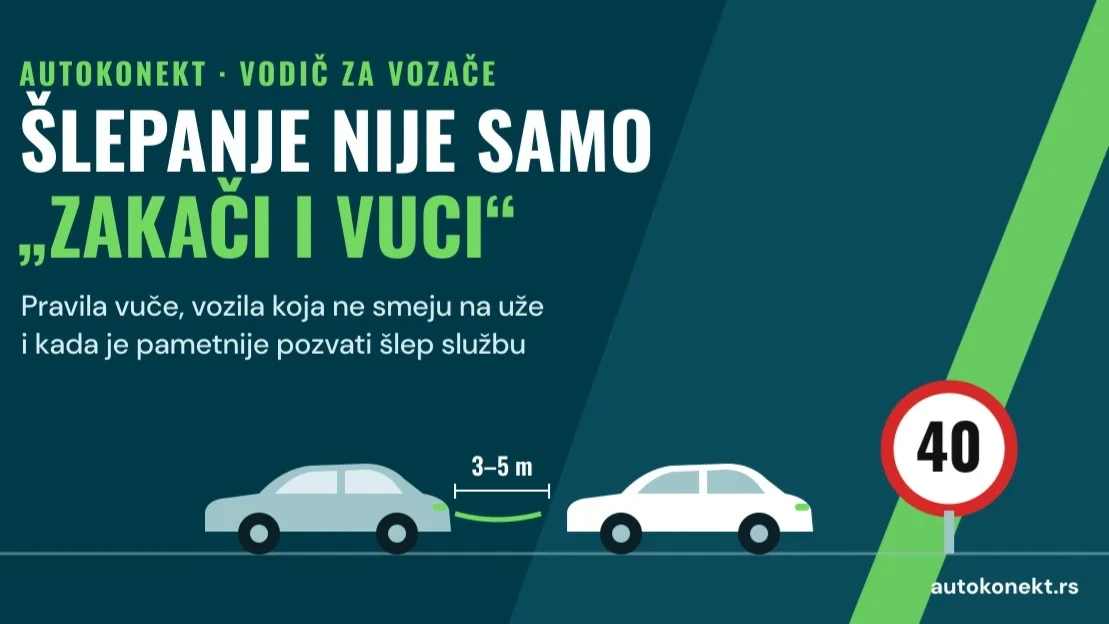
When towing with a rope, the distance between the vehicles must be between 3 and 5 metres. With a rigid tow bar, the distance may be shorter than 3 metres, but no longer than 5 metres.
The vehicle towing the broken-down vehicle must not travel faster than 40 km/h, regardless of the speed limit on that road.
The towing vehicle must have all hazard warning lights switched on, and the towed vehicle must do the same if its lights are operational. A warning triangle must be placed at the front of the towing vehicle and at the rear of the towed vehicle.
At night and during reduced visibility, towing is permitted only if the towed vehicle has its rear position lights switched on, or if the towing vehicle uses a yellow rotating warning light.
Only the driver may remain in the towed vehicle, and that person must hold a driving licence valid for that category of vehicle. Passengers must move to the towing vehicle.
Motorways: only as far as the first exit
Towing a broken-down vehicle on a motorway or expressway is prohibited.
The only exception applies when the breakdown occurs while the vehicle is already on the motorway. In that case, it may be towed only as far as the first exit.
In other words, you cannot tow a broken-down car onto the motorway simply because it would be faster to reach a repair shop in another town. For that kind of journey, you need a tow truck.
A tow rope in the trunk is mandatory equipment
Passenger cars manufactured or first registered after 1 January 1984 must carry a tow rope or towing bar.
The rope must allow the vehicles to be towed at a distance of 3 to 5 metres, while a towing bar must provide a distance of up to 3 metres.
This is also one of the items checked during the vehicle roadworthiness inspection, so it is worth checking whether your tow rope is still in the car and whether it is in good condition.
Vehicles that should not be towed with a rope, even when the law does not prohibit it
The law focuses on whether the steering and brakes are operational. It does not address the transmission, drivetrain or batteries.
That is where the vehicle manufacturer’s instructions become important, and those instructions differ from model to model.
These are the types of vehicles for which you should stop and check before attaching a tow rope.
Automatic transmission
In many automatic transmissions, transmission fluid is circulated by a pump driven by the engine.
When the engine is not running but the driven wheels are turning on the road, parts of the transmission may continue rotating without sufficient lubrication.
Over a short distance and at low speed this may not necessarily cause a problem, but longer or faster towing can result in overheating and serious transmission damage.
That is why many manufacturers allow automatic-transmission vehicles to be towed only in N (Neutral), at low speed and over a short distance, while some prohibit towing altogether.
The same applies to dual-clutch and CVT transmissions.
The exact restrictions for your vehicle can be found in the owner’s manual, usually in the section covering towing.
All-wheel drive (4x4 and AWD)
On vehicles with permanent all-wheel drive, towing with two wheels on the road or lifting only one axle can place excessive stress on the transfer case and differentials.
For this reason, manufacturers usually recommend transporting these vehicles on a flatbed, with no wheels touching the road.
Hybrid and electric vehicles
There is no single rule that applies to all electric vehicles.
According to an overview by the German automobile club ADAC, most manufacturers do not permit electric cars to be towed with their wheels on the road. Those that do allow it specify precise conditions — for example, the vehicle must not have all-wheel drive, the 12-volt electrical system must be operational and the drivetrain must be capable of being placed in neutral.
Some models must not be towed on their own wheels under any circumstances.
The reason is similar to that of an automatic transmission, with one additional factor: an electric motor may generate electricity while the wheels are turning.
For this reason, a flatbed tow truck is generally the safest option for electric vehicles and most hybrids.
Vehicles after an accident and vehicles with a non-running engine
After an accident, it is often impossible to know whether the steering, suspension and brakes are fully operational. A vehicle in this condition must not be towed with a rope if the required systems are not functioning correctly.
Even with an otherwise undamaged car whose engine simply will not start, the driver in the towed vehicle must remember that the power steering and brake assistance may no longer operate.
The steering wheel becomes much heavier, while braking requires considerably more force on the pedal than the driver is used to.
For an inexperienced driver, this creates a real risk of running into the vehicle in front.
Need a tow truck?
Use the AutoKonekt platform to find a verified towing service in your area and compare the available options before making a decision.
Find a towing service on autokonekt.rs
When a tow rope is acceptable — and when it is better to call a tow truck
As a general guideline, towing with a rope can be a reasonable solution when all of the following conditions are met:
the vehicle has a manual transmission, or the manufacturer explicitly permits towing of your particular model;
the steering and brakes of the towed vehicle are fully operational;
the journey is short and does not involve a motorway;
the towing vehicle is not significantly lighter than the vehicle being towed;
the driver of the towed vehicle is experienced and knows what to expect.
It is generally better to call a towing service when:
you drive an automatic, hybrid, electric vehicle or an all-wheel-drive vehicle and the owner’s manual does not clearly state that towing is permitted;
the vehicle has been involved in an accident or you are unsure whether the steering and brakes are working properly;
the route to the repair shop requires motorway driving or covers a longer distance;
it is night-time or visibility is poor and the conditions for safe towing are not met;
the vehicle is a truck or a heavier van.
If you decide to use a tow rope: how to avoid unpleasant surprises
1. Read the owner’s manual.
Check whether the manufacturer permits towing at all, under what conditions, and where the towing point is located.
On most newer cars, the towing eye screws into a mounting point behind a cover in the front or rear bumper and is usually stored with the vehicle tools or spare wheel.
2. Attach the rope only to the designated towing points.
Never attach it to the bumper, suspension components or chassis parts that are not designed for towing.
3. Switch the ignition of the towed vehicle to the driving position so that the steering wheel does not lock and the lights and indicators can operate. Put the transmission in neutral.
4. Switch on the hazard warning lights on the towing vehicle, and on the towed vehicle as well if they are operational. Place a warning triangle at the front of the towing vehicle and another at the rear of the towed vehicle.
5. Agree on signals before setting off.
The driver of the towed vehicle should know how the driver in front will signal braking and turning.
6. Start slowly and avoid sudden jerks.
The tow rope should remain taut. The driver of the towed car should apply light braking when necessary to prevent the rope from becoming slack or getting caught around a wheel.
7. Do not exceed 40 km/h.
Brake earlier than usual and take corners more widely, because the towed vehicle will tend to cut towards the inside of the bend.
Flatbed or partial lifting: how towing services transport vehicles
Towing services mainly use two methods of transporting vehicles.
With a flatbed, the entire vehicle is loaded onto the flat surface of the tow truck, which means none of its wheels rotate on the road.
This is the safest method for vehicles with automatic transmissions, all-wheel drive, electric vehicles and vehicles that have been involved in an accident.
With partial lifting, or wheel-lift towing, one axle is raised while the vehicle rolls on the other.
This method is quicker and often less expensive. It may be suitable, for example, for a front-wheel-drive vehicle when the front axle is lifted.
For all-wheel-drive vehicles, however, this method is generally not appropriate.
That is why it is important to tell the towing service the make and model of your car, the type of transmission and drivetrain, whether the vehicle is electric or hybrid, whether it can be shifted into neutral, and your exact location.
This helps ensure that the towing company sends equipment suitable for your vehicle, rather than simply whichever truck happens to be available.
How to recognise a professional towing service and what determines the price
The cost of towing depends on several factors: the distance, time of day and day of the week, whether the intervention takes place on a motorway, the type of vehicle, the equipment required and any additional work — such as recovering a vehicle from a ditch or moving a vehicle with locked wheels.
That is why a fixed price quoted over the phone without this information may not always remain the final price.
A few things distinguish a professional towing service:
it tells you the price, or at least clearly explains how the price will be calculated, before setting off;
it asks about the vehicle model, transmission and drivetrain and arrives with appropriate equipment;
it issues an invoice and can explain how your vehicle is insured while being transported;
it knows where the vehicle is being taken, either because it works with a repair shop or because it will take the vehicle to the repair shop you have chosen.
Before calling a towing service, also check your insurance policy or automobile club membership.
Some comprehensive insurance and roadside assistance packages include towing, in which case you may simply need to call the number listed on your policy.
Repair shop and towing service in one place
Explore the AutoKonekt partner map, from towing services to repair shops that can take over your vehicle once it arrives.
In short
The law sets the basic framework: a maximum speed of 40 km/h, a distance of 3 to 5 metres when using a tow rope, only the driver may remain in the towed vehicle, and motorway towing is permitted only as far as the first exit when the breakdown occurs on the motorway.
But the law does not know what kind of transmission or drivetrain your car has.
That is why the most important step before attaching a tow rope is checking the owner’s manual. And when the manual specifies a flatbed, calling a towing service is not a luxury — it may be far cheaper than repairing damage caused by incorrect towing.
Frequently asked questions
How fast can a broken-down car be towed?
The vehicle towing the broken-down vehicle must not travel faster than 40 km/h, regardless of the normal speed limit on that road.
How long must a tow rope be?
When towing with a rope, the distance between the two vehicles must be between 3 and 5 metres.
With a rigid tow bar, the distance may be shorter than 3 metres but must not exceed 5 metres.
Can a car be towed on a motorway?
Towing a broken-down vehicle on a motorway or expressway is prohibited.
The exception applies when the breakdown occurs while the vehicle is already on the motorway. In that case, towing is permitted only as far as the first exit.
Can a car with an automatic transmission be towed with a rope?
It depends on the model.
Many manufacturers permit only short-distance, low-speed towing with the transmission in N, while others prohibit it completely.
The rules for your particular vehicle are specified in the owner’s manual. The safest option is generally a flatbed tow truck.
Can passengers remain inside the vehicle being towed?
No.
Only the driver may remain in the towed vehicle, and that person must hold a driving licence valid for that category of vehicle.
Passengers must move to the towing vehicle.
Is a tow rope mandatory equipment?
Yes.
Passenger cars manufactured or first registered after 1 January 1984 must carry either a tow rope or a towing bar.
What type of tow truck is required for an electric vehicle?
As a general rule, a flatbed tow truck should be used so that none of the vehicle’s wheels touch the road.
Towing an electric vehicle on its own wheels is possible only for models and under conditions explicitly specified by the manufacturer.
Sources
Road Traffic Safety Act of the Republic of Serbia (“Official Gazette of the Republic of Serbia”, No. 41/2009, as amended), Articles 70–76.
Regulation on the Classification of Motor Vehicles and Trailers and Technical Requirements for Vehicles in Road Traffic (mandatory equipment: tow rope or towing bar).
ADAC, overview of manufacturers’ instructions for towing electric vehicles.