“Check Engine” Light Came On: Can I Keep Driving?
Short answer: in most cases – yes, but not always, and not for long. There is one situation in which the answer is an unconditional “no”, and drivers often fail to recognize it. Here is how you can determine which category you fall into in just thirty seconds.
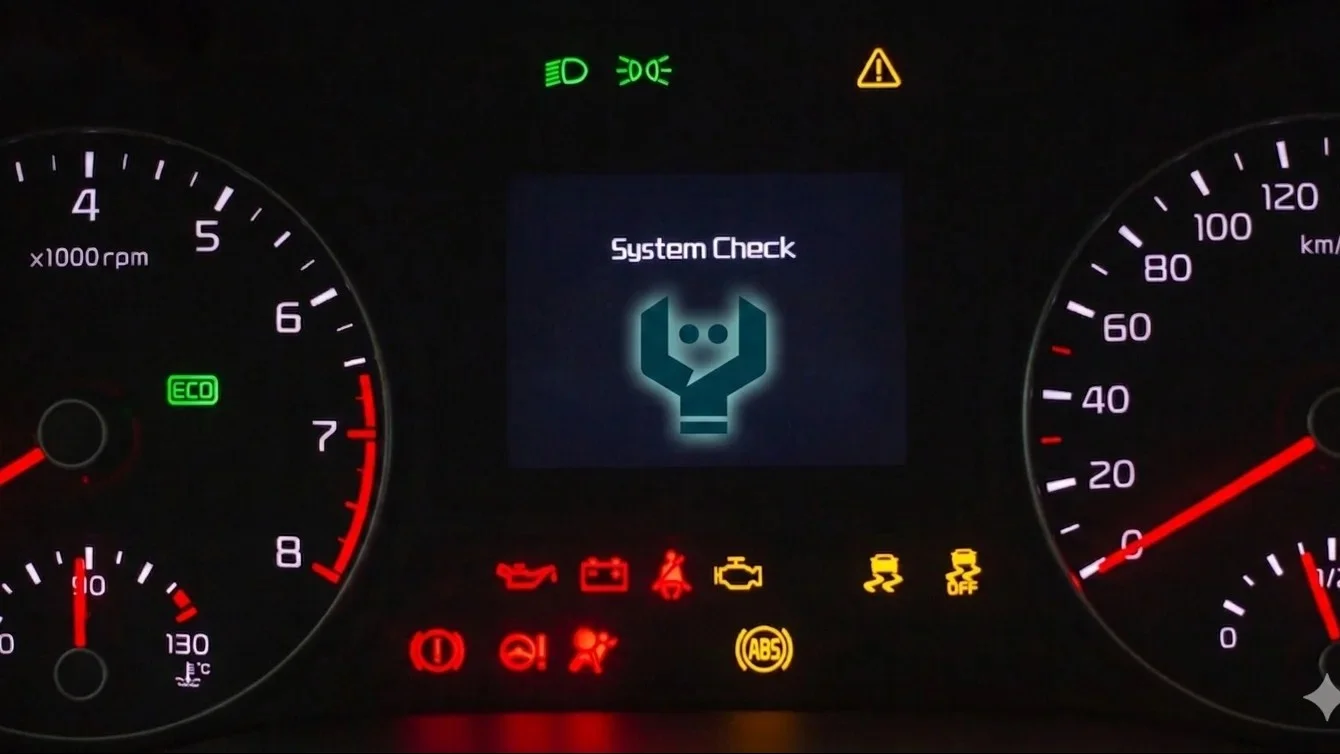
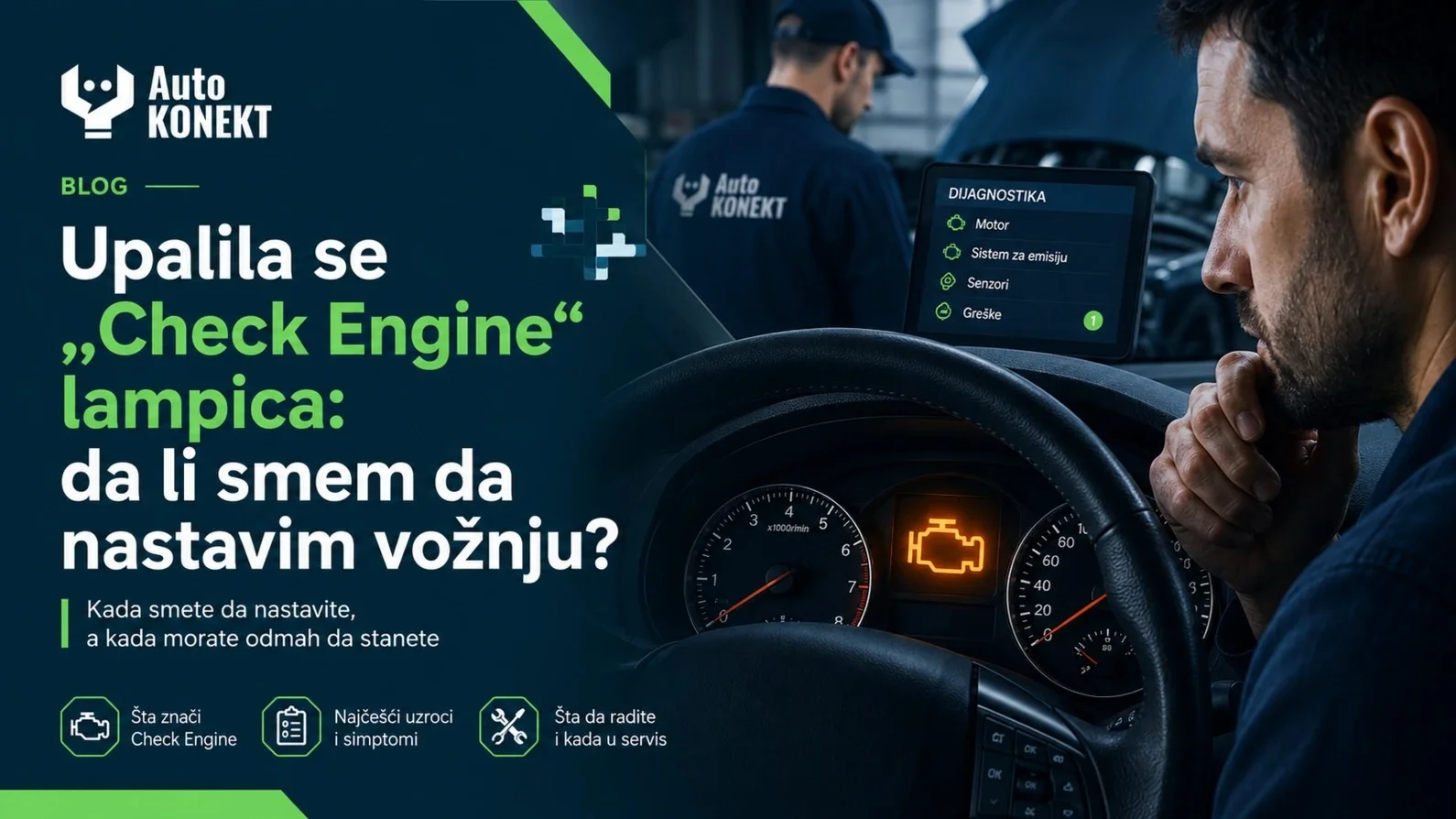
Few things cause that brief knot in your stomach like the orange outline of an engine suddenly appearing on the dashboard. The first reaction is usually one of two extremes: panic and an immediate stop on the roadside, or complete disregard in the hope that it will “go away on its own”. Both reactions are wrong, and both can end up costing you dearly.
In this article, you will get a clear decision-making system – without technical jargon – that tells you whether you should stop immediately, drive carefully to a repair shop, or calmly continue your day and schedule a diagnostic check.
What Does “Check Engine” Actually Mean?
Your car has a built-in diagnostic system known as OBD (On-Board Diagnostics). Dozens of sensors continuously measure engine operating parameters, the fuel-injection system and the exhaust-emissions control system. When a measured value moves outside the manufacturer’s specified range and remains there, the vehicle’s computer stores a fault code in its memory and switches on the warning light.
The key thing to understand is what the light does not mean: it does not mean “the engine is broken”. It means “the system has detected a deviation that needs to be checked”. A large number of fault codes relate to exhaust emissions rather than the mechanical condition of the engine. That is why a car can often drive completely normally while the light is on – and why both panicking and ignoring it are mistakes.
Remember this distinction
The warning light does not tell you what is wrong. It tells you that there is a record stored in the vehicle’s memory that someone with a diagnostic device needs to read and interpret. A fault code is a clue for the technician, not a diagnosis.
First Question: Is the Light Steady or Flashing?
This is the most important point in the entire article, yet many drivers do not even know there is a difference.
The Light Is Steady and Constant
A fault has been recorded. In the vast majority of cases, this is not an emergency. You can continue using the vehicle, but you should schedule a diagnostic check within a few days – not months.
The Light Is Flashing or Pulsing
This is the one situation in which the answer to the title question is an unconditional no.
A flashing light indicates an active cylinder misfire. This means that unburned fuel is entering the exhaust system, where it can ignite inside the catalytic converter and raise its temperature far above its normal operating range. Under these conditions, the catalytic converter can suffer permanent damage after only a few minutes of driving – and replacing it can be one of the most expensive individual repairs on a vehicle.
If the light is flashing: slow down, pull over safely, switch off the engine and call a towing service. Do not try to “just make it home”.
Why this is particularly relevant in Serbia
A large proportion of vehicles on Serbian roads are more than ten years old, and ignition coils and spark plugs on many of them have exceeded their recommended replacement intervals. Misfires are therefore among the more common causes of the Check Engine light coming on – and this is precisely the scenario in which you should not delay.
Traffic-Light Decision System: Assess the Situation in 30 Seconds
Look at the warning light, listen to the engine and pay attention to how the vehicle responds. Then place yourself in one of the following three categories.
RED – Stop Immediately
What you notice — What to do
The light is flashing or pulsing — Pull off the road, switch off the engine and call a towing service.
The oil-pressure warning light is also on — Stop immediately – there is a risk of permanent engine damage.
The temperature gauge is entering the red zone — Stop and allow the engine to cool; do not open the radiator.
Smoke is coming from under the bonnet or you smell burning — Stop, leave the vehicle and call for assistance.
The engine is shaking, suddenly losing power or stalling — Do not continue driving, even for a short distance.
YELLOW – Drive Carefully, Directly to a Repair Shop
What you notice — What to do
The light is on and there is a noticeable loss of power — Drive gently, avoid hard acceleration and avoid the motorway.
The vehicle has entered “limp mode” with restricted RPM — This is a protective mode – take the shortest route to a repair shop.
Uneven idling or noticeable vibration — Schedule an inspection the same day or the following day.
Noticeably higher fuel consumption — Do not delay – additional fuel costs can quickly exceed the cost of diagnostics.
Thick black smoke from the exhaust on a diesel vehicle — Avoid prolonged driving under heavy load.
GREEN – You Can Continue Driving, but Schedule Diagnostics
What you notice — What to do
The light is steadily illuminated and the vehicle behaves normally — Continue driving, but schedule diagnostics within a few days.
The light came on immediately after refuelling — Check whether the fuel cap has been properly tightened.
There is no change in sound, power or fuel consumption — It is not urgent, but it should not be ignored.
If the light switches itself off
That does not mean there was never a problem. It means that the parameter has returned to its permitted range, but the fault code remains stored in the vehicle’s memory.
Intermittent faults are often the first warning of a developing problem – and frequently the least expensive moment to address it.
The Most Common Causes and What They Mean for Driving
Loose or faulty fuel cap. It may sound surprising, but this is one of the common causes. The system detects fuel-vapour leakage. It is harmless in terms of driving – tighten the cap and the warning light will usually switch off after several driving cycles.
Oxygen sensor / lambda sensor. This measures the amount of oxygen in the exhaust gases. A faulty sensor increases fuel consumption and can damage the catalytic converter over time. You can continue driving, but doing so may become expensive.
Mass Air Flow sensor (MAF). Incorrect information about the amount of incoming air results in an incorrect air-fuel mixture. Typical symptoms include poor throttle response and unstable idling.
Spark plugs and ignition coils on petrol engines. These are among the most common causes of a misfire. If the light is flashing, these are among the first components that should be checked. Replacing them is relatively inexpensive – replacing a damaged catalytic converter is not.
EGR valve. It can become stuck due to carbon deposits, particularly on vehicles used mainly for short urban journeys. Loss of power and black smoke are typical accompanying symptoms.
DPF filter on diesel vehicles. A blocked diesel particulate filter is often accompanied by its own warning symbol, but it can also trigger the Check Engine light. Driving on an open road can sometimes be part of the solution, but only if the filter has not already exceeded a critical level of blockage.
Catalytic converter. This is the most expensive item on the list. Its failure is almost always the consequence of an earlier unresolved problem – which is also the best argument against postponing diagnostics.
Three Mistakes Drivers Most Commonly Make
Clearing the fault code without fixing the cause. A cheap OBD adapter and a smartphone app can switch the warning light off in ten seconds. The problem is that you have switched off the warning, not repaired the fault. The light will return – and in the meantime you may have deleted information that could have helped the technician identify the cause more quickly.
Clearing the code immediately before the technical inspection. After the memory is cleared, the vehicle has to complete a certain number of driving cycles before all internal tests, or readiness monitors, return to “ready” status. Until then, diagnostic equipment can clearly show that the memory has recently been erased.
Waiting for it to “go away on its own”. A faulty oxygen sensor can waste fuel for months. An unresolved misfire can destroy the catalytic converter. With a Check Engine warning light, delaying repairs almost always makes the eventual repair more expensive.
“Check Engine” and the Vehicle Technical Inspection
This is often the point at which drivers finally take action – when their registration is about to expire.
In practice, an illuminated dashboard warning light may be enough for a vehicle to fail its technical inspection. Inspectors carry significant responsibility for failing to identify defects and are therefore generally cautious: an illuminated warning light may be interpreted as an indication of a malfunction in the system it monitors, regardless of how minor the underlying cause may be.
Practical advice: if your registration expires in one or two months and the warning light is on, solve the problem now. Give the vehicle enough time to complete several normal driving cycles after the repair so that its internal tests can be completed.
Note
Practices may vary between individual technical inspection centres. If you are unsure how your vehicle will be assessed, the safest option is to fix the underlying problem before the inspection rather than relying on the inspector’s interpretation.
What Do You Actually Get from a Diagnostic Check?
There is an important difference between simply reading a fault code and performing proper diagnostics, and it is worth understanding before you book an appointment.
Reading a fault code takes about a minute and gives you a code such as P0171.
Diagnostics is the process in which a technician uses that code as a starting point.
The same P0171 code, meaning “system too lean”, can be caused by an air leak in a hose, a dirty MAF sensor, a weak fuel pump or a faulty oxygen sensor.
Without checking live data, examining freeze-frame data and carrying out a mechanical inspection, replacing parts based solely on the code is guesswork – and it is guesswork that you are paying for.
A good repair shop should be able to tell you three things after the diagnostic process: what caused the problem, how urgent it is, and how much it will cost to fix.
If you receive nothing more than a recommendation to replace a part without an explanation, consider getting a second opinion.
Frequently Asked Questions
How long can I drive with the Check Engine light on?
If the light is steady and the vehicle behaves normally, driving for a few days until your scheduled appointment should not be a problem. If the light is flashing, the answer is zero kilometres – stop and call a towing service.
Can I switch the warning light off myself?
Technically, yes, using an inexpensive OBD adapter. In practice, there is little point if you have not fixed the cause: the light will return, and you may have erased information that could have helped speed up the diagnostic process.
The light switched itself off. Do I still need to go to a repair shop?
Yes. The fault code remains stored in memory and can be read by a technician. Intermittent faults are often an early stage of a developing problem and the least expensive point at which to intervene.
Does a Check Engine light mean that the engine is seriously damaged?
Usually not. A large number of fault codes relate to the exhaust-emissions control system rather than to the engine’s mechanical components. Serious damage is almost always accompanied by some noticeable symptom – noise, loss of power, smoke or a smell.
Can I take my vehicle to the technical inspection with the light on?
You can attend the inspection, but you risk the vehicle being assessed as defective. It is safer to fix the underlying problem before the inspection.
Can motorway driving solve the problem if the DPF is the cause?
Sometimes. A longer drive at higher engine speeds can trigger filter regeneration. However, if the filter has already exceeded a critical level of blockage, the vehicle may enter protective mode and a forced regeneration at a repair shop will be required.
Conclusion
The Check Engine light is not a death sentence and it is not a reason to panic, but it is a message with an expiry date.
Remember one rule that covers around ninety per cent of situations:
If the light is steady and the car drives normally – keep driving and schedule diagnostics this week. If the light is flashing, if the oil warning light is also on, or if the engine temperature is rising – stop immediately.
Everything between those two extremes can be resolved by booking an appointment with a technician who has the right equipment and knows how to explain what they have found.
Book a Diagnostic Check Through AutoKonekt
AutoKonekt connects drivers with trusted automotive repair shops throughout Serbia. Compare repair shops in your city, see what they offer and book a diagnostic appointment online – without phone calls or waiting for a reply.
→ autokonekt.rs – find a repair shop, compare and book
Note: This article is for informational purposes only and does not replace a professional assessment by a qualified automotive technician. If you have any concerns about the safety of your vehicle, stop driving and seek professional assistance.