Jump-Starting a Car: The Correct Procedure and the Mistakes That Can Cost You
A cold morning. You turn the key and, instead of the engine starting, you hear it crank slowly and then just click. Someone arrives with jumper cables, and two minutes later both cars are running and the problem seems to be over.
At least, that is how it looks.
In many cases, it really is over. In others, the driver notices only a few weeks later that the start-stop system no longer works, a warning light appears on the instrument panel, or the car fails to start again after sitting for two days.
The cause is almost always the same: the jumper cables were connected in an order that was correct twenty years ago.
This is not a question of driving skill. Vehicle manufacturers describe the exact procedure in their manuals, but very few people read it before they actually need it, while advice circulating on forums and websites is often older than the car to which it is being applied.
That is why everything you need is explained here in one place.
Before You Reach for the Jumper Cables: Three Checks
Is the Battery Really the Problem?
The signs of a discharged battery are usually easy to recognise: the starter turns slowly and struggles, the dashboard lights dim when you try to start the engine, and the central locking and interior lights work weakly or not at all.
If, on the other hand, the engine cranks normally and strongly but refuses to start, the battery is probably not the problem and jump-starting will not help.
Safety Comes Before Everything Else
If you have stopped on the road, switch on the hazard warning lights first.
Put on your reflective vest before getting out of the vehicle, not afterwards — which is why it belongs in the passenger compartment rather than in the boot.
Place the warning triangle behind the vehicle at the legally required distance.
Both the reflective vest and warning triangle are mandatory equipment in Serbia.
Bring the two vehicles close enough for the cables to reach, but make sure the vehicle bodies do not touch each other.
Switch off unnecessary electrical consumers in both vehicles and remove the keys from the ignition before connecting the cables.
When You Should Not Attempt a Jump-Start
There are situations in which jumper cables are not a solution but a risk:
The battery is frozen. A completely discharged battery can freeze at temperatures at which a fully charged one would not even be weakened. Jump-starting a frozen battery carries a risk of explosion — something the German inspection organisation GTÜ also warns about. The battery must first be allowed to thaw slowly.
The battery casing is cracked, swollen or leaking. Such a battery should neither be jump-started nor charged. It should be replaced.
You cannot clearly identify the battery terminals. The plus and minus symbols are usually moulded into the plastic around the terminals. If you cannot find them or are not certain, do not guess — reversing the polarity can cause damage costing as much as several new batteries.
The vehicles do not use the same system voltage. Jump-starting is intended only between vehicles using the same voltage, normally 12 V.
The Correct Sequence, Step by Step
The procedure has two simple halves that are easy to remember:
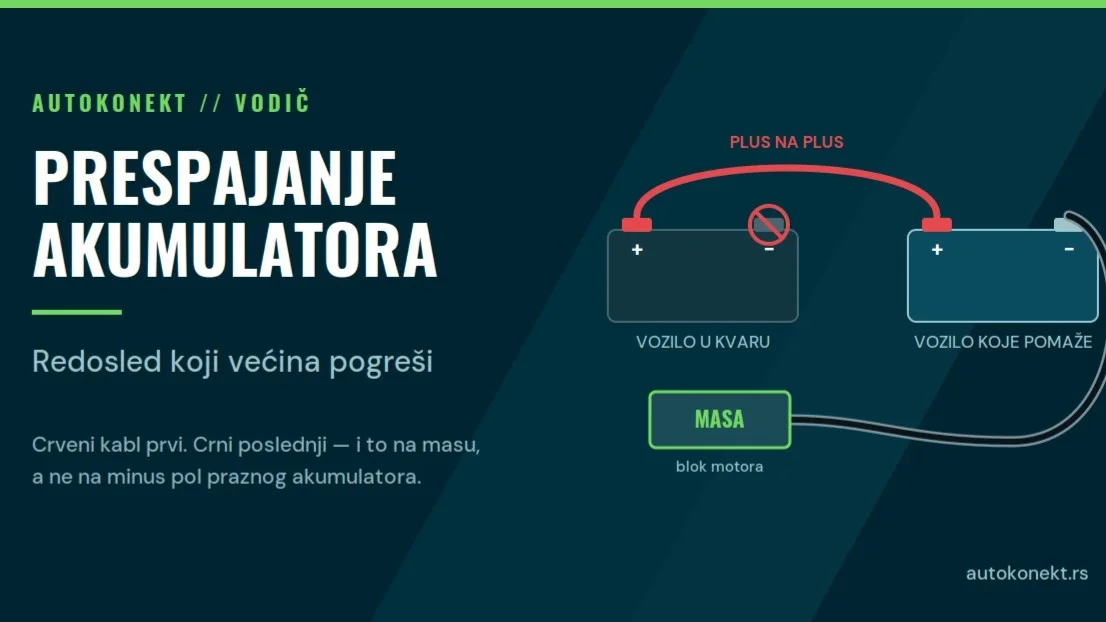
Red first goes to the disabled vehicle, and black goes last to the ground point of the disabled vehicle.
Removal is done in the reverse order.
1. Connect the red cable to the positive terminal of the disabled vehicle.
Connect the first end of the red cable to the positive terminal of the discharged battery.
2. Connect the other end of the red cable to the positive terminal of the assisting vehicle.
At this point, no cable is yet completing the circuit, so there should be no sparking.
3. Connect the black cable to the negative terminal, or the designated ground point, of the assisting vehicle.
4. Connect the other end of the black cable to a ground point on the disabled vehicle.
Do not connect it to the negative terminal of the discharged battery. Connect it to the designated ground point or to a clean, unpainted metal part of the engine block, as far away from the battery as possible.
Why this matters is explained below.
5. Start the engine of the assisting vehicle.
Let it run for several minutes.
6. Try to start the disabled vehicle.
Keep the attempt short. If it does not start, wait a minute and try again.
After the third unsuccessful attempt, stop — continuing to crank the starter may cause damage. At that point, call for assistance.
7. Once the vehicle starts, leave both engines running for a few more minutes.
8. Switch on major electrical consumers in the vehicle that has just been started.
Turn on the heater fan, ventilation blower and lights.
They help absorb voltage spikes that may occur when the cables are removed and can therefore help protect the vehicle electronics.
Important: switch these consumers on in the vehicle that received assistance, not in the vehicle providing it.
9. Remove the black cable, first from the disabled vehicle and then from the assisting vehicle.
10. Remove the red cable in the same reverse sequence.
Make sure the clamps do not touch metal while the other end of the cable is still connected.
11. Switch off the electrical consumers and leave the engine running.
Still will not start after the third attempt?
Continuing to crank the starter will not solve the problem — it may only make it worse.
At that point, you need roadside assistance or a repair shop, not another attempt.
Find verified towing services and auto repair shops in one place at autokonekt.rs.
Why the Black Clamp Should Not Go on the Negative Terminal of the Discharged Battery
This is the step that is most often skipped, and there are two completely different reasons why it matters.
The first is chemical.
No lead-acid battery is completely hermetically sealed. During charging and discharging, hydrogen and oxygen can be released, and a mixture of these gases is highly flammable.
The final connection you make is also the one most likely to produce a spark.
If that spark occurs directly above the battery, it is happening in exactly the wrong place.
Connecting the cable to the engine block, away from the battery, moves the spark away from the area where gas may accumulate.
The second reason is electronic and concerns modern vehicles.
More on that in the next section.
The same principle applies when disconnecting the cables: the black cable is removed first because this breaks the electrical circuit before anything starts moving around the battery.
Start-Stop Vehicles: A Sensor That Can Be Easily Damaged
Vehicles with start-stop systems have a battery sensor installed at the negative terminal.
Through this sensor, the control unit monitors the state of charge and decides when it is safe to switch the engine off at traffic lights.
If the black clamp is connected directly to the negative battery terminal, the jump-starting current may bypass the sensor or pass through it, and the sensor can be damaged.
That is why, on start-stop vehicles, the negative cable should never be connected directly to the battery terminal, but instead to the designated ground point in the engine compartment.
On many modern models, the battery is not even located in the engine compartment — it may be under the floor, in the boot or under a seat — while the engine compartment contains a specially marked positive terminal and grounding point specifically intended for jump-starting.
The vehicle owner's manual usually illustrates these points.
The consequences of incorrect connection are often not immediate.
The vehicle starts and everything appears normal, but only later does the driver notice that the start-stop system no longer works or that the system is calculating the battery's state of charge incorrectly.
Diesel Engines, Larger Engines and Cable Cross-Section
A diesel engine draws significantly more current during a cold start than a petrol engine.
This is where the difference becomes obvious between jumper cables that actually work and those that merely look as though they should.
Thin cables, aluminium conductors covered with a thin layer of copper, and loose clamps cause voltage drop within the cable itself.
The result is that energy is converted into heat in the cable instead of reaching the starter motor — and with diesel engines this can often mean that the vehicle simply will not start.
The clamps and cables can also become seriously hot, so gloves are a sensible precaution.
What should you look for in a usable set of jumper cables?
compliance with DIN 72553 or ISO 6722, stated on the packaging
a cross-sectional area of at least 25 mm² for passenger vehicles, with larger cross-sections recommended for diesel engines and larger-displacement engines; aluminium cables require a noticeably larger cross-section than copper cables to provide comparable conductivity
fully insulated clamps, with metal exposed only on the contact surfaces
enough length to avoid having to park the vehicles too close together, while the cable should remain flexible even at low temperatures
Jumper cables are usually bought once and left in the boot for years, so saving money on conductor cross-section is saving money in the wrong place.
Electric and Hybrid Vehicles
An electric vehicle also has a conventional 12 V battery.
It does not propel the vehicle. Instead, it wakes up the high-voltage system — and it can discharge just like the battery in any other car.
The result is the same: the vehicle does not respond.
As a general rule, an electric vehicle may receive a jump-start, but in many cases it must not provide one.
Many manufacturers explicitly prohibit using an EV to jump-start another vehicle because the EV's 12 V battery is smaller and is not designed to power the starter motor of another car.
Attempting to do so may damage both the 12 V battery and the vehicle's electrical system.
The owner's manual for the specific model is the only authoritative source, both for electric and hybrid vehicles.
It Started. What Now?
This is where the part that is most often ignored begins — and it determines whether you will find yourself in exactly the same situation tomorrow.
The alternator is not a battery charger.
Its job is to maintain the battery's state of charge, not to bring a deeply discharged battery back to life.
A fifteen-minute drive to work will not do that.
For proper recovery, the battery needs either prolonged charging with a suitable battery charger — for example overnight — or a longer drive on an open road.
While driving after a jump-start, pay attention to warning lights and error messages.
If anything appears, stop and call for assistance.
Problems with the electrical supply can also affect electrically assisted systems, including power steering, and that can change the way the vehicle behaves on the road.
Most importantly:
A discharged battery is a symptom, not a diagnosis.
The cause may be natural ageing, the vehicle being left unused for a long period, driving almost exclusively on short journeys, an electrical consumer remaining active after the vehicle is switched off, or an alternator that is not charging correctly.
If the problem happens again, having the vehicle checked at a repair shop is cheaper than needing another tow.
A battery that has discharged once should be checked.
Testing the condition of the battery and the alternator charging system takes only a few minutes and can be performed by any competent repair shop.
Find a repair shop in your city and book an appointment through autokonekt.rs/lokacije.
Five Mistakes That Keep Happening
1. Connecting the black clamp to the negative terminal of the discharged battery.
A spark in the worst possible place, and on start-stop vehicles there is also a risk of damaging the sensor.
2. Repeatedly cranking the starter.
After three unsuccessful attempts, stopping is not merely a recommendation — it is the rule.
3. Buying excessively cheap jumper cables.
This is one of the most common reasons a jump-start fails even when everything else has been done correctly.
4. Removing the cables in the wrong order.
A voltage spike during disconnection can be just as dangerous to the electronics as one during connection.
5. Assuming the job is finished as soon as the engine starts.
Without charging the battery and identifying the cause, the same problem may return.
Frequently Asked Questions
Do I Connect Positive or Negative First?
Positive first.
The red cable goes first to the positive terminal of the disabled vehicle and then to the positive terminal of the assisting vehicle.
Only then is the black cable connected, with its final end going to a ground point on the disabled vehicle — never directly to the negative terminal of the discharged battery.
When removing the cables, the order is reversed.
Can a Diesel Car Be Jump-Started from a Petrol Car?
Yes, provided both vehicles use a 12 V system and the jumper cables have a sufficient cross-section.
A diesel engine requires more current during starting, so weak cables or a weak battery in the assisting vehicle may not be sufficient.
How Long Should the Engine Run After a Jump-Start?
Let it run for several minutes before removing the cables, but this only stabilises the situation.
It does not recharge the battery.
Afterwards, the battery needs longer charging with a proper battery charger or a longer drive.
If the problem occurs again, have the vehicle checked at a repair shop.
What If the Car Still Does Not Start After Several Attempts?
Stop after the third unsuccessful attempt.
The cause may be a deeply discharged or faulty battery, but it could also be a fault unrelated to the battery.
Continuing to crank the starter places additional strain on both the starter motor and the electronics.
Can an Electric Vehicle Be Used to Jump-Start Another Vehicle?
In most cases, no.
Many manufacturers allow an electric vehicle to receive a jump-start but prohibit it from providing one because its 12 V battery is not designed for that kind of load.
The owner's manual for the specific model is the authoritative source.
What If the Battery Is Frozen?
Do not jump-start or charge it.
A frozen battery carries a risk of the casing rupturing and of explosion.
Allow it to thaw slowly, then have it checked or replaced.
Development note: The FAQ section should be marked up using FAQPage JSON-LD schema. The complete code is included in the accompanying CMS file for this article.
Sources
ADAC — vehicle jump-starting instructions, edition dated 8 May 2026
GTÜ — warning about the risk of explosion when jump-starting a frozen battery
DIN 72553 and ISO 6722 — standards for jumper cables
Serbian Road Traffic Safety Act and the Rulebook on the Classification of Motor Vehicles and Trailers and Technical Requirements for Vehicles in Road Traffic — mandatory vehicle equipment
Vehicle manufacturer instructions for model-specific jump-starting points and restrictions for electric and hybrid vehicles.