How to Fill Out the European Accident Statement
Step-by-step instructions, field by field
The European Accident Statement is a form you keep in your car’s glove compartment and have probably never looked at carefully—until you need it. Then, standing in the middle of the road, under stress and with the other driver waiting, you are trying for the first time to understand what should be entered in each field.
This guide takes you through all 15 sections of the form, in order, explaining exactly what should be entered in each one. At the end, you will find the most common mistakes that may cause an insurer to reject or delay a claim, as well as answers to the questions drivers ask most frequently.
What is the European Accident Statement and when should it be completed?
The European Accident Statement is a standardised form used throughout Europe. When completed correctly and signed by both drivers, it has the same legal validity as a police accident report and serves as the basis on which the insurance company processes and pays the claim.
You receive it together with your compulsory motor third-party liability insurance policy, and under the Road Traffic Safety Act, you are required to keep a copy in your vehicle. The fine for failing to carry one ranges from RSD 6,000 to RSD 20,000.
The form should be completed only when all three of the following conditions are met:
no one has been injured in the accident;
only minor material damage has occurred;
both drivers agree on who is responsible for the accident.
If even one of these conditions is not met, do not complete the form. Call the police on 192 instead. We have explained this decision in detail in the article “What to Do After a Traffic Accident.”
About the RSD 200,000 threshold
It is often stated that minor material damage is limited to exactly RSD 200,000. However, the Road Traffic Safety Act itself does not specify a particular amount—this figure is used as a practical guideline by insurance companies.
Therefore, when you are unsure about the extent of the damage, it is safer to call the police than to complete the form for damage that may later prove to be substantial.
Before you begin: four rules
Several details may determine whether the accident statement will be accepted at all.
1. Only one form should be completed
For two vehicles, only one joint accident statement is completed. It does not matter whose copy is used or who physically fills it in.
For three vehicles, two forms are completed, and so on. A common mistake is for each driver to complete a separate form containing their own version of events. This is of no practical use to the insurance company.
2. Use a ballpoint pen only
Do not use a pencil. The form contains a carbon copy, meaning that everything written on the first sheet is transferred to the second.
Pencil can later be erased, which reduces the credibility of the report.
3. Do not leave any field blank
When a field does not apply to your situation, write “not applicable” or cross it out.
A blank field leaves room for someone to add information later.
4. Nothing may be changed after signing
Once both drivers have signed the form, no corrections or alterations should be made.
Read everything carefully before signing.
What does the form look like?
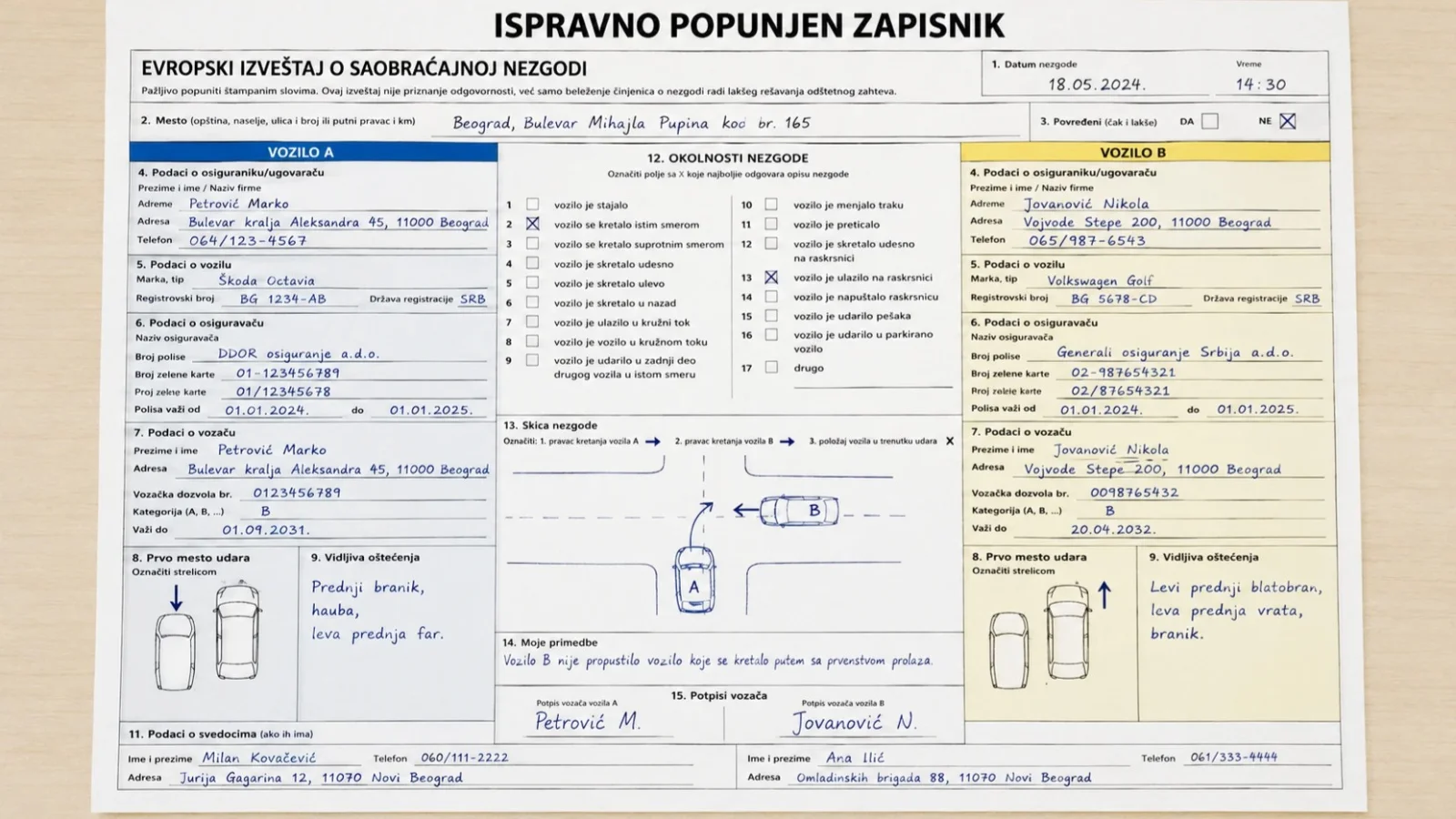
The form has three columns. The left-hand blue column is for Vehicle A. The right-hand yellow column is for Vehicle B. The centre column is shared and contains Section 12—the circumstances of the accident.
It does not matter which vehicle is designated as Vehicle A and which as Vehicle B. This designation has no bearing on liability—it is simply the layout of the form.
Agree on who will be Vehicle A and who will be Vehicle B, and use those designations consistently throughout the form.
All 15 sections, in order
We will now go through the form field by field.
Sections 1–5 are shared by both parties. Sections 6–14 must be completed separately for each vehicle in the appropriate column.
FORM FIELD — WHAT TO ENTER
1. Date and time of the accident
Enter the exact date and time.
Provide the time as accurately as possible, as it may be used when comparing the statement with other evidence.
2. Place of the accident
Enter the street name and number, or the road section and kilometre marker, together with the town or city and country.
The more precise the information, the better.
3. Injuries
State whether anyone was injured, including minor injuries.
Remember: when anyone has been injured, the accident statement should not be completed. The police must be called instead.
4. Material damage
State whether any damage was caused to vehicles other than the two involved in the accident, or to other property, such as a fence, traffic sign or someone else’s property.
5. Witnesses
Enter the witness’s full name, address and telephone number.
Ask witnesses for their details before they leave. In a disputed situation, a witness may be decisive.
6. Policyholder / insured person
Enter the information from the insurance policy:
full name;
address;
postcode;
country;
telephone number of the policyholder.
7. Vehicle
Enter:
vehicle make and model;
registration number;
country of registration.
When towing a trailer, enter the trailer details as well.
All this information can be found in the vehicle registration certificate.
8. Insurance company
Enter:
the name of the insurance company;
the insurance policy number;
the Green Card number;
the policy validity period.
This section also asks whether the vehicle is covered by comprehensive insurance.
9. Driver
Enter the information from the driving licence:
full name;
date of birth;
address;
driving licence number;
licence category;
licence expiry date.
The driver and the vehicle owner do not have to be the same person.
10. Point of initial impact
On the pre-printed vehicle diagram, use an arrow to indicate the point of first contact—the location where the vehicles first touched.
11. Visible damage
Briefly describe the visible damage to the vehicle, for example:
“Rear right wing and bumper.”
Photographs should supplement this description.
12. Circumstances of the accident
This is the centre column.
It contains a list of 17 possible circumstances, such as:
parking;
reversing;
changing lanes;
turning;
and other manoeuvres.
Tick every circumstance that applies to your vehicle. At the bottom, enter the total number of boxes you have ticked.
13. Sketch of the accident
Draw the accident scene, including:
streets and traffic lanes;
street names;
traffic signs and traffic lights;
the position of both vehicles at the moment of impact;
the direction in which each vehicle was travelling, shown with arrows;
the designations A and B.
14. Remarks
This is the space for your description of what happened.
The driver who accepts responsibility should state this clearly in this section.
This is one of the most important fields for determining liability, so complete it carefully and specifically.
15. Signatures
Both drivers must sign the form.
One copy—the original—is kept by the person submitting the damage claim, while the other driver keeps the copy.
Sections 12, 13 and 14 are the most important parts of the form.
Section 12, concerning the circumstances, and Section 13, containing the sketch, together show clearly how the accident occurred. Section 14, containing the remarks, is where responsibility may be stated explicitly.
These are the fields the insurance company primarily uses to determine who was responsible.
The most common mistakes that delay payment
Each of the following mistakes may prolong the claims process or result in the claim being rejected.
Each driver completes a separate form
Only one joint form should be completed.
Two separate forms containing two different versions of events only create confusion.
Blank fields
A blank field allows information to be added later.
Cross out the field or write “not applicable.”
An illegible or incomplete description
When Sections 12–14 are completed superficially, the insurance company is left with too much room for interpretation—usually not in your favour.
Signing a statement you disagree with
Do not sign the form when you disagree with its contents.
Call the police instead.
No photographs
The statement describes what happened. Photographs provide evidence.
Always photograph both vehicles and the accident scene before moving them.
Late submission
The completed accident statement must be submitted to the insurance company within five days.
A delay may complicate or prevent payment of the claim.
What should you do after completing the form?
Once the statement has been signed, the original is kept by the party submitting the claim, while the other party receives the copy.
The compensation claim must be submitted to the insurance company of the driver responsible for the accident within five days.
Attach photographs and any other documents that help explain the circumstances of the accident.
You are free to choose where your vehicle will be repaired—the repair shop does not have to be selected by the insurance company.
Not sure whether you are completing the form correctly?
The AutoKonekt contact centre is available 24 hours a day.
When you are at the accident scene with the form in your hands and are unsure what should be entered in a particular field, call us. We will guide you through every section.
When towing or repair services are required, we can arrange them through our network of verified partners.
Register before you need assistance.
Opening an account takes only a minute, and your vehicle information will already be available when you need it. No one wants to create an account in the middle of an accident.
Frequently asked questions
Who should complete the European Accident Statement—me or the other driver?
It does not matter.
Only one joint form is completed, and it does not matter whose copy is used or who physically writes the information.
What matters is that both drivers agree on responsibility and that both sign the form.
Does signing the form mean that I admit liability?
No.
The signatures of both drivers do not constitute an admission of liability. They confirm the identities of the parties and the accuracy of the information entered.
Responsibility may be stated in Section 14, under remarks, while the final decision is made by the insurance company.
What happens if I make a mistake while completing the form?
Before the form is signed, cross out the incorrect information and enter the correct information in a way that allows both parties to see the change.
Once both drivers have signed, nothing should be altered.
Do we complete one form or two?
For two vehicles, complete one joint form.
For three vehicles, complete two forms.
For four vehicles, complete three forms, and so on.
What should I use to complete the form?
Use a ballpoint pen only and write legibly.
Pencil can be erased, which reduces the credibility of the report.
How long do I have to submit the statement to the insurance company?
The statement must be submitted within five days of the accident.
A late submission may complicate or prevent payment of the claim.
What happens if the other driver disagrees with the description in Section 14?
When there is no agreement about how the accident occurred, do not complete the accident statement.
Call the police on 192 and ask them to investigate the accident scene.
Am I required to keep this form in my vehicle?
Yes.
The law requires every driver to keep a copy of the European Accident Statement in their vehicle.
The fine for failing to carry one ranges from RSD 6,000 to RSD 20,000.