
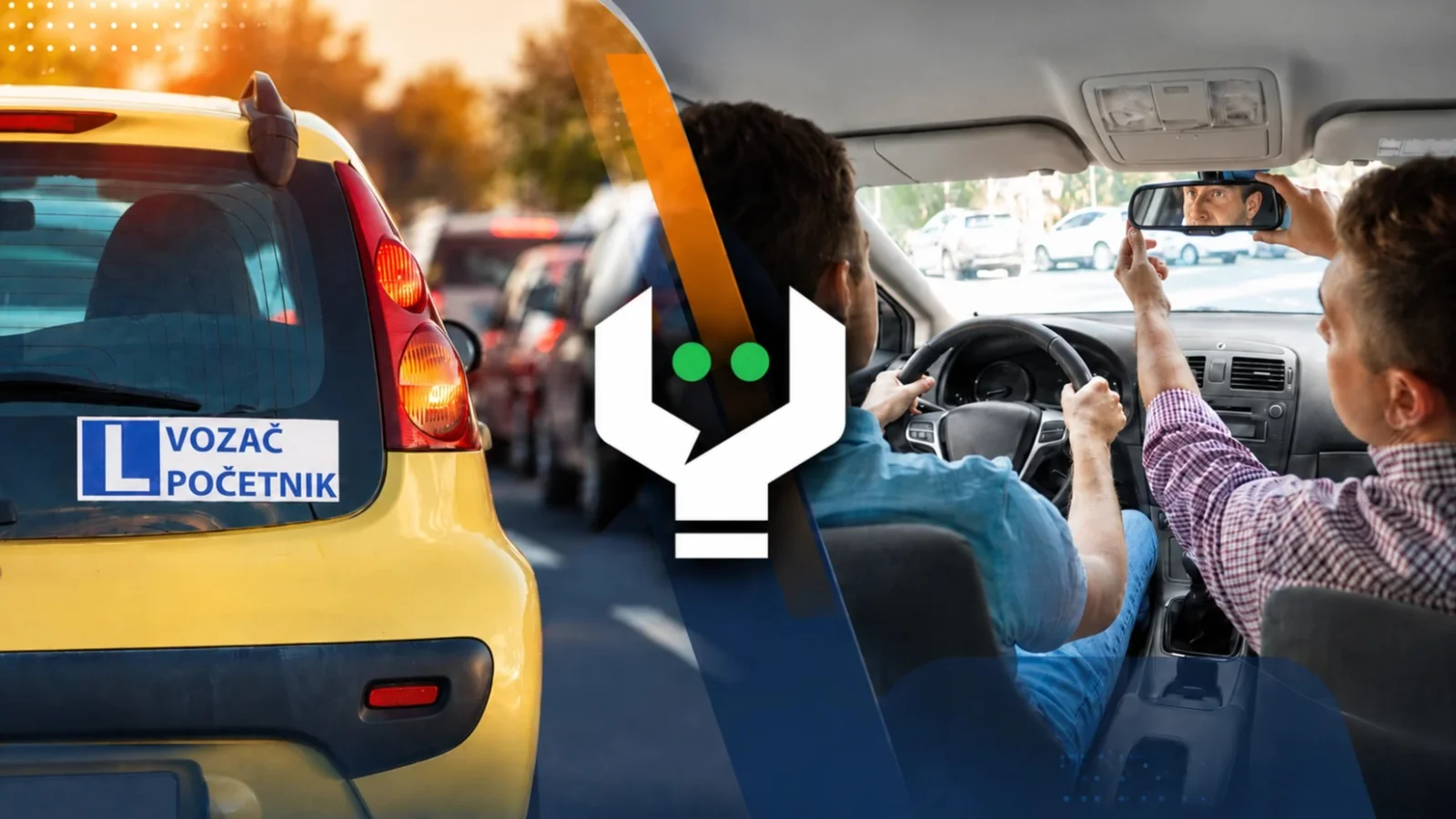
Your Child’s First Car: How to Choose a Car for a Beginner Driver
Buying your child’s first car is not just an ordinary used-car purchase. It is not only a question of budget, brand, appearance or fuel consumption. It is a decision that directly affects the safety of a young driver, the everyday peace of mind of parents and future maintenance costs.
Parents usually think like this: “It should not be expensive, it should consume little fuel, it should be easy to park and it should not be too powerful.” That is a good starting point, but it is not enough. A first car should be chosen according to a different logic: it should be small enough for city driving, stable enough for open roads, simple enough to maintain and safe enough to protect the driver when experience is not yet on their side.
Rules for a probationary driving licence in Serbia
Before you even choose a model, check whether the vehicle complies with the legal restrictions for a probationary licence. The most important rule concerns engine power:
• Engine power: a driver with a probationary B-category driving licence may not drive a vehicle whose engine power exceeds 80 kW, approximately 109 hp, unless supervised in the vehicle by a family member who has held a B-category driving licence for at least five years.
• Speed limits: maximum 110 km/h on motorways, 90 km/h on expressways and 90% of the permitted speed limit on all other roads.
• Night driving: driving is prohibited between 11:00 p.m. and 6:00 a.m. Being accompanied by a family member does not allow night driving — the only exception is an extraordinary emergency situation.
• Alcohol: zero tolerance, 0.00‰.
• Mobile phone: using a mobile phone is prohibited, including hands-free devices.
IMPORTANT BEFORE BUYING
In many popular used-car models, engine power is very close to the 80 kW limit. Before buying, always check field P.2 in the vehicle registration certificate — this is where the exact power in kW is stated.
Small or large car?
For a beginner, the best choice is usually a compact car from the B or C segment.
A very small city car is easy to park, but it often offers weaker crash protection, less stability on open roads and more modest equipment. A car that is too large, on the other hand, can be stressful when parking, checking visibility and manoeuvring in the city.
That is why the most reasonable middle ground is a car the size of a Renault Clio, Toyota Yaris, VW Polo, Škoda Fabia, Ford Fiesta, Peugeot 208, Opel Corsa, Hyundai i20 or Kia Rio — or slightly larger models such as the Golf, Auris, Focus, Astra, Ceed or Megane — with mandatory checks of engine power, vehicle condition and safety equipment.
Important: not every small car is a good first car, and not every larger car is safer. A lot depends on the year of production, construction, equipment and the actual condition of the specific vehicle.
Manual or automatic?
If your child is just gaining driving experience, an automatic transmission can reduce stress in city driving. There is no stalling at traffic lights, no struggle with the clutch on hills, and the driver can focus more attention on traffic.
However, a manual transmission has its advantages. It is cheaper to buy and maintain, usually more available on the used-car market, and it helps a beginner better understand how the engine works, speed control and vehicle handling.
The most practical advice
If your child will mostly drive in the city, an automatic is an excellent choice. If the budget is limited and you are looking for a simpler used car, a manual is still a very rational choice.
With an automatic transmission, pay special attention to the service history, regular gearbox oil changes and how the car behaves when moving off, changing gears and reversing. Repairs to automatic transmissions can be significantly more expensive than repairs to manual gearboxes.
Petrol, diesel, hybrid or electric car?
For a beginner driver who mainly drives in the city, a petrol car is often the simplest choice. It is less sensitive to short journeys than a diesel, simpler to maintain and often has lower repair costs.
A diesel can make sense if the car is used for longer journeys, but for a beginner who drives short, urban and occasional routes, a diesel with a DPF, EGR system and dual-mass flywheel can become more expensive than it first appears.
A hybrid can be a very good choice if the budget is higher, especially for city driving. An electric car is simple to drive, but for a beginner driver it is necessary to carefully consider the price, power, vehicle weight, charging infrastructure and potentially higher repair costs for the bodywork or battery system.
Safety is more important than appearance
Parents often look at mileage, fuel consumption and price. That is understandable. But when buying a first car for a child, safety must be one of the main criteria.
Minimum equipment to look for
• ABS and ESP, electronic stability programme
• Airbags — at least front and side airbags, preferably curtain airbags as well
• Properly functioning brakes and quality tyres with sufficient tread depth
• Good visibility from the cabin and properly working lights
• Stable behaviour under braking
• The best possible result in independent safety tests, such as Euro NCAP
Euro NCAP emphasises that safety should not be compromised and allows ratings to be compared by brand, vehicle type and category. It is also important to know that Euro NCAP ratings cannot always be directly compared across different years, because the tests become more demanding over time.
THE RULE FOR A GOOD FIRST CAR
A good first car is not the one that “goes well”. A good first car is the one that brakes well, offers good visibility, is easy to control and protects the driver when they make a mistake.
Car colour: aesthetics or practicality?
Colour is not the most important criterion, but it is not completely irrelevant either.
For a beginner, lighter colours are more practical: white, silver, light grey, beige or light blue. Such cars are more visible in traffic, easier to maintain and often more suitable for later resale. Black looks attractive, but it gets dirty more quickly, scratches are more visible, and the cabin heats up more in summer.
What should you avoid?
For a beginner driver, avoid cars that are too powerful, too expensive to maintain, have poor visibility, sports suspension, large rims and low-profile tyres. Also be careful with cars that have been heavily modified, chip-tuned, lowered or have an unclear service history.
The biggest mistake is buying a car only because it “looks good” or because it “turned out to be a bargain”. With a first car, the more important question is: how much will the next 12 months of use cost?
Before buying, always check
Before buying your child’s first car, check the condition of:
• brakes, tyres, suspension and shock absorbers
• lights and steering system
• electronics and airbags
• service history and any signs of accident damage
Pay special attention to whether the vehicle’s power complies with the limit for a probationary licence, because in many popular used cars the power is very close to the 80 kW threshold.
Conclusion
Your child’s first car should not be the most beautiful car in the classifieds. It should be a car that helps a young driver gain experience without unnecessary risk.
The best choice is a car in good technical condition, with reasonable power, good safety equipment, simple maintenance and a clear service history.
When it comes to a first car, one simple rule applies: you are not only buying a car — you are buying your child the first years of independence in traffic. That is why the choice must be reasonable, verifiable and safe.
HOW AUTOKONEKT HELPS
AutoKonekt helps you check the condition of a vehicle before purchase, estimate the real maintenance costs and choose a service centre that will keep the car roadworthy, safe and ready for everyday driving.
Find verified car service centres, tyre shops and vehicle inspection stations in your city at car.4bees.io.
Find a service centre in your city: autokonekt/lokacije
Frequently Asked Questions (FAQ)
How powerful can a first car be for a driver with a probationary licence?
A driver with a probationary B-category driving licence may not drive a vehicle whose engine power exceeds 80 kW, approximately 109 hp, unless supervised in the vehicle by a family member who has held a B-category licence for at least five years. Check the power in kW in the vehicle registration certificate, field P.2.
Is an automatic or manual better for a beginner?
For mostly city driving, an automatic reduces stress because there is no clutch work. A manual is cheaper to buy and maintain and is more widely available on the used-car market. The choice depends on budget and driving habits.
What safety equipment is the minimum requirement?
Look for ABS, ESP and airbags — at least front and side airbags, preferably curtain airbags as well. In addition, properly functioning brakes, quality tyres, good visibility and the best possible Euro NCAP safety rating are important.
Can a driver with a probationary licence drive at night?
No. Driving between 11:00 p.m. and 6:00 a.m. is prohibited, and being accompanied by a family member does not change that. The only exception is an extraordinary emergency situation.
What should be checked before buying a used car for a child?
Check the brakes, tyres, suspension, shock absorbers, lights, steering system, electronics, airbags, service history and any signs of accident damage. The safest option is to take the vehicle for an independent inspection at a trusted service centre.
INTERNAL LINKS
• Home: autokonekt.rs
• Services by location: autokonekt/lokacije