Had an Accident? Here’s What to Do in the First 30 Minutes.
A collision lasts one second. What you do during the following hour determines whether you will receive compensation within two weeks or spend months corresponding with the insurance company.
The problem is that nobody thinks clearly during that hour. Adrenaline is running high, your hands are shaking, the other driver is either shouting or saying nothing, and a line of vehicles is forming behind you. This is precisely when you make decisions that cannot be corrected later—whether you called the police, what you signed and, perhaps most importantly, which photographs you took before the vehicles were moved.
This guide takes you through those first sixty minutes in the order in which events actually unfold. It does not focus on legal theory, but on the decisions you must make at the scene.
The First 60 Seconds: Safety Before Everything Else
Before you think about insurance, liability or damage, move yourself and everyone else out of danger. The risk of secondary collisions—accidents that occur after the initial impact because someone remains standing on the road—is far from negligible.
The order is always the same:
Stop the vehicle and switch off the engine. This reduces the risk of fire if fuel is leaking.
Switch on the hazard warning lights. This is the first signal to other drivers that something is wrong.
Put on a high-visibility vest before leaving the vehicle. Not afterwards. The vest cannot protect you while it is still in the boot and you are already standing on the road.
Place the warning triangle at a safe distance. In a built-up area, approximately 50 metres may be sufficient. On an open road or motorway, it should be placed considerably farther away. Take vehicle speed and visibility around bends into account.
Move everyone involved away from the road, preferably behind a safety barrier if one is available.
The law does not leave these obligations to your personal judgement. A driver or another person involved in an accident in which someone has been injured or killed, or in which substantial property damage has occurred, must stop the vehicle, switch off the engine, activate the hazard warning lights, place a warning triangle at a safe distance and notify the police and/or emergency medical services.
They must also warn everyone present to move away from the road so that they are not injured and do not destroy evidence from the accident scene.
Pay attention to that second point—the evidence. We will discuss it in greater detail below, but remember this immediately: after a collision, the road contains information that can disappear within minutes.
Is Anyone Injured? This Question Changes Everything
This is the first real decision point. The answer determines everything that follows.
If Someone Is Injured
Call 194 for emergency medical assistance, followed by 192 for the police. Alternatively, call 112, the single European emergency number.
Then—and this is where people most commonly make a mistake—do not move the vehicles or the injured person unless they are in immediate danger, such as from a fire.
At that moment, the vehicle is part of the accident scene. By moving it, you may destroy evidence that could support your case.
The law goes further than simply requiring you to make a phone call. Anyone who is present at or comes across an accident in which someone has been injured must immediately notify the police and/or emergency medical services. In accordance with their knowledge and abilities, they must also assist the injured person and do everything within their power to prevent the existing consequences from becoming worse or new consequences from occurring.
This obligation applies both to you as a participant in the accident and to anyone who happens to pass by.
There is also a narrow exception to the rule prohibiting people from leaving the scene. A participant may leave if they require urgent medical assistance or need to transport an injured person to the nearest medical facility. However, they must return to the accident scene as soon as they are able to do so.
The European Accident Report must not be used in this situation—under any circumstances. This applies even if the other driver suggests it or the injury initially appears insignificant.
If Nobody Is Injured
You move on to the next question: whether the drivers agree about what happened.
Before that, however, there is one important practical warning. Some injuries only become apparent later. Whiplash symptoms may not appear until that evening or even the following day.
If you feel any discomfort, see a doctor on the same day and ask for it to be entered into your medical records. Without medical documentation, proving an injury afterwards can be extremely difficult.
Do You Agree on Who Is Responsible?
This is the second major decision point. It determines whether you should complete the European Accident Report or call the police.
The European Accident Report may be used only when all three of the following conditions are met:
nobody has been injured;
only minor property damage has occurred;
both drivers agree on how the accident happened and who is responsible.
If even one of these conditions is not met, call 192.
About the “RSD 200,000 Limit”
You may have read that minor property damage is defined as damage worth exactly RSD 200,000.
This figure appears on many websites and online forums, but it is important to be precise: the Serbian Road Traffic Safety Act does not prescribe a specific monetary threshold.
It defines the European Accident Report as the prescribed form completed by the participants following an accident involving minor property damage—but it does not state a specific amount.
The figure of RSD 200,000 is a practical guideline used by insurance companies, not a statutory threshold.
What does this mean in practice?
You should not try to estimate the value of the damage by looking at the vehicle while standing beside it under stress. Visible damage to a bumper may conceal a bent mounting bracket, a damaged sensor or a damaged radiator. The final repair bill may be several times higher than your initial estimate.
A useful rule of thumb is simple: if you are uncertain, call 192. The call costs you nothing and protects you from a situation in which you completed a European Accident Report only to discover that the damage was substantial.
There is also a legal provision that works in your favour. A police officer is required to attend the scene of an accident involving minor property damage if one of the participants requests it and to conduct an official investigation.
If at least one participant requests an investigation, all other participants must remain at the scene until it has been completed.
In other words, the other driver cannot deny your right to request a police investigation. If they insist that you “settle the matter without the police” but you do not feel comfortable doing so, you have the legal right to call the police, and the other driver is required to wait.
Photographs: Eight Shots to Take Before Moving the Vehicles
This is the step that most people overlook—and the one that can ultimately be worth the most.
The reason is simple: a written report describes what happened, but a photograph proves it.
If, six months later, an insurance assessor, expert witness or judge needs to determine how the vehicles were positioned or how long the braking marks were, the memories of the two drivers will have little value. A photograph will not.
Evidence disappears quickly. Debris is scattered by the next passing vehicle. Braking marks fade. Fluids evaporate or spread across the road.
Take the following eight photographs, in this order:
1. A Wide Shot of the Entire Scene
Take photographs from a distance of approximately 10–15 metres and from two opposite directions. The photographs must show the position of both vehicles in relation to each other and their surroundings.
2. The Position of the Vehicles in Relation to the Road
Make sure the traffic lanes, kerbs and road markings are visible.
3. Damage to Your Vehicle
Photograph the damage from several angles. Also photograph undamaged parts of the vehicle, as they may be useful for comparison.
4. Damage to the Other Vehicle
Follow the same procedure.
5. The Registration Plates of Both Vehicles
Make sure they are legible and not obscured by glare.
6. Evidence on the Road
Photograph braking marks, broken parts, fluids, paint residue and any other visible evidence.
7. Relevant Traffic Signs or Traffic Lights
Take the photograph in a way that clearly shows their position in relation to the accident scene.
8. The Completed European Accident Report
Photograph both sides clearly and legibly if you have completed the form.
Also photograph anything else that appears relevant, including weather conditions, the condition of the road, potholes, obstacles or a damaged roadside shoulder.
There is one more detail that people often forget. If there are witnesses, ask for their names and telephone numbers before they leave. Five minutes later, they may no longer be there.
An independent witness can be decisive when liability is disputed. The law recognises their importance: the authority conducting the investigation must establish the identity of anyone who was present when the accident occurred or who possesses information relevant to the accident.
The European Accident Report: Three Things You Must Know
If all the conditions have been met and you are completing the report, these are the three most important points.
1. Signing the Report Is Not an Admission of Liability
This is the most common concern and one of the most common misunderstandings.
The form itself states, above the accident sketch, that the mandatory signatures of both drivers do not constitute an admission of liability. They are used to confirm the drivers’ identities and the circumstances of the accident so that the claim can be processed more quickly.
By signing, you confirm that you were present and that the information entered on the form is correct. You are not admitting that you were responsible.
However, read everything carefully before signing. If you disagree with the description of the accident, do not sign the report. Return to the option of calling the police.
2. The Deadline Is Five Days
The completed report must be submitted to the insurance company within five days.
Missing the deadline may complicate or even prevent the payment of compensation.
3. You Must Keep the Form in Your Vehicle
You receive the European Accident Report together with your compulsory motor insurance policy. When issuing the motor third-party liability policy, the insurance company must also provide the policyholder with a European Accident Report form.
Keep it in the glove compartment—not at home.
What happens if the other driver is not present?
For example, you return to your parked vehicle and discover that it has been scratched.
The law covers this situation as well. If a participant in an accident involving minor property damage is unable to provide their personal and insurance details because the other driver is absent, they must notify the police and provide their own personal details and information about the damaged vehicle.
Leaving a note under the windscreen wiper is therefore not sufficient. Reporting the accident to the police is mandatory.
What You Must Not Do
Several actions may appear harmless but can have serious consequences.
Do Not Leave the Scene
This is the most serious mistake.
In accidents involving injuries or fatalities, leaving the scene may go beyond a traffic offence and constitute a criminal offence against public traffic safety.
The insurance company may also seek recourse from you, meaning that it may demand that you personally reimburse the compensation it paid to the injured party.
Do Not Consume Alcohol After the Accident
Many people are unaware of this rule.
A person who has been involved in a traffic accident must not consume alcohol or psychoactive substances until the official investigation has been completed.
Having a drink “to calm your nerves” is not an acceptable excuse. A subsequent test cannot distinguish between alcohol consumed before the collision and alcohol consumed afterwards.
Do Not Admit Liability at the Scene
This is not about avoiding responsibility. In the first few minutes, you may not know everything that happened.
The other driver may have gone through a red light, may have been using a mobile phone or may have been driving an unroadworthy vehicle.
Determining liability is not a matter of courtesy at the scene.
Do Not Sign Anything You Do Not Understand
Do not agree to an undocumented private cash settlement.
A verbal promise that someone will “pay you next week” has no value once that week has passed.
Do Not Move the Vehicles When There Are Injuries or Substantial Damage
In accidents involving only minor property damage, the situation is different.
Participants are required to remove their vehicles and other objects from the road if they are obstructing or endangering traffic or creating a risk of another accident—but only after the scene has been photographed.
After the Investigation: What Happens Next?
Once the police have completed their work or the European Accident Report has been filled in, several practical matters remain.
Removing the Vehicle
After the investigation has been completed, the driver or vehicle owner must remove the vehicle, cargo or scattered material from the road without delay.
If they fail to do so, the road authority may remove it at the owner’s expense.
Possible Removal of the Registration Plates
It is useful to know this in advance.
If the vehicle has visibly defective components or systems that are essential for safe operation, or if it is not roadworthy, an authorised officer will remove the vehicle from traffic and confiscate its registration plates.
You will receive a written confirmation. The vehicle will remain prohibited from participating in traffic until evidence that it is technically roadworthy has been submitted to the competent authority.
In practical terms, the vehicle must be transported by a recovery truck rather than driven away.
Filing the Insurance Claim
You submit the claim for compensation to the insurance company of the driver responsible for the accident.
You will need the European Accident Report or the police report, together with the insurance policy, vehicle registration certificate, driving licence and identity card.
Without either the European Accident Report or the police report, the insurance company has no basis on which to process the claim.
Repairing the Vehicle
You have a choice that many people do not realise they have: you choose the repair workshop, not the insurance company.
It is worth obtaining estimates from several workshops before making a decision.
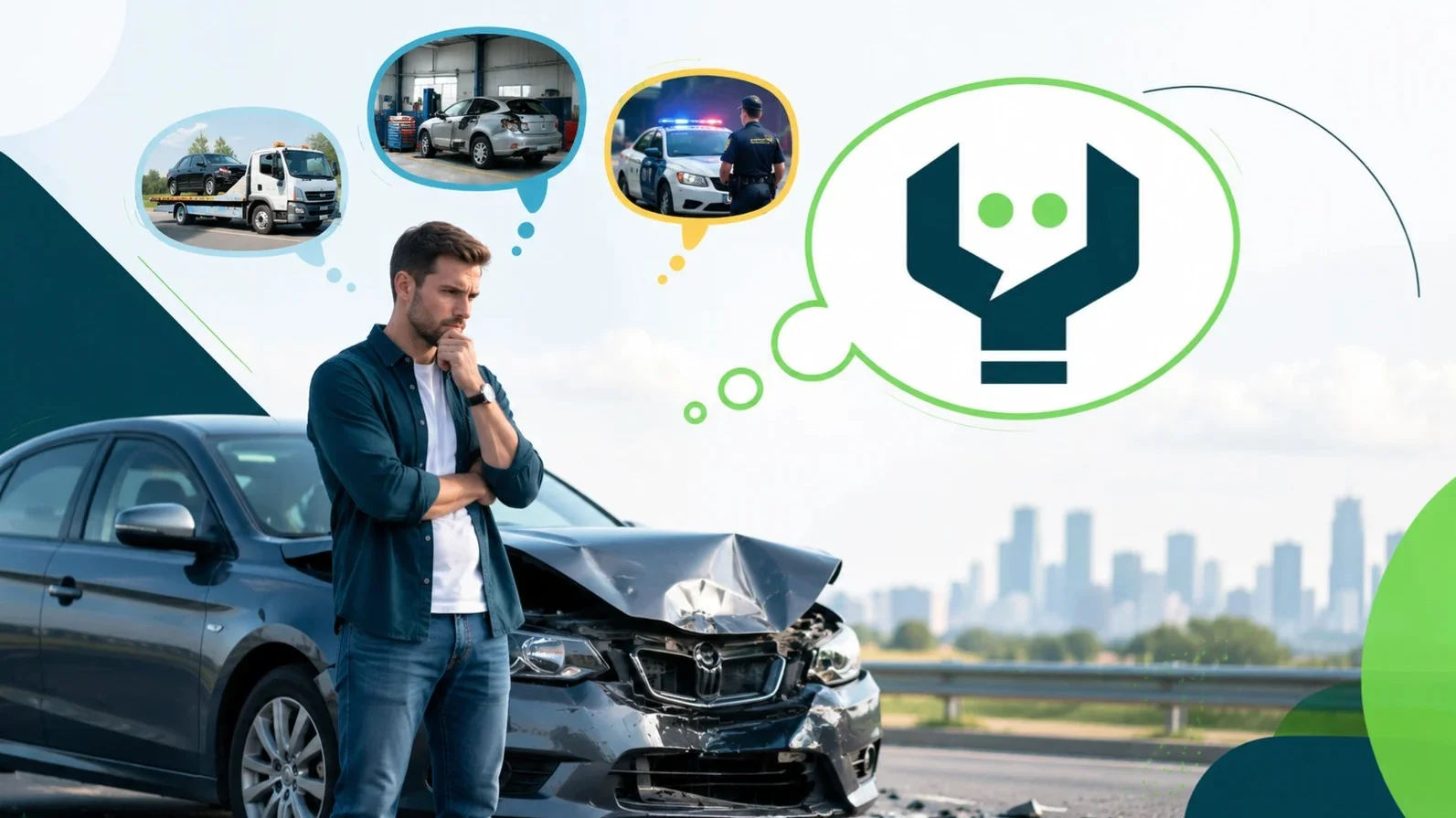
When You Do Not Know What to Do, Call Someone Who Does
Everything described above is easier to read now than to remember when your hands are shaking.
That is why the AutoKonekt contact centre operates 24 hours a day.
You describe the situation, and the person on the other end guides you through the process—whether you should call the police, what you need to photograph, how to complete the European Accident Report and what to do with the vehicle afterwards.
If you require roadside recovery or a repair workshop, we can arrange it through our network of verified partners.
The most useful thing you can do is prepare in advance: register while you do not need assistance.
It takes only a minute to open an account, and your vehicle details will already be available when you need them. Nobody wants to create an account in the middle of an accident.
Frequently Asked Questions
Do I Have to Call the Police If the Damage Is Minor and We Agree About Liability?
No. In that situation, you can complete the European Accident Report.
However, if you are unsure about the extent of the damage, calling 192 is the safer option. In such cases, the police may not always conduct a full investigation, but they may prepare an official note, which can be useful when dealing with the insurance company later.
The Other Driver Does Not Want to Call the Police, but I Do. Who Decides?
You have the right to request an official investigation.
If you request one, all other participants are legally required to remain at the scene until the investigation has been completed.
I Signed the European Accident Report. Does That Mean I Admitted Liability?
No.
The form explicitly states that the signatures of both drivers do not constitute an admission of liability. They confirm the drivers’ identities and the circumstances of the accident so that the claim can be processed more quickly.
How Long Do I Have to Report the Claim?
The European Accident Report must be submitted to the insurance company within five days of the accident.
The Damage Is Greater Than I Initially Thought, but I Have Already Completed the European Accident Report. What Should I Do?
The report does not automatically prevent you from claiming compensation for more substantial damage.
However, the process becomes more complicated and may require the involvement of a lawyer. This is why the recommendation is to call the police whenever there is any uncertainty about the extent of the damage.
I Returned to My Car and Found a Scratch, but Nobody Was There. What Should I Do?
Report the accident to the police and provide your personal details and information about the damaged vehicle.
Leaving or looking for a note under the windscreen wiper is not a substitute for reporting the incident.
May I Have a Drink After the Accident to Calm Down?
No.
The law prohibits the consumption of alcohol and psychoactive substances until the official investigation has been completed.