Why a Child Should Never Travel in Someone’s Arms — and What Crash Physics Tells Us
One question parents ask more often than you might expect is: At what speed is it still safe to hold a child in your arms? The answer is simple — at no speed at all.
This has nothing to do with strength, reflexes or how careful a parent is. It comes down to physics, and physics makes no exceptions.
What happens in the first tenth of a second
When a car suddenly stops in a collision, the child’s body does not stop with it. It continues moving at the same speed as the vehicle until something brings it to a stop.
A collision unfolds in roughly a tenth of a second — far faster than any human reaction. There is not enough time to brace, tighten your muscles or somehow “hold on” more firmly.
In a crash at a typical urban speed of around 50 km/h, the forces involved can easily reach around twenty times the force of gravity.
In practical terms:
– a 10 kg child can generate a force comparable to the weight of around 200 kg
– a 5 kg child can generate a force comparable to around 100 kg
The exact force depends on the severity of the crash and what the vehicle hits, but the conclusion remains the same: no human grip is strong enough to restrain a child in a serious collision.
The danger parents rarely hear about
There is another risk that receives much less attention.
If an adult is wearing a seat belt while holding a child on their lap, the belt restrains the adult, but their upper body still moves forward during the impact. The child is then trapped between the adult and the dashboard or the seat in front.
Using the same principle, a 60 kg adult in a collision at 50 km/h can generate forces equivalent to roughly 1.2 tonnes.
That means a child being held in someone’s arms is not simply unrestrained.
They are also positioned in one of the most dangerous places inside the vehicle.
There does not even need to be a crash
A serious injury does not always require a major traffic accident.
Emergency braking for a pedestrian, suddenly swerving to avoid an obstacle or even a low-speed impact can cause an unrestrained child to be thrown from someone’s arms.
Many accidents also happen on short, familiar journeys — the drive to kindergarten, school, the supermarket or a family member’s home.
“We’re only going a short distance” is one of the most common reasons for skipping the child seat.
It is also one of the most dangerous assumptions a parent can make.
What actually protects a child
The only equipment designed to protect a child during those critical fractions of a second is an approved child safety seat that has been correctly installed and properly adjusted.
Approval standards
An approved child seat must comply with the applicable UNECE safety regulations, such as R44/03 or R129.
Approved seats carry an “E” approval mark together with information such as the country that issued the approval, the approval number, seat category and the relevant weight or height range.
If those markings are missing, the seat should not be considered suitable for use, regardless of how sturdy or well designed it may look.
R44 or R129
The older R44 standard classifies child seats primarily according to the child’s weight, using groups such as 0, 0+, I, II and III.
The newer R129 regulation, commonly associated with the i-Size standard, places greater emphasis on the child’s height, introduces mandatory side-impact testing and makes wider use of ISOFIX installation.
R129 represents a newer and more demanding safety standard.
Rear-facing is safer for young children
R129 requires children to remain rear-facing until at least 15 months of age.
There is a simple anatomical reason for this.
A young child’s head is proportionally much heavier than an adult’s, while the neck is still developing. In a frontal collision, a rear-facing child seat spreads the crash forces across the child’s back and shoulders instead of concentrating them on the neck.
Many modern seats allow children to remain rear-facing well beyond 15 months, often up to approximately 105 cm in height.
If the seat manufacturer allows it, keeping a child rear-facing for longer is generally considered the safer option.
Three common mistakes even with the right child seat
Buying a good child seat is only the first step.
The seat must also be installed correctly, and the child must be properly secured every time.
Serbia’s Road Traffic Safety Agency has repeatedly highlighted improper use of child restraints as a major safety issue, including seats that are incorrectly installed or harnesses that are not adjusted tightly enough.
Winter jackets
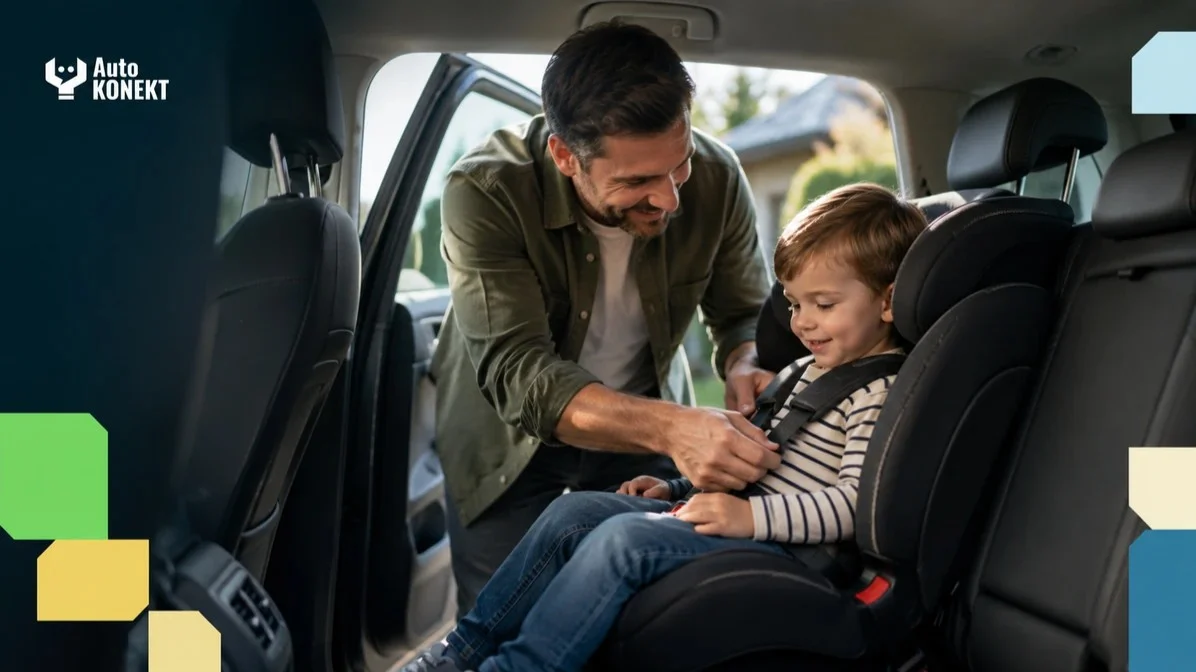
A thick padded winter jacket can create dangerous slack between the child’s body and the harness.
During an impact, the jacket compresses dramatically, while the harness remains in the same position. The result is extra space that allows the child’s body to move much further than intended.
The safer approach is simple: remove the bulky jacket before fastening the harness, then place a blanket or the jacket over the child once they are securely strapped in.
Loose harness straps
The harness should sit snugly against the child’s body.
A useful rule of thumb is the “pinch test”: if you can easily pinch and fold the harness strap between your fingers, it is probably too loose.
Turning the child forward-facing too early
Parents sometimes turn the seat forward-facing as soon as the child appears to have outgrown the rear-facing position.
That decision should not be based on appearance.
The correct limits are determined by the child’s height and weight and, most importantly, by the child-seat manufacturer’s instructions.
What Serbian law requires
Under Article 31 of Serbia’s Road Traffic Safety Act:
– A child under the age of 12 may not normally be transported in the front passenger seat.
– A person shorter than 135 cm must be transported using an appropriate approved child restraint system, installed in accordance with the instructions of the vehicle or child-seat manufacturer, with certain exceptions for public passenger transport.
– A child under three years of age may be transported in the front seat in a rear-facing child seat only if the vehicle has no passenger airbag or the airbag has been deactivated.
– A child over four years of age may use the vehicle’s seat belt together with an approved booster seat if the child’s height allows the belt to fit correctly and the seating position is equipped with a head restraint.
Fines are prescribed for failing to comply with these requirements, with more serious penalties applying in particularly dangerous situations such as carrying a child on someone’s lap.
But the fine is not the real issue.
It is by far the least serious possible consequence.
The bottom line
Children are among the most vulnerable passengers in any vehicle, and serious road accidents continue to claim young lives every year.
A child safety seat is not a formality. It is not something you use only on long journeys, and it is not a reflection of how much confidence you have in your own driving.
It is a safety system designed to work in the exact fraction of a second when you are physically unable to protect your child yourself.
There is no safe speed for holding a child in your arms while driving.
AutoKonekt is a digital network of verified automotive service providers in Serbia. We publish educational content about vehicle maintenance, responsible ownership and road safety.