Seat Belts: Who Invented Them, How Many Lives They Save, and What Serbian Law Requires
It takes approximately one second to fasten it. It has no battery, software, camera, or complicated electronics. Yet the seat belt is probably the most important safety device ever installed in a car.
Estimates by the World Health Organization show that seat belts reduce the risk of death for front-seat occupants by 45 to 50 percent. Despite this, many passengers still do not use them—especially those sitting in the rear.
According to research into road safety performance indicators conducted by Serbia’s Road Traffic Safety Agency in 2025, 83.9 percent of drivers and front-seat passengers use seat belts, while only 32.5 percent of rear-seat passengers do so. This represents significant progress compared with 2024, when just 21.3 percent of rear-seat passengers wore seat belts. Nevertheless, it still means that two out of every three people in the rear travel without this basic protection.
Seat Belts Existed Before 1959
The idea of restraining passengers did not originate with the modern automobile. Different belts and restraint systems had been used much earlier, primarily in aviation, racing vehicles, and some passenger cars.
However, early automotive seat belts were generally designed as two-point lap belts. They passed only across the abdomen or pelvis and did not adequately restrain the upper body. In a severe collision, occupants could strike their heads and chests against the steering wheel, dashboard, or windscreen, while the belt itself could cause serious injuries to the soft tissues of the abdomen.
The solution we use today was developed by Swedish engineer Nils Bohlin.
From Aircraft Ejection Seats to the Family Car
Before joining Volvo, Bohlin worked as an aeronautical engineer at Saab. Among other things, he was involved in the development of ejection seats and protective equipment for pilots.
This experience helped him understand how the human body reacts to extreme acceleration and sudden deceleration. In 1958, Volvo hired him as the company’s first engineer specifically responsible for occupant safety.
His task was not simply to create a stronger belt. He had to develop a system that would:
restrain both the upper and lower body;
distribute forces across the chest and pelvis;
remain correctly positioned during a collision;
be easy to fasten with one hand.
The result was the three-point seat belt, consisting of one section that passes across the pelvis and another that runs diagonally across the chest.
The patent application was filed in Sweden in 1958, while US Patent No. 3,043,625 was granted on 10 July 1962. In the patent documentation, Nils Bohlin is named as the inventor, while Aktiebolaget Volvo is listed as the rights holder. The German Patent Office later included this design among the eight patents of greatest importance to humanity since 1885.
The First Cars With Three-Point Seat Belts
In 1959, Volvo began fitting three-point seat belts as standard equipment in the PV544 and Amazon 120 models, initially in Nordic markets.
It became the first manufacturer to equip production cars with this type of seat belt as standard in the front seats. However, the new technology was not immediately welcomed by customers. Many drivers believed that seat belts were unnecessary, uncomfortable, or restricted their freedom of movement.
Resistance to seat belts may sound unusual today, but it accompanied their introduction for decades. Extensive testing, public-awareness campaigns, and legislative changes were required before fastening a seat belt became normal behaviour. In 1967, Bohlin published a study based on approximately 28,000 road accidents, showing that unrestrained occupants suffered fatal injuries across the entire range of vehicle speeds.
Did Bohlin Refuse to Charge for the Patent?
A popular version of the story claims that Nils Bohlin “did not want to patent his invention” because he wanted to save as many lives as possible. That is not entirely accurate.
The design was indeed patented. However, Volvo decided to make the patent available to other vehicle manufacturers without charging a licensing fee. The company did not attempt to prevent competitors from using this safety solution. Instead, it wanted the three-point belt to become an industry standard.
In its historical documentation, Volvo states that the patent was immediately made available to all vehicle manufacturers.
The most accurate way to describe it is therefore this: Nils Bohlin developed and patented the modern three-point seat belt, while Volvo allowed other manufacturers to use it free of charge.
It is probably one of the best-known decisions in automotive history in which the widespread adoption of a safety technology was given priority over direct income from a patent.
How Many Lives Does the Seat Belt Actually Save?
It is impossible to determine an exact number. A life saved cannot be counted directly. It is estimated by comparing the outcomes of road accidents involving restrained and unrestrained occupants.
Volvo estimates that Bohlin’s invention has saved more than one million lives worldwide and has prevented or reduced injuries for several million more people. This is an estimate by the company, rather than a figure from a single official global register.
Independent data also demonstrate the scale of its impact:
The World Health Organization estimates that seat belts reduce the risk of death for front-seat occupants by 45–50 percent and reduce fatal and serious injuries among rear-seat occupants by approximately 25 percent.
The US National Highway Traffic Safety Administration, NHTSA, estimated that seat belts saved 14,955 lives in the United States in 2017—the latest year for which it published this particular analysis—and that a further 2,549 people could have survived had they been wearing seat belts.
Using the same methodology, seat belts are estimated to have saved 374,276 lives in the United States between 1975 and 2017.
An NHTSA study examining the contribution of individual technologies found that seat belts saved 329,715 lives in the United States between 1960 and 2012—more than all other occupant-protection technologies combined, including airbags and electronic stability control.
It is therefore more useful to consider the order of magnitude than to insist on a single, perfectly precise number. Regardless of the methodology used, hundreds of thousands—and possibly more than one million—people have survived because of a device that takes only one click to use.
Why Does a Seat Belt Save Lives?
When a vehicle stops suddenly, the bodies of the driver and passengers continue moving at the vehicle’s previous speed. Without a seat belt, the body will only be stopped by the steering wheel, dashboard, windscreen, the seat in front, or by being thrown from the vehicle.
A three-point seat belt distributes the load across stronger parts of the body—the pelvis and chest. At the same time, it:
keeps the occupant in the seat;
reduces the likelihood of striking the vehicle interior;
prevents ejection from the vehicle;
allows the airbag to function as designed.
Complete ejection from a vehicle during a collision almost always has extremely serious consequences.
An Airbag Is Not a Substitute for a Seat Belt
One common misconception is: “The car has airbags, so the seat belt is not that important.”
Airbags are supplementary restraint systems. They are designed to work together with seat belts, not to replace them. Without a seat belt, the occupant’s body may move too quickly towards an airbag that is deploying at high speed, which can cause additional injuries.
Modern passive-safety systems—including seat belts, pretensioners, load limiters, airbags, seats, and head restraints—function as a single system. Not wearing a seat belt compromises the way the entire system was designed to protect the occupant.
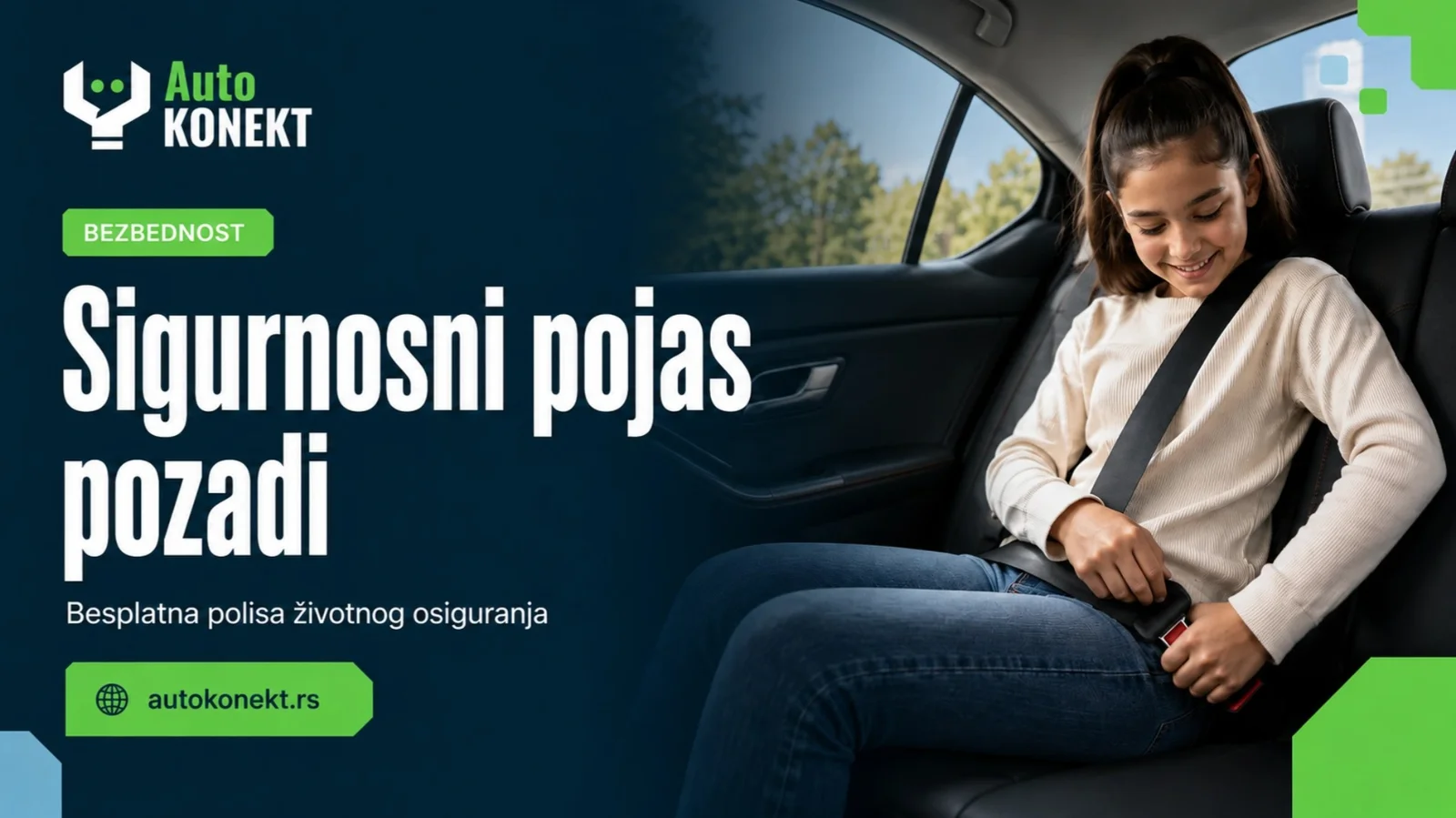
Why Is a Seat Belt Mandatory in the Rear Seat?
Many passengers believe that they are sufficiently protected in the rear by the front seats. In reality, an unrestrained passenger continues moving forwards during a collision.
That person may strike the seat back, the driver, or the front passenger, seriously injuring both themselves and the person sitting in front. Research cited by the World Health Organization shows that the presence of an unrestrained passenger increases the risk of injury to other vehicle occupants by approximately 40 percent. In a frontal collision, an unrestrained passenger sitting behind a restrained driver increases that driver’s risk of death by approximately 137 percent compared with a situation in which the rear passenger is also wearing a seat belt.
In other words, failing to wear a seat belt is not merely a personal risk. It endangers everyone in the vehicle.
This remains a serious problem in Serbia. Although the proportion of rear-seat passengers wearing seat belts increased to 32.5 percent in 2025, this still means that two-thirds of rear-seat passengers remain unrestrained. Serbia’s Road Traffic Safety Agency estimates that approximately 100 lives could be saved every year in Serbia if all vehicle occupants used seat belts correctly.
AutoKonekt Check
Vehicle safety is not determined only by brakes and tyres. Seat belts, buckles, pretensioners, airbags, and warning lights are all parts of a system that must be fully operational.
When a seat belt is difficult to pull out, does not retract correctly, fails to lock when pulled suddenly, or the airbag warning light is illuminated on the instrument panel, an inspection should not be postponed. At autokonekt.rs, you can compare verified repair shops, view prices and available appointments, and book an inspection without making phone calls or waiting.
What Does Serbian Law Require Regarding Seat Belts?
Article 30, paragraph 1 of Serbia’s Road Traffic Safety Act stipulates that drivers and passengers in motor vehicles equipped with seat-belt positions must use the belts in the manner prescribed by the vehicle manufacturer.
The obligation therefore does not apply only to the front seats. When a vehicle is fitted with rear seat belts, rear-seat passengers must also use them.
What Is the Fine for Not Wearing a Seat Belt?
Under Article 332a of the Act, failure to use a seat belt is punishable by a fixed fine of 10,000 Serbian dinars. The fine may be issued by a police officer on the spot, without the offender having to appear before a misdemeanour judge. When paid within eight days, only half of the amount is payable.
Who Pays the Fine—the Driver or the Passenger?
An adult passenger who is not wearing a seat belt is personally responsible for the offence, and the fine is issued in their name. When a child is involved, responsibility rests with the driver. Article 31 of the Act also stipulates that a child under the age of 12 may not be transported in the front seat and that a child up to three years of age must be transported in an appropriate child safety seat or infant carrier.
The insurance aspect should also be considered. When it is established that an injured person was not wearing a seat belt, the insurer may dispute part of the compensation for non-material damage, arguing that the failure to wear a seat belt contributed to the severity of the injuries.
Will the Fine Increase to 50,000 Dinars?
An amount of 50,000 dinars is frequently mentioned in public discussions. That figure comes from a draft of a new Road Traffic Safety Act being prepared by a working group of the Serbian Ministry of the Interior.
The draft has not yet been adopted by the National Assembly, so the currently applicable fine remains 10,000 dinars. Before relying on figures mentioned in media reports, it is advisable to check whether the new law has been published in the Official Gazette of the Republic of Serbia.
How Should a Seat Belt Be Worn Correctly?
A seat belt can provide full protection only when it is positioned correctly.
The lap section should pass low across the hips and pelvis, not across the abdomen. The diagonal section should pass across the centre of the chest and over the shoulder without touching the neck.
A seat belt should not be:
routed under the arm;
placed behind the back;
fastened over hard objects in pockets;
used when the webbing is twisted;
left excessively loose.
How Should a Pregnant Woman Wear a Seat Belt?
For pregnant women, the lap section should be positioned beneath the abdomen, low across the hips and pelvis, while the diagonal section should pass between the breasts and over the shoulder. Routing the belt under the arm or across the middle of the abdomen is dangerous.
Pregnancy alone does not exempt a person from the obligation to wear a seat belt. An exception applies only when a medical certificate confirms that using a seat belt could be harmful to the person’s health.
Children and Child Car Seats
Children should use an appropriate child safety seat or booster seat until a standard seat belt fits their body correctly. Data from Serbia’s Road Traffic Safety Agency for 2025 show that 59.6 percent of children are transported using child car seats, meaning that approximately one in every four or five children travels without adequate protection.
When Should a Seat Belt Be Inspected?
A seat belt is a safety component and should not be viewed as merely a strip of fabric. It should be checked for the following:
cuts, damage, or signs of melting on the webbing;
correct operation of the retraction and tensioning mechanism;
proper locking when the belt is pulled suddenly;
reliable engagement of the buckle;
correct operation of the warning light;
faults reported by the pretensioner or airbag system.
Following a serious road accident, the seat belt and its pretensioners should be professionally inspected and replaced when required. These systems should never be repaired using improvised methods or second-hand components of unknown origin.
One Click Before Every Journey
Nils Bohlin did not invent the first belt ever used. He invented a system that was safe, simple, and practical enough to become standard equipment in almost every car in the world.
Even more significant was the decision not to retain the patent as the exclusive advantage of a single manufacturer. As a result, the three-point seat belt spread throughout the automotive industry and became a device that has continued to save lives every day for decades.
Whether you are sitting in the front or rear, driving to a nearby shop, or travelling a thousand kilometres, the rule is the same: the vehicle should not be set in motion until every occupant is properly restrained.
Find a Repair Shop in Your City
Seat belts, pretensioners, and airbag systems can be inspected at authorised repair shops, while seat-belt condition is also checked during the mandatory vehicle inspection.
At autokonekt.rs/lokacije, you can search for verified partners by city and service category, compare prices, and book an appointment online.
Frequently Asked Questions
Who Invented the Seat Belt?
Different types of belts existed earlier, but the modern three-point seat belt was developed by Volvo engineer Nils Bohlin in the late 1950s.
Was the Seat Belt Patented?
Yes. The patent application was filed in 1958, and US Patent No. 3,043,625 was granted in 1962. Nils Bohlin was named as the inventor, while Volvo was the rights holder.
Did Volvo Make the Patent Available Free of Charge?
Volvo allowed other manufacturers to use the design without paying licensing fees so that the three-point seat belt could be adopted throughout the automotive industry.
How Many Lives Has the Seat Belt Saved?
There is no completely precise global figure. Volvo estimates that the three-point seat belt has saved more than one million lives. Independent NHTSA estimates show that approximately 374,000 lives were saved in the United States alone between 1975 and 2017.
What Is the Fine for Not Wearing a Seat Belt in Serbia?
The fine is 10,000 dinars and may be issued as a fixed, on-the-spot penalty. When paid within eight days, only half of the amount is payable. The figure of 50,000 dinars mentioned in the media appears in a draft of a new law that has not yet been adopted.
Is a Seat Belt Mandatory in the Rear Seat?
Yes. The law requires all occupants to use seat belts in vehicles fitted with them. In a collision, an unrestrained rear-seat passenger can seriously injure both themselves and the driver or front-seat passenger.
Must a Pregnant Woman Wear a Seat Belt?
Yes. The lap section should be positioned beneath the abdomen, low across the hips, while the diagonal section should pass between the breasts and over the shoulder. An exemption applies only with a medical certificate.
Is a Seat Belt Necessary During a Short Urban Journey?
Yes. A seat belt should be used on every journey, regardless of speed, distance, or seating position. Research shows that seat-belt use in urban areas is approximately ten percent lower than on motorways, even though many accidents occur on short journeys.
Sources
Road Traffic Safety Agency of the Republic of Serbia — Research into Road Safety Performance Indicators in the Republic of Serbia for 2025 (abs.gov.rs)
Road Traffic Safety Agency of the Republic of Serbia — Seat-belt use campaign and 2024 data (abs.gov.rs)
Road Traffic Safety Act, Articles 30, 31, and 332a, Official Gazette of the Republic of Serbia, No. 41/2009, including amendments up to 19/2025
Global Road Safety Partnership / WHO — Seat-Belts Fact Sheet
NHTSA — Lives Saved in 2017 by Restraint Use and Minimum-Drinking-Age Laws, DOT HS 812 683
NHTSA — Lives Saved by Vehicle Safety Technologies, 1960–2012
Volvo Group Heritage — The Three-Point Safety Belt
National Inventors Hall of Fame — Nils I. Bohlin, US Patent 3,043,625