
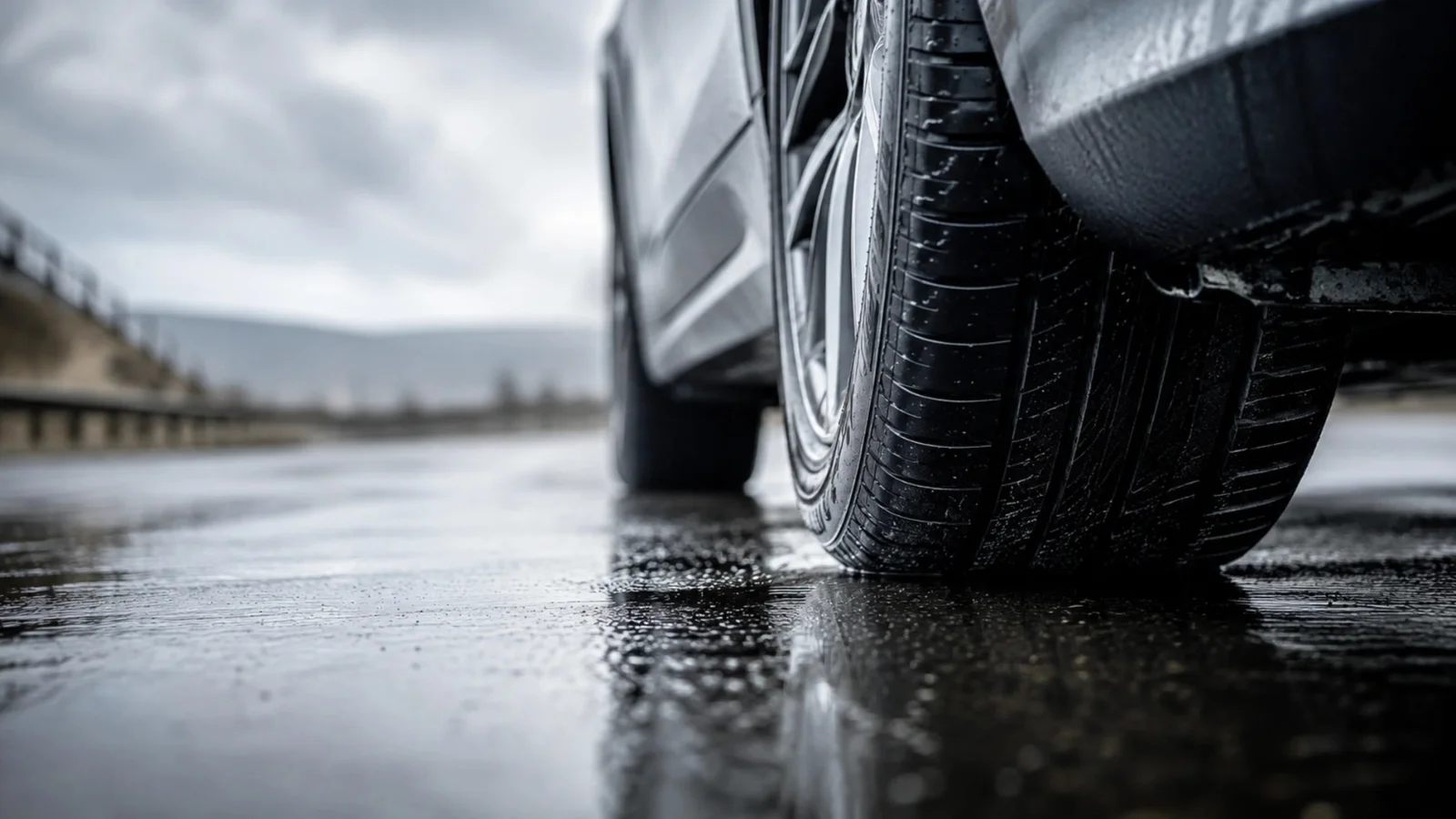
Tyres: The Most Underestimated Safety System on a Car
When we talk about vehicle safety, we most often mention ABS, ESP, airbags, cameras, sensors and driver-assistance systems.
But there is one part of the car that we often forget.
The tyre.
It is the only part of the vehicle that actually touches the asphalt. All the engine power, all the braking force, all the electronics, all the safety equipment and all the technology in the car ultimately depend on four relatively small contact patches between the tyres and the road.
If the tyre is not in good condition, the car cannot accelerate properly, brake effectively, corner safely or react predictably in a critical situation.
That is why a tyre is not just a “consumable”. It is part of the steering, braking, stability and safety system.
An Interesting Fact Few People Know: Tyres Were Not Always Black
The first car tyres were not black at all. They were white, almost milky in colour, because natural rubber naturally has that shade. The black colour appeared only when manufacturers realised that rubber without the addition of carbon black simply could not last — without it, a tyre would last only around 8,000 kilometres.
What we now consider standard is actually the result of decades of safety improvements.
Without carbon black in the compound, a tyre would last only around 8,000 km. Today, an average tyre can last more than 40,000–50,000 km, thanks to this technological change from the early 20th century.
What You Should Actually Check on Your Tyres
The problem is that many drivers only think about tyres when it is time for the seasonal change. At that point, the focus is usually on price, size and whether the tyre can “last one more season”.
But the real questions are different:
Tread depth and wear
Is the tread depth sufficient? Is the tyre wearing evenly?
Tyre age
Is the tyre several years old, even if it looks fine at first glance? A tyre ages even when it is not being used.
Pressure and vehicle behaviour
Is the pressure correct? Does the car pull to one side?
Visible damage
Are there any cuts, bulges or cracks on the sidewall?
Seasonal suitability
Are the tyres suitable for the season and the driving conditions?
Tyre Pressure: Why “Harder” Does Not Mean “Better”
Pressure is a separate topic — and this is where most drivers make the mistake of thinking that “the harder, the better”. The truth is the opposite.
For ordinary passenger cars, the optimal pressure is usually around 2.1–2.5 bar, depending on the model and the manufacturer’s recommendation. You should always check the sticker on the vehicle’s door frame.
Interestingly, even Formula 1 cars — the fastest and most demanding vehicles on the planet — run on lower tyre pressures than the average car on the street, usually between 1.4 and 1.9 bar, depending on the track and conditions. The reason is simple: lower pressure increases the tyre’s contact patch with the surface, and a larger contact patch means more grip.
In Formula 1 and on a city street, the principle is the same — the tyre is what determines how well the car truly grips the road.
Correct tyre pressure should be checked strictly according to the vehicle manufacturer’s recommendation, not according to the maximum value printed on the tyre itself. You can find this value on the sticker inside the driver’s door or in the vehicle manual.
If you are not sure where to check the condition of your tyres, find a trusted tyre service near you through the AutoKonekt network.
When the Difference Really Becomes Visible
Because the difference between a good tyre and a bad tyre is not always visible in a parking lot.
It becomes visible when heavy rain starts. It becomes visible during sudden braking. It becomes visible in a corner. It becomes visible when the vehicle in front of you stops unexpectedly.
At that moment, it no longer matters how much horsepower the car has, how much it cost or how much equipment it has. What matters is how well those four tyres grip the asphalt.
That is why tyres should not be chosen based only on price, but according to purpose, vehicle condition, driving style and the real conditions in which the car is used.
A good tyre does not make a car more luxurious. It makes it safer.
And safety is most often not measured when everything is going normally, but in those few metres when the car has to stop in time.
If you want to check the condition of your tyres with a trusted partner, explore the complete AutoKonekt service network in your city.
Frequently Asked Questions
How often should tyre pressure be checked?
It is recommended to check tyre pressure at least once a month, as well as before longer journeys. Pressure should be measured when the tyres are cold, because it increases during driving as the tyres heat up.
How long does one tyre last?
On average, between 40,000 and 50,000 km, depending on driving style, vehicle type and road conditions. Tyre age is just as important as mileage — a tyre older than 5–6 years should be inspected regardless of how the tread looks.
Is tyre pressure the same for all types of vehicles?
No. Tyre pressure depends on the vehicle’s weight, load distribution and the manufacturer’s recommendation. You should always use the value shown on the vehicle sticker, not a generic table or the maximum value printed on the tyre itself.
How do I know if my tyres need to be replaced?
Check the tread depth, evenness of wear, any cracks or bulges on the sidewall, and the age of the tyre. The legal minimum tread depth is 1.6 mm, but experts recommend replacing tyres earlier.