
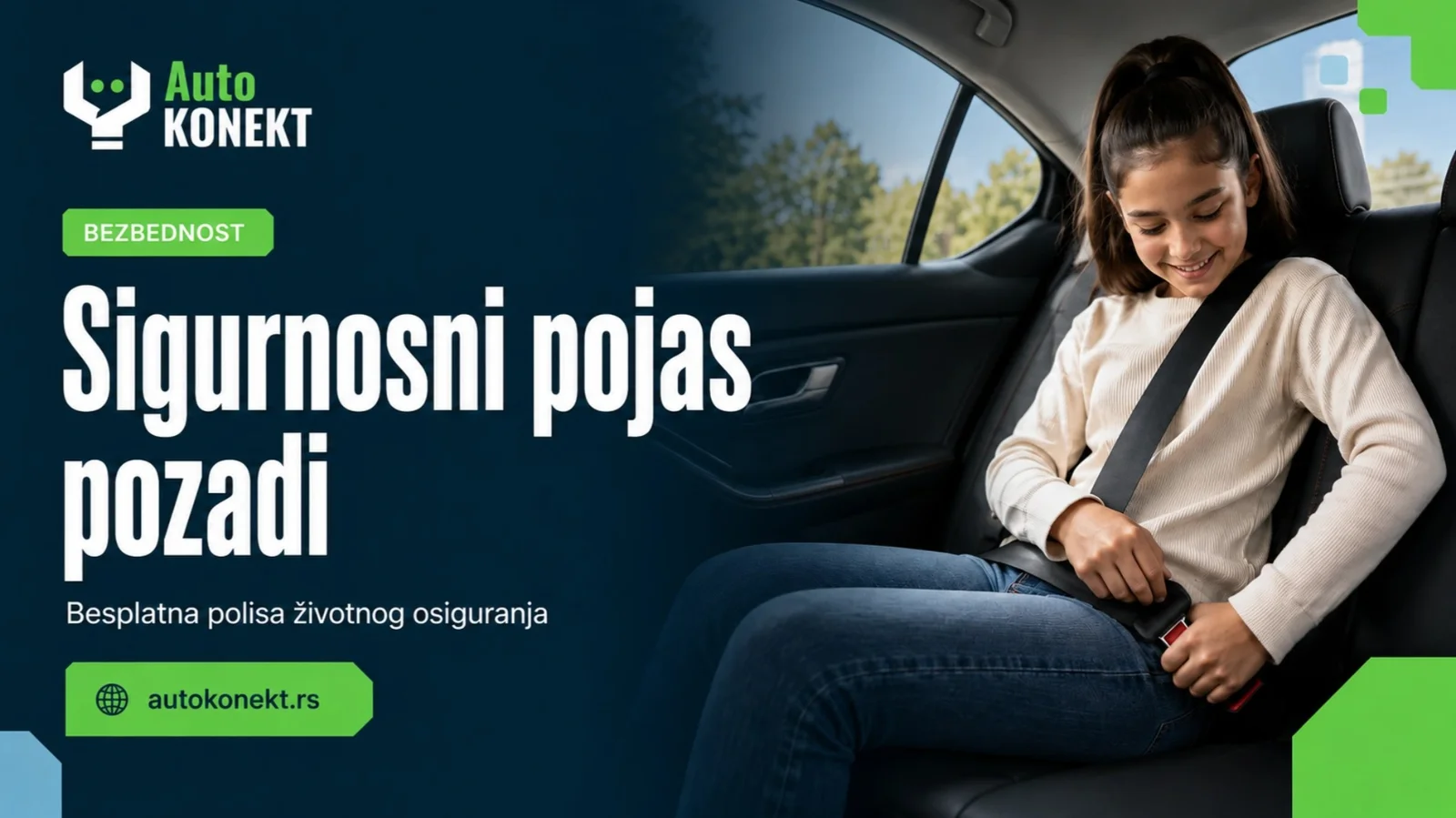
Rear-Seat Seat Belt: A Free Life Insurance Policy
When we sit behind the wheel, most of us automatically fasten our seat belt. We expect the same from the front passenger. The warning sound, habit, police checks and a sense of responsibility have all done their part.
But when we sit in the back, the rules often change.
“We’re only going into town.”
“I’m sitting in the back, it’s not a big deal.”
“I can’t get comfortable.”
“It won’t happen right now, surely.”
That is exactly where the problem begins. The rear seat is still perceived as a safer zone in the car, almost as a space where the risk somehow decreases on its own. In reality, physics makes no distinction between the front and rear seats.
If the vehicle brakes suddenly, hits an obstacle or is hit by another vehicle, an unbelted passenger continues moving at the same speed at which the car was travelling before the collision. At that moment, a person is no longer just a passenger. They become a body that strikes the seat in front, the door, the glass, the roof or another passenger with great force.
That is why the seat belt in the rear seat is not a formality. It is not a detail. It is not something we do only because of the police.
It is one of the simplest, cheapest and most important life-saving habits in a car.
The rear seat is not an exception to safety rules
According to the Road Traffic Safety Agency, in Serbia in 2024, seat belt use in the front seats of passenger cars was 85.6%, while in the rear seat it was only 21.3%. In other words, most drivers and front passengers wear their seat belts, but most rear-seat passengers still do not.
This is perhaps the most important reason why this topic needs to be discussed more often. Not because people do not know that the seat belt exists, but because they still underestimate its importance when sitting in the back.
In Serbia, the Law on Road Traffic Safety stipulates that the driver and passengers in a motor vehicle equipped with seat belts must use them in the manner prescribed by the vehicle manufacturer. This does not apply only to the driver and front passenger, but also to passengers in the rear seats.
But the point is not the fine.
The point is that a seat belt does not protect only the person wearing it. It protects everyone else in the car as well.
An unbelted rear-seat passenger endangers both themselves and those in front
One of the most dangerous misconceptions is that an unbelted passenger in the rear seat risks only their own life. In a crash, their body moves forward at high speed and can strike the back of the front seat, the driver or the front passenger with great force.
This means that a rear-seat passenger who is not wearing a seat belt can seriously injure the person in front of them — even if that person is properly restrained.
That is why the driver should not start the car until everyone inside is buckled up. Not because they want to be strict, but because they are responsible for the people they are transporting.
Just as you would not drive off with the doors open, faulty brakes or a child not properly seated in a child seat, you should not drive off with unbelted passengers in the back.
AutoKonekt advice
Before you set off, check three things: whether all passengers are wearing their seat belts, whether children are properly seated, and whether the car is technically ready for the road. Regular servicing and technical inspection are part of the same safety story — find a trusted service provider through the AutoKonekt platform.
“It’s only a short drive” is often the most dangerous excuse
Most excuses for not wearing a seat belt happen precisely during short drives.
To school. To work. To the shop. To a restaurant. To the other side of town.
The problem is that traffic accidents do not choose routes. An accident can happen on a main road, but also at an intersection 500 metres from home. It can happen at high speed, but also in city driving, when someone fails to stop at a stop sign, runs a red light, brakes suddenly or does not see a vehicle coming from a side street.
A seat belt is not important only on the motorway.
A seat belt is important every time the car is moving.
Airbags do not replace seat belts
Another common misconception is that modern cars have enough safety systems and that the seat belt is therefore no longer crucial. Today’s vehicles have ABS, ESP, multiple airbags, automatic braking systems, cameras, sensors, blind spot warnings and many other technologies.
But none of these systems replaces the basic role of the seat belt.
An airbag is designed to work together with the seat belt, not instead of it. According to generally accepted recommendations from vehicle manufacturers and road safety experts, airbags are not sufficient as standalone protection — improper seat belt use or not wearing a seat belt can still lead to serious injuries, even if the airbag deploys.
In other words, the seat belt is the foundation of passive safety. Everything else is additional protection.
If the foundation is not active, even the best safety systems cannot show their full effect.
The numbers are clear: seat belts save lives
The Road Traffic Safety Agency states that proper seat belt use can reduce the risk of fatal injury by 40–50% for the driver and front passenger, and by up to 75% for rear-seat passengers.
These figures change the way we should look at seat belts.
Because a seat belt does not require extra money. It does not require servicing. It does not require an app. It does not require special training. It does not require time.
It requires only one click.
That is why the rear-seat seat belt can be called the cheapest life insurance policy you already have in your car.
Children learn from what they see
What we do when children are in the car is especially important. Children do not learn only from what we tell them. They learn most from what they see.
If a parent tells a child that they must be buckled up, while an adult passenger in the back is not wearing a seat belt, the message becomes confusing. The child understands that the rule may apply only to them, only while they are small, only while the parent insists on it.
That is why there should be one simple rule in every car:
The car does not move until everyone is buckled up.
No discussion. No exceptions. Regardless of whether the journey is 300 kilometres or three streets away.
This is not a question of strictness. It is a question of safety culture.
A safe car is not only a technically sound car
When we talk about vehicle safety, we usually think of technical condition: brakes, tyres, lights, suspension, shock absorbers, steering system, glass, wipers and electronics.
And all of that matters.
But safety is not only in the car. Safety is also in the behaviour of the people travelling in it.
A technically sound car with unbelted passengers is not a completely safe car.
That is why the role of the driver is more important than is often thought. The driver does not only control the vehicle. The driver sets the rules inside the vehicle. The driver decides whether to move off before everyone is buckled up. The driver makes the difference between a casual habit and responsible driving.
AutoKonekt advice
If you are not sure whether your car’s safety systems are working properly — seat belts, airbags, brakes — book a technical inspection with a trusted partner. Find services in your city through AutoKonekt locations.
A seat belt is not the inconvenience. The accident is.
Many people do not like seat belts because they feel tight, crease their clothes, bother them across the shoulder or seem unnecessary on a short trip. But that small inconvenience lasts only a few minutes.
The consequences of a traffic accident can last a lifetime.
That is why a seat belt should not be seen as an obligation imposed on us by someone else. It should be seen as protection we provide for ourselves, our family and the people sitting with us in the car.
One click does not guarantee that an accident will not happen.
But it can decide how it ends.
So the next time someone in the rear seat says, “It doesn’t matter, it’s a short drive,” the answer should be simple:
It does matter. Fasten your seat belt. The car moves only when everyone is safe.
Frequently Asked Questions
Is wearing a seat belt in the rear seat legally required in Serbia?
Yes. The Law on Road Traffic Safety stipulates that all passengers in a vehicle, including those in the rear seats, must use seat belts in the manner prescribed by the vehicle manufacturer.
What percentage of rear-seat passengers wear seat belts in Serbia?
According to the Road Traffic Safety Agency data for 2024, only 21.3% of rear-seat passengers use a seat belt, compared with 85.6% in the front seats.
Do airbags replace seat belts?
No. Airbags are designed to work together with seat belts, not instead of them. Without a fastened seat belt, the protection provided by the airbag is significantly reduced.
Why is it dangerous not to wear a seat belt on short drives?
Traffic accidents do not happen only on long journeys or motorways — many accidents occur in city driving, over short distances from home.