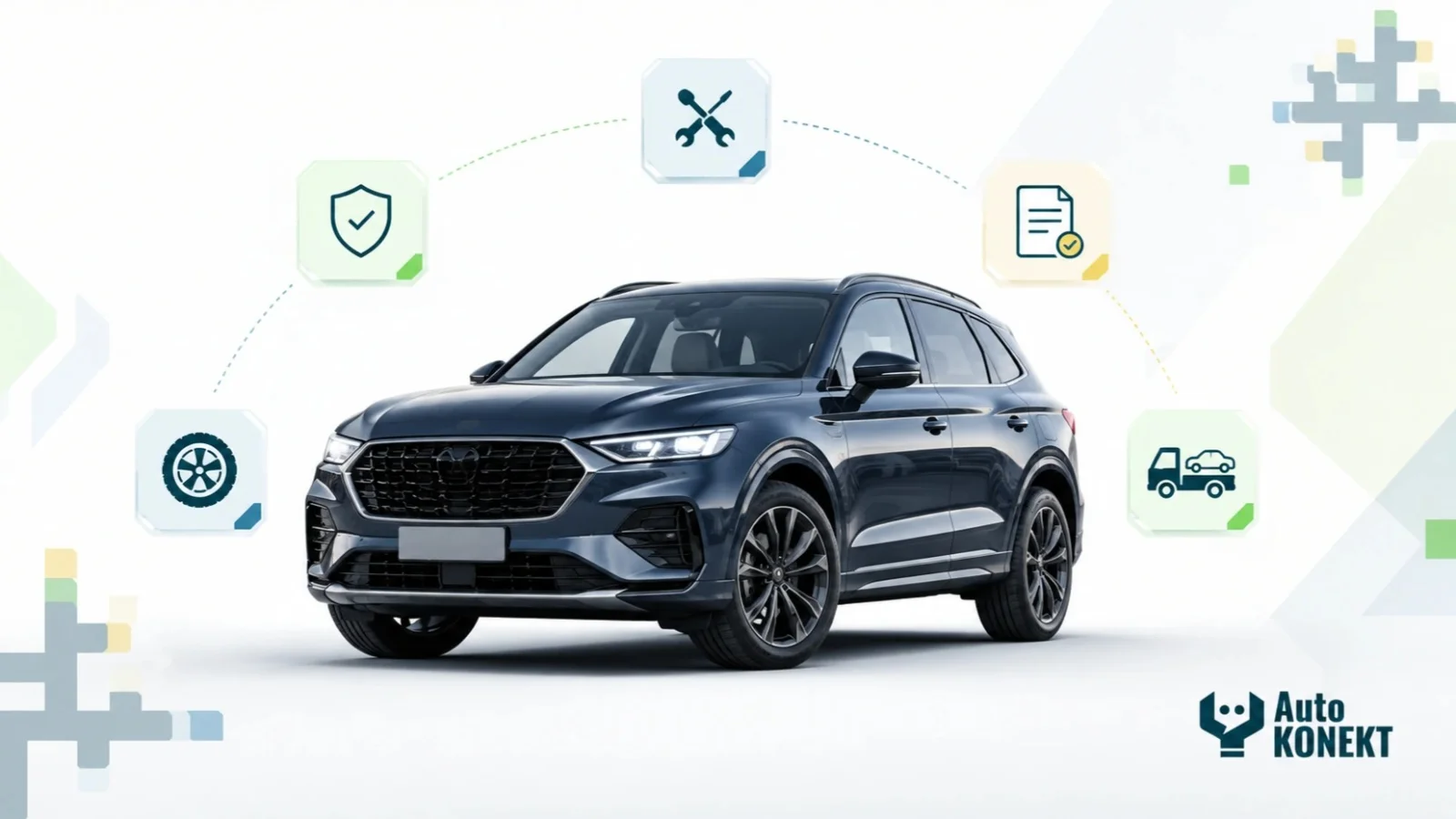
What Is Included in the Cost of Operating Leasing for a Vehicle?
Service, tires, registration and insurance — and everything that is not included in the monthly payment
When you compare two operating lease offers, the first thing you notice is the monthly payment. At the same time, that is probably the least useful piece of information in the entire offer.
A monthly payment that includes registration, comprehensive insurance, scheduled maintenance and two sets of tires, and a monthly payment that covers only the vehicle are not two prices for the same product — they are two different products. The difference usually does not appear on the first page of the offer, but in the contract appendix, in the section that is often read only after the first unexpected invoice arrives.
This article breaks the monthly payment down into its individual components: what is usually included, what is almost never included, how this affects VAT and tax treatment, and which questions you should ask before signing.
1. First: operating leasing is not legally “leasing”
Under Serbian law, operating leasing and financial leasing are not the same category, and this distinction directly affects the way the price is structured.
Financial leasing is regulated by the Law on Financial Leasing, agreements are entered into the Financial Leasing Register maintained by the Serbian Business Registers Agency (APR), and leasing companies are supervised by the National Bank of Serbia.
Operating leasing is not regulated by a separate law. Instead, the provisions governing lease agreements under the Law on Obligations (Articles 567–599) apply. In practical terms, operating leasing is a long-term vehicle rental.
Why this matters for the price
Financial leasing has standardized elements — nominal and effective interest rates, as well as a repayment schedule. With operating leasing, however, the content of the agreement is a matter of negotiation between the parties. What is written in the agreement is the rule. What is not written there does not exist.
2. Anatomy of the monthly payment
The monthly payment consists of two groups of items: the cost of using the vehicle and the cost of services related to the vehicle.
A. Cost of using the vehicle — always included in the payment
Depreciation. The difference between the vehicle's purchase price and its estimated value at the end of the contract, divided by the number of months. This is the largest individual component. This is why the monthly payment for the same model can vary between providers: a provider that expects the vehicle to be worth more after 48 months can offer a lower monthly payment.
Financing cost and provider's margin. In operating leasing, this is not presented as an interest rate, but is incorporated into the lease fee. There is no obligation to disclose it separately — you can ask, but you may not receive that information.
Residual value risk. The risk that the vehicle will be worth less than estimated at the end of the contract remains with the leasing provider. That risk is factored into the monthly payment.
B. Services — depending on the agreed package
Registration. This usually covers everything included in annual vehicle registration: technical inspection, motor vehicle use tax, compulsory third-party liability insurance, national and local fees, and the registration sticker. The motor vehicle use tax depends on engine displacement and vehicle age — for vehicles with engines above 2,000 cm³, it is by far the largest component of registration costs, which means that including registration in the monthly payment is significantly more valuable for such vehicles than for a small city car.
Insurance. As a rule, this includes compulsory third-party liability insurance plus comprehensive insurance. Comprehensive insurance is practically mandatory under operating leasing because the vehicle is owned by another party and serves as the provider's primary security. One question you should always ask is: how much is the deductible per claim and who pays it? It is almost never the leasing provider.
Scheduled maintenance. Services performed according to the manufacturer's maintenance schedule — oil, filters and prescribed service intervals. Pay attention to the difference between “scheduled maintenance” and “full maintenance”: scheduled maintenance covers the manufacturer's maintenance plan, while full maintenance also includes wear-and-tear items such as brake pads, discs, shock absorbers, the battery and wiper blades. That difference can be worth several dozen euros per month.
Tires. The agreement should specify the number of sets for the entire contract period, the tire category, and whether fitting, balancing, seasonal replacement and storage (“tire hotel”) are included. A common trap is having one set of winter tires and one set of summer tires for a 48-month contract with high annual mileage — mathematically, that may simply not be enough.
Additional services. Replacement vehicle, roadside assistance, telematics and fleet reports, fuel card. A fuel card does not mean fuel is included — it is a payment method, not a component of the monthly payment.
3. What is almost never included in the monthly payment
This is the part that determines whether you will actually stay within your planned budget.
Who pays for what:
Fuel or charging — this cost is always borne by the user;
Tolls and parking — these costs are borne by the user;
Traffic fines — these are also borne by the user. The leasing provider, as the vehicle owner, may pay them first and then recharge them to the user, often with an additional administrative fee;
Comprehensive insurance deductible — borne by the user for each insured event;
Excess mileage — paid by the user at the agreed rate for every kilometer above the contract limit;
Damage beyond “normal wear and tear” — paid by the user and assessed when the vehicle is returned;
Vehicle washing and cleaning — borne by the user;
Tires damaged due to driver-related causes such as potholes or sidewall impacts — usually borne by the user;
Lost keys or damaged glass not covered by the package — borne by the user;
Early termination of the agreement — subject to penalties defined in the contract.
Two items deserve special attention
Mileage. The agreement defines either an annual or total mileage limit, with excess mileage charged per kilometer. Estimate your mileage realistically: if you are likely to be close to the limit, it is usually cheaper to agree on a higher allowance in advance than to pay excess-mileage charges later. Some providers also offer a refund for unused mileage — ask specifically, because this is not automatically included.
“Normal wear and tear.” This is the most subjective provision in the entire contract. The vehicle is returned in its original condition, without permanent modifications, and anything beyond normal wear may be charged to the user. The problem is that “normal” is rarely defined precisely. Ask for a written standard explaining how the assessment is performed — how many scratches per panel are acceptable, their permissible length and depth, and how wheels and the interior are assessed. If there is no written standard, the assessment is effectively performed by the party that will charge you for the damage.
4. VAT: the item companies most often calculate incorrectly
This can be the most expensive mistake when planning the total cost.
According to Article 29 of the Serbian VAT Law, a VAT taxpayer is not entitled to deduct input VAT related to the purchase of passenger cars, nor VAT related to their rental, maintenance, repairs, fuel and other services associated with their use. Exceptions apply only to taxpayers that use such vehicles exclusively for activities involving the sale or rental of vehicles, passenger or goods transport, or driver training.
What does this mean in practice?
If your company is not a rent-a-car business, transport company, taxi service or driving school, you will most likely not be able to deduct the VAT charged on the monthly operating lease payment for a passenger vehicle. A monthly payment of EUR 400 + VAT therefore represents a total cost of EUR 480 for your company. This restriction does not apply to commercial vehicles.
The favorable aspect is that the full lease fee is recorded in the company's books as a rental expense and is recognized as an expense. Unlike financial leasing, whose figures are recorded in the balance sheet and affect borrowing capacity, operating lease obligations are generally not recorded in the same way — which is one of the main reasons companies choose this model.
Tax and accounting treatment depends on the specific terms of the agreement. Before signing, check this with your accountant rather than relying solely on the salesperson.
5. How to compare two offers
Do not compare monthly payments.
Compare the total cost of use.
Formula
Total cost = (monthly payment × number of months) + deposit tied up during the contract period + expected costs outside the monthly payment
Then divide this amount by the contracted mileage to obtain the cost per kilometer — the only figure that can be meaningfully compared between two differently structured offers.
Before signing, check these ten items in the agreement:
1. Registration: Is registration included for every year of the contract?
2. Comprehensive insurance: What is the deductible per claim, and how many claims per year are covered?
3. Maintenance: Does it cover only the manufacturer's scheduled maintenance or also wear-and-tear items? Ask for the covered items to be listed individually.
4. Tires: How many sets are included, what category of tires, and are fitting, seasonal replacement and storage included?
5. Mileage: What is the limit, how much does each excess kilometer cost, and is there any refund for mileage below the agreed limit?
6. Replacement vehicle: From which day of vehicle downtime is it provided, what vehicle class is included, and for how many days per year?
7. Servicing: Can I use a repair shop of my choice, or only the provider's designated service network?
8. Vehicle return: Is there a written standard for assessing vehicle damage?
9. Early termination: How exactly is the termination penalty calculated?
10. Deposit: How much is it, when is it refunded, and under what conditions can deductions be made?
If you receive a verbal answer to any of these questions but cannot find it in the agreement — that answer does not exist.
6. What remains the driver's responsibility
Even with the most comprehensive package, certain costs remain outside the monthly payment and require separate service providers:
washing and regular vehicle cleaning;
repairing minor damage before returning the vehicle;
glass repair or replacement, if not included in the package;
tires damaged due to driver-related causes;
complete maintenance of any fleet vehicles that are not under a leasing agreement — which still represents the majority of vehicles operated by small and medium-sized companies in Serbia.
Preparing the vehicle for return — one of the most tangible opportunities to save money
A few weeks before the contract expires, it is worth carrying out an objective assessment of the vehicle's condition: dents, scratches on bumpers and sills, stone chips and minor glass damage, as well as the condition of the wheels and interior.
Repairing these issues through an independent service provider will almost always cost less than the fee charged by the leasing provider according to its own price list when the vehicle is returned.
The key is having someone to turn to without spending half a day making phone calls and comparing providers. AutoKonekt brings car repair shops, body shops, tire services, auto glass services, car washes and technical inspection centers together in one place — with partner profiles and online appointment booking.
Frequently Asked Questions
Can an individual take out an operating lease for a vehicle in Serbia?
Yes, although the product is primarily intended for companies. Different approval conditions apply to individuals, and providers generally require a security deposit and proof of sufficient income relative to the monthly payment.
Is operating leasing recorded as credit debt?
Unlike financial leasing, operating lease obligations are generally not recorded in the same way because the arrangement represents a rental agreement rather than financing the purchase of a vehicle. The specific accounting treatment depends on the contents of the agreement, so this should be checked with your accountant.
Can I purchase the vehicle at the end of the contract?
It depends on the provider and the agreement. Some providers include a purchase option, others allow the vehicle to be purchased by a third party designated by the user, while some do not allow a purchase at all. Ask this question at the beginning of the contract, not at the end.
Who registers a vehicle under an operating lease?
The leasing provider is the owner of the vehicle and is therefore responsible for registering it. Registration costs are included in the monthly payment only if this service is explicitly included in the agreement — check whether this applies to every year of the contract.
Can I service the vehicle at a repair shop of my choice?
For packages that include maintenance, servicing is generally restricted to the network designated by the leasing provider. Using a repair shop outside that network may mean that the cost will not be reimbursed, and in some cases it can also affect the vehicle warranty. For services not covered by the package — washing, minor body repairs or glass work — you are free to choose your own provider.
What is a “tire hotel”?
It is a storage service for the set of tires that is not currently fitted to the vehicle, usually provided by a tire shop or service center together with seasonal tire replacement. Under operating leasing, it is contracted as an additional service and is not automatically included — check whether it is part of your package.
Conclusion
Operating leasing sells predictability, and it does that very well — as long as you remain within the limits defined by the agreement. Once you move beyond those limits, the costs shift back to the user, usually according to a price list that the user did not set.
That is why the only useful way to compare offers is not to ask “Which monthly payment is lower?”, but rather “What happens when I go outside the agreed limits?”
The answer to that question is always in the contract — and rarely on the first page.
AutoKonekt
AutoKonekt connects drivers with verified automotive partners across Serbia — car repair shops, tire services, technical inspection centers, car washes, towing services, auto glass specialists, anti-theft system providers, body shops and auto parts suppliers — with online appointment booking available.
Find a partner and book an appointment at autokonekt.rs.