
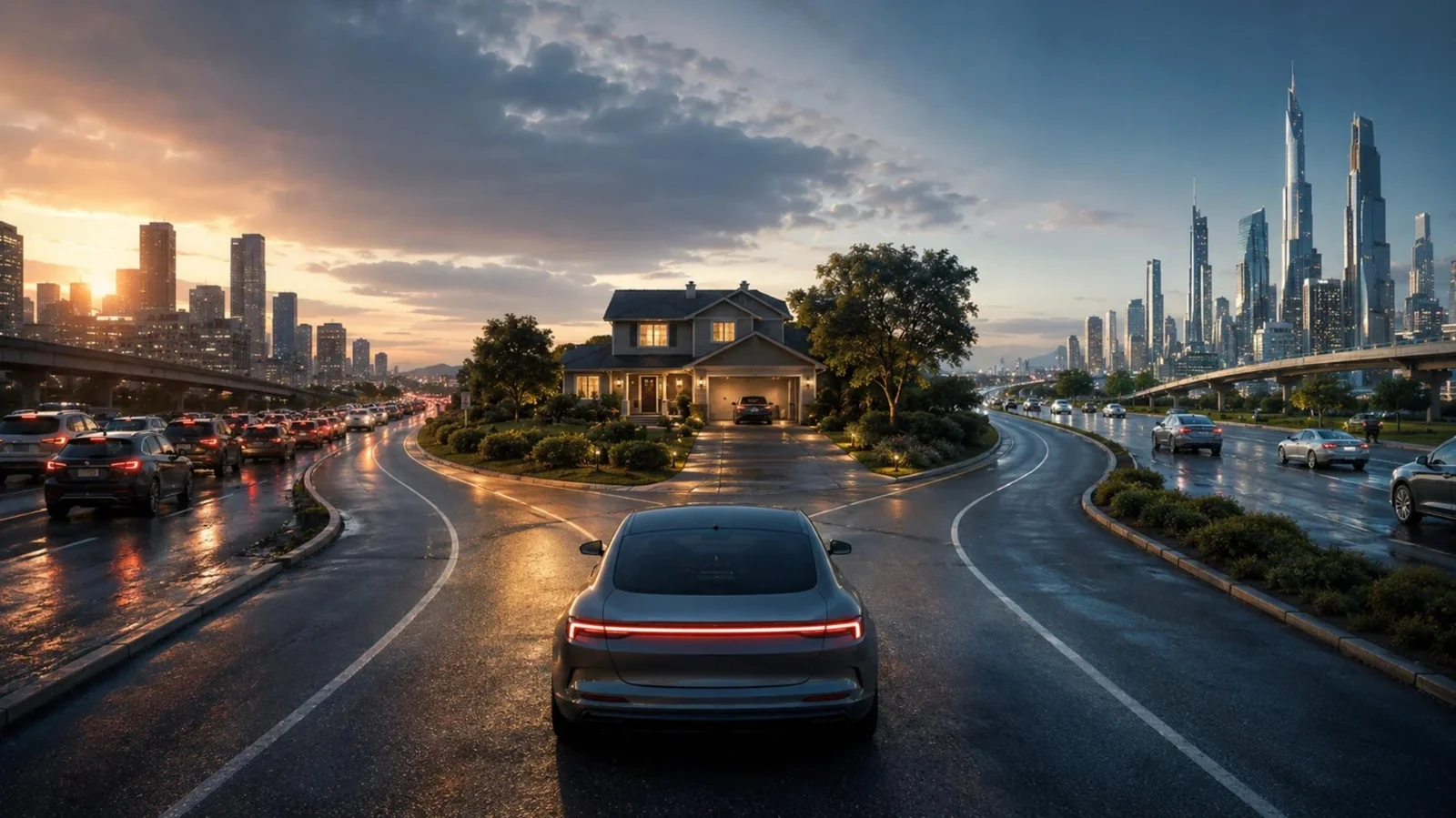
The Future of Mobility: Will We Drive, Own or Simply Use Cars?
For decades, the car has been much more than a means of transport. It has been a symbol of freedom, status, family security and personal choice. We chose it based on the brand, engine, fuel consumption, design, boot size and the impression it made when parked in front of the house.
But the car is changing faster than ever.
Electrification, autonomous driving, connected systems, software updates and new models of use are changing the very logic of the automobile. The question is no longer only which car to buy. The question is: will we own it at all, how long will it last, who will maintain it, and will the driver of the future really be a driver?
Autonomous driving: the future is coming, but not overnight
When we talk about the future of mobility, the first association is usually autonomous driving. The image is appealing: you get into a car, enter your destination, and the vehicle drives itself, follows traffic, parks and avoids danger.
Technology is indeed advancing. In June 2026, UNECE adopted the first global regulatory framework that legally enables fully autonomous driving systems, which is an important step towards their wider application. However, this does not mean that fully autonomous vehicles will suddenly flood the roads.
According to McKinsey’s 2026 research, timelines for the broader deployment of autonomous vehicles have shifted by one to two years compared to earlier expectations. Large-scale commercial deployment of robotaxis is now expected around 2030, while urban autonomous driving of private passenger cars is moving towards 2032.
This means the transition will be gradual. First, we will see increasingly advanced driver assistance systems: automatic braking, adaptive cruise control, lane keeping, blind spot monitoring, automatic parking and better communication between vehicles and their surroundings. Fully autonomous driving will not arrive everywhere at the same time. It will first develop in large cities, on controlled routes, in taxi fleets, delivery vehicles and trucks.
For the average driver in Serbia, the more realistic question in the coming years will not be “when will the car drive itself?”, but “how much of the technology in my car do I really understand, and how well am I maintaining the systems that affect safety?”
The car is becoming software on wheels
In the past, a car was primarily a mechanical product. Engine, gearbox, brakes, suspension, bodywork. Today, it is increasingly a digital device on wheels.
Modern cars have dozens of electronic control units, sensors, cameras, radars, connected services, apps and software that can be updated remotely. McKinsey estimates that the global automotive software and electronics market could reach 519 billion dollars by 2035.
This is also changing the way vehicles are maintained. In the future, a fault will not always mean that “something has broken” or that a part has physically worn out. The problem may be a software error, a sensor sending incorrect information, an incompatible software version, camera calibration, a battery system update or a communication issue between modules.
That is why the workshop of the future will not only be a place where oil is changed. It will be a combination of mechanics, electronics, diagnostics, software and data.
A number that speaks for itself
519 billion dollars — that is how much, according to McKinsey’s estimate, the global automotive software and electronics market could be worth by 2035. Vehicle maintenance is increasingly becoming a matter of diagnostics and software, not just mechanics.
Will car ownership survive?
One of the biggest questions about the future is: will people still want to own cars?
In large cities, there are more and more alternatives: car sharing, hourly rental, vehicle subscriptions, taxi apps, electric bicycles, public transport and multimodal mobility. In its 2026 Global Automotive Consumer Study, Deloitte points out that customer expectations are changing and that consumers are increasingly looking for value, transparency, trust and flexibility, not just the traditional purchase of a car.
Still, car ownership will not disappear quickly, especially not in countries such as Serbia. The reason is simple: a car is not only a matter of comfort, but often a matter of everyday functionality. Family, work, children, travel, visits to the doctor, weekends, the countryside, holidays — these are all situations in which a personal car remains difficult to replace.
The more likely scenario is that ownership will become more diverse. Some people will continue to buy a car for 7, 10 or 15 years. Some will use operational leasing. Some will choose a subscription. Some will have one family car, while replacing a second car with occasional use of someone else’s vehicle or a mobility service.
In other words, the future will not eliminate the car. It will only change the way we use it.
Cars will last longer, but maintenance will become more complex
One of the paradoxes of the modern automotive market is that cars are becoming more technologically advanced, while owners are keeping them for longer.
In the European Union, passenger cars are 12.3 years old on average, vans 12.5 years old and trucks 13.9 years old. In Serbia, the problem is even more pronounced: according to data from the Road Safety Strategy, the average age of registered cars at the end of 2020 was 17.3 years. The Statistical Office of the Republic of Serbia also reported that in the first quarter of 2026, 82.9% of passenger cars registered for the first time were more than two years old.
This means that the future of mobility in Serbia will not only be a story about new electric and autonomous vehicles. It will also be a story about how to safely maintain a large number of used, increasingly complex and increasingly older cars — and finding a reliable workshop in your city will become increasingly important. You can find an overview of partners by location at autokonekt.rs/lokacije.
For older vehicles, regular maintenance is not a luxury. It directly affects safety, fuel consumption, emissions, reliability and total costs. For newer vehicles, maintenance is becoming even more important because faults are not always visible to the naked eye. A poorly calibrated camera, a faulty sensor or an ignored software error can have serious consequences.
Serbia in numbers
82.9% of passenger cars registered for the first time in Serbia in the first quarter of 2026 were more than two years old, according to the Statistical Office of the Republic of Serbia. In our market, maintenance is not an exception — it is the rule.
Electric cars will not eliminate workshops
We often hear the sentence: “Electric cars break down less, so workshops will have no work.” This is only partly true.
Electric cars have fewer traditional mechanical components. There is no engine oil change, no exhaust system, no clutch in the traditional sense. But that does not mean there is no maintenance.
There are still tyres, brakes, suspension, shock absorbers, air conditioning, battery cooling systems, electronics, software, bodywork, glass, sensors and diagnostics. In electric vehicles, the condition of the battery, charging habits, software updates and proper inspection of the high-voltage system are particularly important.
According to the IEA, electric cars exceeded 20 million global sales in 2025 and accounted for around 25% of new car sales worldwide. This means that the service sector will not disappear — it will transform. Workshops that invest in knowledge, diagnostics and transparent communication with drivers will become increasingly valuable.
The real battle of the future will be access to data
As cars become connected, one question becomes increasingly important: who has access to vehicle data?
This data can show the condition of the battery, driving style, consumption, system faults, component wear, tyre pressure, the need for servicing or warnings that the driver may not understand. If this data is closed and available only to the manufacturer, independent workshops and users may be placed at a disadvantage.
In September 2025, the European Commission published guidance on vehicle data under the Data Act, with the aim of clarifying obligations related to access to and use of data generated by connected vehicles.
For the driver, this is not an abstract legal issue. It is a question of choice: whether they will be able to choose a workshop, whether they will receive transparent diagnostics, whether they will know the real condition of the vehicle and whether maintenance will be fair, accessible and understandable.
What does the future mean for the driver?
For the driver, the future brings more technology, but also more responsibility.
It will be necessary to understand that the car is no longer just a machine we drive until something breaks. It is becoming a system that needs to be monitored, maintained preventively and serviced properly. Just as a phone is updated, the car will increasingly be updated as well. Just as apps send notifications, the car will increasingly notify the driver when a check is needed.
But technology alone is not enough.
Drivers will still need a reliable workshop, clear information, a realistic price, a timely appointment and an explanation of what really needs to be done and what is not urgent. This is exactly where platforms that connect drivers with trusted service partners come in — such as AutoKonekt, which helps drivers in Serbia find a partner they can trust.
The future of mobility will not only be autonomous. It will be connected, digital, electrified and more transparent. But one thing will not change: a car that is not properly maintained, no matter how advanced it is, cannot be a reliable car.
Frequently Asked Questions
Q: Will autonomous vehicles soon be driving in Serbia?
A: Not in the near future. Although UNECE adopted the first global regulatory framework for fully autonomous vehicles in June 2026, McKinsey estimates that mass commercial deployment of robotaxis will arrive around 2030, while urban autonomous driving of private cars is expected around 2032. Until then, more advanced assistance systems — automatic braking, lane keeping and automatic parking — will gradually become standard.
[FAQPage schema — Question 1 / Answer 1]
Q: Do electric cars require less maintenance?
A: They require different maintenance, not necessarily less. There is no oil change or exhaust system, but tyres, brakes, air conditioning, the battery cooling system, electronics and software still require regular checks. The battery condition and high-voltage system are especially important.
[FAQPage schema — Question 2 / Answer 2]
Q: Why are cars in Serbia older on average than in the EU?
A: According to the Road Safety Strategy, the average age of registered cars in Serbia at the end of 2020 was 17.3 years, while the EU average is 12.3 years. Data from the Statistical Office of the Republic of Serbia for the first quarter of 2026 show that as many as 82.9% of passenger cars registered for the first time were more than two years old, making regular maintenance essential for vehicle safety and reliability.
[FAQPage schema — Question 3 / Answer 3]
Q: Who has access to the data generated by my car?
A: It depends on the manufacturer and the regulatory framework. In September 2025, the European Commission published guidance on vehicle data under the Data Act, with the aim of enabling fairer access for independent workshops and users, not only vehicle manufacturers.
[FAQPage schema — Question 4 / Answer 4]
Conclusion
Cars of the future may brake by themselves, park by themselves, choose routes by themselves and notify the driver when something is wrong. We may not all own them in the same way as we do today. Some drivers may pay for use instead of ownership.
But maintenance will not disappear. On the contrary, it will become more important, smarter and more complex.
In a world where the car is becoming software on wheels, the most valuable thing for the driver will be trust: knowing what they are driving, what condition their vehicle is in, who they are entrusting it to and how much it will really cost.
That is why the future of mobility does not begin only when the car starts driving itself. It begins the moment the driver starts taking smarter care of their car.