Tyre Blowout on the Road: What to Do, How to Change a Wheel and When to Call for Help
When a tyre blows out, most drivers immediately think about the wheel: Do I have a spare? Where is the jack? How long will it take to replace it? But the most important decisions come earlier, in the first few seconds and minutes after the incident.
According to data published by Serbia's public road authority, JP Putevi Srbije, in 2024, more than 20 people lost their lives on motorway hard shoulders in Serbia over a five-year period. Negligence is not necessarily the reason. Often, drivers simply do not know exactly what to do, in what order, or when it is safer to call for help rather than attempt to solve the problem themselves.
This guide takes you through the entire process, from the moment you feel a sudden jolt through the steering wheel to your visit to a tyre specialist. We have checked the relevant laws and regulations against their original texts and clearly distinguish legal requirements from practical recommendations.
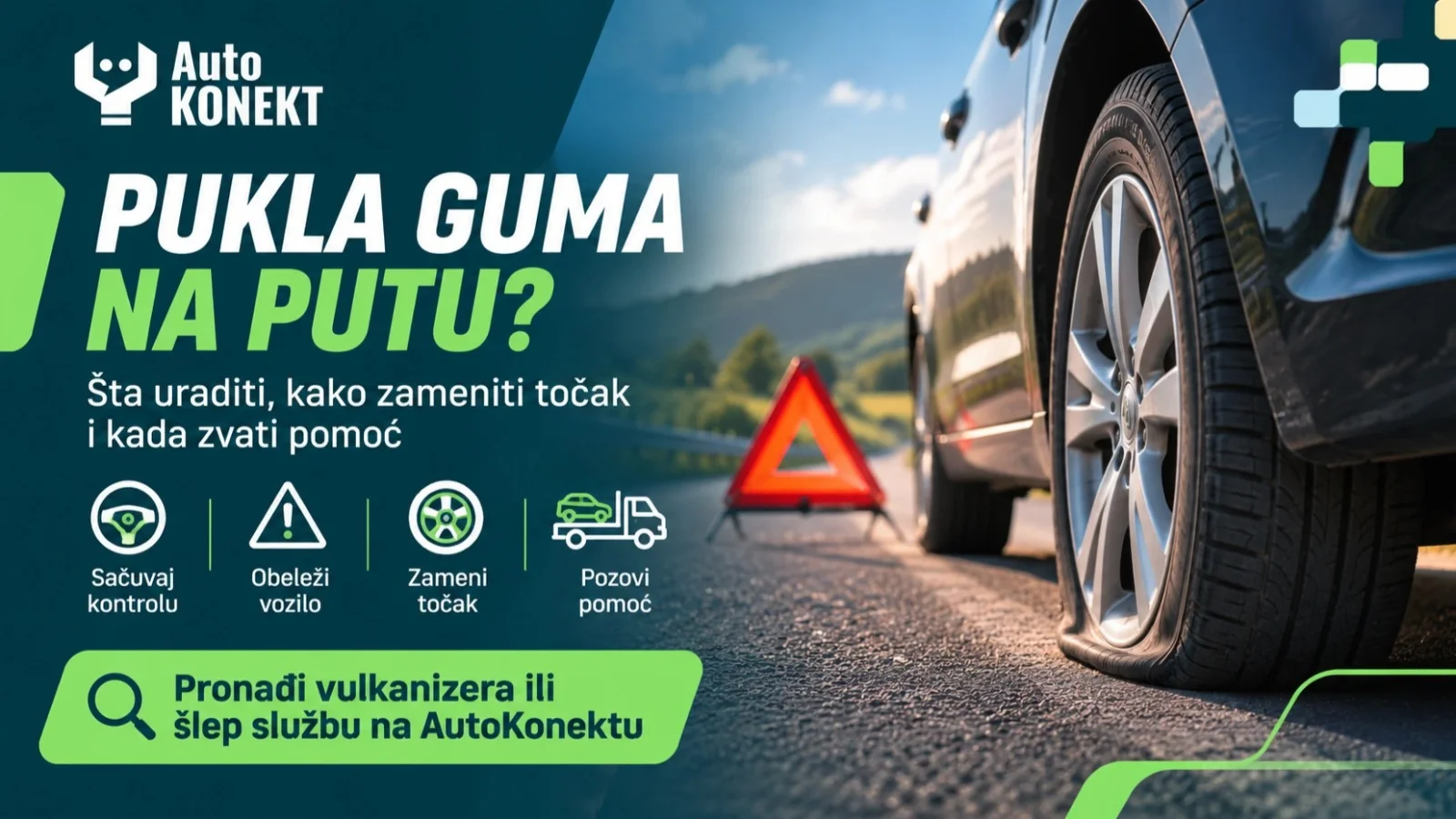
TYRE BLOWOUT? REMEMBER THESE 5 ESSENTIAL STEPS
Hold the steering wheel firmly and avoid sudden braking.
Slow down gradually and bring the vehicle to a safe stop.
Switch on your hazard warning lights and put on a reflective safety vest.
Move passengers away from traffic and mark the vehicle if it is safe to do so.
Only change the wheel in a safe location. Otherwise, call for roadside assistance.
The First Few Seconds: How to Maintain Control
A tyre blowout usually feels like a dull bang, immediately followed by the car pulling to one side. If a front tyre blows out, you will generally feel stronger vibrations and pulling through the steering wheel. If a rear tyre fails, the back of the vehicle may become unstable and start to sway.
Your instinct may be to brake hard immediately. That is precisely what you should avoid. Sudden braking transfers weight towards the front of the vehicle, making a car with a damaged tyre more likely to lose directional stability.
1. Hold the steering wheel firmly with both hands and keep the vehicle in its lane.
2. Do not brake suddenly. First, stabilise the vehicle, then gradually release the accelerator and allow the car to slow down naturally. Abruptly lifting off the accelerator can also destabilise the vehicle.
3. Avoid sudden steering movements. Your priority is to keep the vehicle travelling straight, not to reach the roadside as quickly as possible.
4. Switch on your right indicator as soon as you determine that it is safe to do so.
5. Once you have significantly reduced your speed, apply the brakes gently and gradually move to the right, towards the hard shoulder, a lay-by or a parking area.
Driving a few dozen metres on a deflated tyre will probably damage the tyre and possibly the wheel rim. That is an acceptable trade-off. A wheel rim can be replaced; stopping safely in an appropriate location is far more important.
Where to Stop and How to Warn Other Drivers
The ideal stopping place is a firm, level surface as far away from moving traffic as possible: a car park, lay-by, roadside pull-off or a wide, stable area beside the road.
If you can safely travel a little further at low speed to reach such a location, that is almost always preferable to stopping on a bend, a bridge or a narrow roadside verge.
What to Do After Stopping
1. Switch on your hazard warning lights.
2. Put on a reflective safety vest before leaving the vehicle. This is why it is best to keep the vest inside the passenger compartment rather than in the boot. Serbian law requires you to wear it whenever you are outside your vehicle on the carriageway.
3. Exit the vehicle on the side furthest from moving traffic, usually the passenger side.
4. Passengers, especially children, should leave through the same side and move away from the road. On motorways, they should stand behind the safety barrier, never behind or beside the stopped vehicle.
5. Place a warning triangle behind the vehicle, provided you can do so safely.
How Far Behind the Vehicle Should the Warning Triangle Be Placed?
Many online guides get this wrong by providing just one distance. Serbia's Road Traffic Safety Law establishes general distances under Article 67 and a specific requirement for motorways under Article 105:
In built-up areas: At least 10 metres behind the vehicle.
On roads outside built-up areas: At least 50 metres behind the vehicle.
On motorways and expressways: At least 100 metres behind the vehicle, with hazard warning lights switched on (Article 105).
These legal distances are minimum requirements, not necessarily the ideal distances in every situation. If you have stopped just beyond a bend or the crest of a hill, position the triangle so that approaching drivers can see it before reaching the hazard.
However, personal safety always takes priority over warning equipment.
On motorways, walk behind the safety barrier wherever possible rather than along the hard shoulder. Wear your reflective vest and remain aware of approaching traffic.
If the hard shoulder is narrow, your vehicle is on a bend, or conditions involve darkness, rain or fog, do not put yourself at risk simply to position the triangle. Stay behind the safety barrier with your passengers and call for assistance immediately.
Motorways: Stricter Safety Rules Apply
Stopping on motorways is prohibited except in specially designated and marked areas. A vehicle breakdown is an exception: in that situation, you must stop on the hard shoulder and take the necessary steps to have the vehicle removed from the road as quickly as possible.
The hard shoulder is not a safe place. It is simply the least dangerous available option.
Vehicles may pass just one or two metres away at speeds that leave virtually no room for error.
Should You Change the Wheel Yourself? A Quick Safety Check
Changing a wheel is not particularly complicated, but that does not mean it is always a good idea.
Before opening the boot, ask yourself a few important questions.
It is better to call for roadside assistance if:
You are stopped on a motorway hard shoulder, regardless of which side of the vehicle has the damaged tyre. Even when the tyre is on the side furthest from traffic, you may be working just one or two metres away from vehicles travelling at high speed.
You are stopped on a narrow roadside verge and the wheel requiring replacement is on the traffic-facing side.
It is dark, raining or snowing, or visibility is poor.
The ground is soft, sloping or slippery, making it impossible to position the jack securely.
You do not have a spare wheel, wheel wrench or locking wheel nut adapter, or your spare tyre is flat.
The wheel rim is also damaged or two tyres have been affected.
You are not physically confident that you can loosen the wheel nuts or lift and handle the wheel.
If you are parked on firm, level ground, well away from traffic, with the necessary equipment and adequate lighting, changing a wheel will generally take around 15 to 20 minutes.
How to Change a Wheel: Step by Step
First, consult your vehicle's owner's manual.
It will explain where the equipment is stored, which jacking points to use and the correct tightening torque for the wheel nuts or bolts.
The general procedure is as follows:
1. Apply the parking brake, engage a gear or select P if your vehicle has an automatic transmission, and switch off the engine.
2. Secure the wheel diagonally opposite the one you are changing. Use a wheel chock or another suitably stable object, such as a block of wood or a stone.
3. Remove the spare wheel, jack and wheel wrench from the vehicle and prepare them beside the car.
4. Remove the decorative wheel cover, if fitted, and loosen the wheel nuts by approximately half a turn while the wheel is still on the ground. Do not remove them completely.
5. Position the jack only at the jacking point specified by the vehicle manufacturer. These points are often identified by a notch or an arrow near the sill.
6. Raise the vehicle until the tyre is a few centimetres above the ground. Never place your hands, feet or any part of your body underneath a vehicle supported only by a jack.
7. Completely remove the wheel nuts and take off the wheel. You may place it flat beside the sill, partially beneath the edge of the vehicle, as an additional precaution in case the jack fails. Move it using your foot or from the side, without ever reaching underneath the raised vehicle.
8. Fit the spare wheel, align the holes and screw in all the wheel nuts by hand.
9. Lower the vehicle until the tyre touches the ground, then tighten the nuts in a diagonal or star-shaped sequence rather than working around the wheel in a circle.
10. Lower the vehicle completely and remove the jack. Tighten the wheel nuts to the torque specified by the manufacturer, ideally using a torque wrench. If you do not have one, tighten them securely with the supplied wheel wrench and have the tightening torque checked at a garage or tyre specialist as soon as possible.
11. Put the damaged wheel and equipment back in the vehicle, retrieve the warning triangle and only then continue your journey.
After driving the first few dozen kilometres, the wheel nut tightness should be checked again. Check the spare tyre pressure at the first petrol station.
What Do You Actually Have in Your Car: A Full-Size Spare, Space-Saver, Repair Kit or Run-Flat Tyres?
Serbia's Regulation on the Classification of Motor Vehicles and Trailers and Technical Requirements for Vehicles stipulates that passenger cars must carry a spare wheel.
The spare tyre must have the same dimensions and load capacity as the tyres fitted to the vehicle, or the wheel must be approved as a temporary spare.
A spare wheel is not mandatory if the vehicle has tyres or wheels equipped with a run-flat system, or an appropriate temporary tyre repair solution specified by the vehicle manufacturer, such as a sealant spray, foam canister or emergency repair kit.
Interestingly, a jack is not included in the regulation's list of mandatory equipment.
In practice, however, a spare wheel is of little use without a jack, so make sure your vehicle has one.
Full-Size Spare Wheel
A full-size spare has the same dimensions as the vehicle's other wheels.
If it is in good condition and compatible with the other wheels, you can normally continue your journey.
However, check its pressure, age and general condition. A spare tyre that has been sitting in the boot for years may have lost much of its pressure or may be considerably older than the tyres currently fitted.
In any case, have the damaged tyre inspected as soon as possible.
Temporary Space-Saver Spare Wheel
A space-saver spare is narrower and lighter, designed only to help you reach a tyre specialist.
It has speed and distance limitations, typically a maximum speed of 80 km/h. Always follow the restrictions printed on the spare wheel or specified in your vehicle's owner's manual.
Drive smoothly, avoid sudden manoeuvres and allow for longer braking distances.
Tyre Repair Kit (Sealant, Foam or Compressor)
An increasing number of new cars are supplied with a temporary tyre repair kit instead of a spare wheel.
These kits can help with small punctures in the tread area, such as those caused by a nail or screw.
They are not suitable for cuts, extensive damage or damage to the tyre sidewall.
Always inform the tyre specialist if you have used sealant or foam. The tyre and rim may need cleaning, and the tyre pressure monitoring sensor may also be affected.
Remember to check the expiry date of the repair kit's sealant.
Run-Flat Tyres
Run-flat tyres have reinforced sidewalls that allow you to continue driving for a limited distance at a restricted speed even after losing air pressure.
The exact speed and distance limits depend on the manufacturer's specifications.
You do not normally need to change the wheel at the roadside, but you should reach a tyre specialist as soon as possible.
Important Note for Winter Driving
In Serbia, winter equipment is mandatory between 1 November and 1 April when roads are covered with snow, ice or black ice.
If your spare wheel was purchased with summer tyres, it should only be used as a temporary solution in winter conditions, allowing you to reach a tyre specialist slowly and carefully.
Serbian regulations require tyres on the same axle to match not only in category (summer or winter), but also in manufacturer, type, construction, load capacity and dimensions.
Do not delay having the appropriate tyre fitted by a specialist.
NEED A TYRE SPECIALIST NEAR YOU?
On AutoKonekt, you can find tyre specialists and towing services from our network of verified partners and contact them directly.
Find a tyre specialist at autokonekt.rs
When to Call Roadside Assistance and What Information to Provide
If you have decided not to change the wheel yourself, that is not a failure. It is a sensible safety decision.
Before calling anyone, check whether you already have roadside assistance coverage.
Many drivers have this service included in their insurance policy, comprehensive insurance package, bank account, payment card benefits or new-car warranty, without even realising it.
We have explained how to check your existing coverage in our guide to roadside assistance in Serbia.
When calling for assistance, have the following information ready:
Your exact location: Road name, direction of travel, nearest toll plaza, petrol station, kilometre marker or a location pin shared from your phone.
Vehicle details: Make, model, colour and registration number.
Description of the problem: Explain that a tyre has blown out, whether you have a spare wheel, whether the rim is damaged, how many passengers are travelling and whether there are children in the vehicle.
Insurance policy or membership number: If roadside assistance is provided through an insurance policy or assistance package.
While waiting, stay behind the safety barrier rather than inside a vehicle stopped on the motorway hard shoulder.
If a recovery vehicle arrives without being requested, ask who sent it and verify this with your roadside assistance provider before handing over your vehicle or making any payment.
After Changing the Wheel: Which Tyres Can Be Repaired and Which Must Be Replaced?
A temporary spare wheel is not a permanent solution, and even a full-size spare should be checked.
At the tyre shop, the damaged tyre should be removed from the rim and inspected internally.
Driving on a deflated tyre can damage its internal structure even when the exterior appears to be in good condition.
Puncture in the tread area: Damage caused by a nail or screw can generally be repaired, provided the puncture is not too large or too close to the edge of the tread.
Cuts or damage to the sidewall: These are not considered repairable. The tyre must be replaced.
A bulge on the sidewall: This indicates damage to the tyre's internal structure. The tyre must be replaced even if it still holds air.
Replacing just one tyre: The tyre specialist should check whether the replacement matches the other tyre on the same axle. Serbian regulations require tyres on the same axle to match in manufacturer, type, category, construction, load capacity and dimensions. Similar tread wear is also desirable, which is why replacing both tyres on the same axle is often the better option.
How to Reduce the Risk of a Tyre Blowout
Tyres rarely fail without a reason.
The most common contributing factors include underinflation, tyre age, vehicle overloading and hidden damage caused by hitting potholes or kerbs.
Check tyre pressure once a month and before long journeys. Always check when the tyres are cold. The correct pressure for your vehicle is usually listed on a sticker inside the driver's door frame, on the fuel filler flap or in the owner's manual.
The pressure printed on the tyre sidewall is not the recommended pressure for your car. It indicates the tyre's maximum permitted pressure. Confusing these two values is a common mistake.
Check the tread depth. In Serbia, the legal minimum for passenger car tyres is 1.6 mm, while winter tyres used as mandatory winter equipment must have a tread depth of at least 4 mm. For safer driving on wet roads, it is better not to wait until the legal minimum is reached.
Check the manufacturing date (DOT marking). Tyres age even when they have plenty of tread remaining. The rubber can harden, and small cracks may begin to appear on the sidewalls.
Inspect your tyres after hitting a pothole or kerb. A bulge or cut on the sidewall is a reason to visit a tyre specialist immediately, not something to put off until the next season.
Avoid overloading your vehicle. This is especially important before a summer holiday or when travelling with a roof load or trailer. Adjust tyre pressures according to the vehicle manufacturer's recommendations for the load being carried.
TYRE BLOWOUT?
Find a tyre specialist or towing service on AutoKonekt, whether in your home town or somewhere along your route.
Explore locations at autokonekt.rs/lokacije
Key Takeaways
If a tyre blows out: Hold the steering wheel firmly, avoid sudden braking and slow down gradually.
After stopping: Switch on your hazard lights, put on a reflective vest before leaving the vehicle and move passengers away from the road.
Warning triangle: Position it at least 10 metres behind the vehicle in built-up areas, 50 metres outside built-up areas and 100 metres on motorways, but only if it can be done safely.
On a motorway hard shoulder: Calling roadside assistance is the safest option, regardless of which side of the vehicle has the damaged tyre. The same applies at night or in poor weather conditions.
Temporary spare wheels: These are intended only to help you reach a tyre specialist safely. If you have a full-size spare, check its condition, pressure and compatibility with the other wheels, and have the damaged tyre inspected by a professional as soon as possible.
Frequently Asked Questions
How Far Behind the Vehicle Should a Warning Triangle Be Placed on a Motorway?
Under Article 105 of Serbia's Road Traffic Safety Law, a warning triangle must be placed at least 100 metres behind a vehicle stopped on a motorway or expressway, with hazard warning lights switched on.
On roads outside built-up areas, the minimum distance is 50 metres, while in built-up areas it is 10 metres.
Only place the triangle if it is safe to do so. If you would have to walk along a narrow hard shoulder, especially at night or in poor visibility, remain behind the safety barrier and call for assistance.
Is a Spare Wheel Mandatory in Serbia?
Yes, passenger cars are generally required to carry a spare wheel.
Exceptions apply to vehicles equipped with run-flat tyres or another system that allows driving with a deflated tyre, as well as vehicles carrying an appropriate temporary tyre repair solution specified by the manufacturer, such as a sealant spray, foam or emergency repair kit.
Is a Jack Mandatory Equipment?
A jack is not listed among the mandatory equipment items in Serbia's Regulation on the Classification of Motor Vehicles and Trailers and Technical Requirements for Vehicles.
However, without a jack, you cannot change a wheel yourself, so carrying one is strongly recommended.
How Fast Can I Drive on a Space-Saver Spare Wheel?
A temporary space-saver wheel has a speed limit, most commonly 80 km/h.
Always follow the limit stated on the wheel itself or in the vehicle's owner's manual.
It is designed only for temporary use until you reach a tyre specialist.
Can a Punctured Tyre Be Repaired?
A puncture caused by a nail or screw in the tread area can generally be repaired, provided it meets the necessary safety criteria.
Cuts, sidewall damage and bulges are not considered repairable. In these cases, the tyre must be replaced.
What Should I Do If a Tyre Blows Out on a Motorway?
Avoid sudden braking, slow down gradually and stop on the hard shoulder.
Switch on your hazard warning lights, put on a reflective vest before leaving the vehicle and move passengers behind the safety barrier.
If it is safe, place a warning triangle at least 100 metres behind the vehicle.
On a motorway hard shoulder, it is best to call roadside assistance rather than attempt to change the wheel yourself, regardless of which side of the vehicle has the damaged tyre.