Petrol, Diesel or Electric in 2026: What Really Pays Off for Drivers in Serbia?
The Price on the Showroom Sticker Is Only the Beginning
The price displayed on the showroom sticker is only the beginning of the story. The true cost of a car lies in what comes afterwards: fuel or electricity, scheduled maintenance, registration and insurance. Two vehicles in the same class may appear to differ by only a few thousand euros on paper, yet after five years of ownership, that difference can grow to tens of thousands.
That is why we did something few buyers do before making a purchase: we compared ten current compact-class models available in Serbia—petrol, diesel, plug-in hybrid and fully electric—based on their total cost of ownership (TCO) for three types of drivers: those covering 20,000, 40,000 and 60,000 kilometres per year.
What Is TCO and Why Is the Purchase Price Only the Beginning?
TCO, or Total Cost of Ownership, includes everything a vehicle costs during the period of use: the purchase price, reduced by any available subsidy, energy, maintenance and fixed annual expenses such as registration and insurance. Only when all these costs are put on paper can we see how much each type of powertrain truly costs per kilometre driven.
Our analysis covers a five-year ownership period and deliberately excludes the vehicle’s resale value. We explain the reasons for this in the section covering the analysis assumptions and limitations.
Starting Assumptions: Energy Prices in Serbia in July 2026
The calculation begins with current energy prices. Under the regulation effective from 17 July 2026, one litre of Euro Premium BMB 95 petrol costs RSD 198, while one litre of Euro Diesel costs RSD 222.
Electricity pricing is more complex. A household charging an electric vehicle overnight at the lower tariff pays several times less per kilowatt-hour than under the higher tariff. However, grid charges, various fees, excise duty and VAT must also be added to the base energy price.
At commercial public charging stations, prices generally range from approximately €0.30 to €0.90 per kilowatt-hour, depending on the operator and charging power. At the time of writing, chargers operated by Roads of Serbia along motorways are still free of charge.
Key Figures for July 2026
BMB 95 petrol: RSD 198/litre
Euro Diesel: RSD 222/litre
Home charging at the lower tariff, including all fees: estimated at approximately RSD 7/kWh
Public DC chargers: approximately €0.30–€0.90/kWh
Government subsidies: €5,000 for electric vehicles and €3,500 for plug-in hybrids. Applications can be submitted from 1 March to 30 September, while the available budget is limited.
Methodology: Ten Vehicles and Three Driver Profiles
The analysis includes ten compact-class, or C-segment, models officially sold in Serbia at current promotional importer prices:
Four petrol models: Škoda Octavia 1.5 TSI, Volkswagen Golf 1.5 eTSI, Kia XCeed 1.0 T-GDI and Volkswagen T-Roc 1.5 TSI
Three diesel models: two versions of the Škoda Octavia 2.0 TDI and the Volkswagen Golf 2.0 TDI
One plug-in hybrid: Toyota C-HR PHEV
Two electric models: Škoda Elroq 50 and Hyundai Kona Electric
For each model, we calculated the energy cost per kilometre based on realistic combined consumption, maintenance costs per kilometre depending on the type of powertrain, and fixed annual expenses.
For electric vehicles, we assumed a realistic charging mix: 80% home charging, predominantly overnight, and 20% charging at public stations.
Maintenance costs were estimated using international studies that consistently show that electric vehicle servicing costs per kilometre are approximately 40% lower than those of internal combustion engine vehicles. Electric vehicles do not require engine oil, spark plugs or an exhaust system, while regenerative braking reduces brake wear.
For diesel vehicles, we included somewhat higher scheduled servicing costs and the potential risk associated with components such as diesel particulate filters and EGR valves at higher mileages.
Results: Total Cost Over Five Years of Ownership
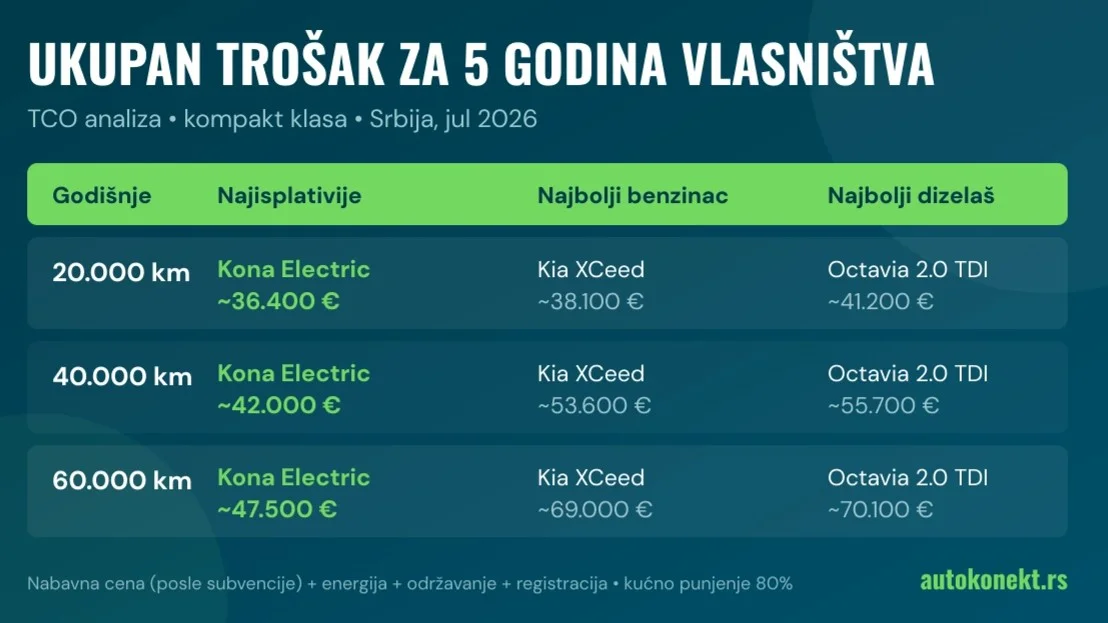
The table shows the total expenditure—the purchase price after subsidies, energy, maintenance and registration—over five years for three different annual mileage levels. The table is used as the main visual for the blog article.
The pattern is clear: the more the vehicle is driven, the more convincing the advantage of electricity becomes.
At 60,000 kilometres per year, the difference between the most cost-effective electric vehicle and the most expensive diesel model in the analysis exceeds €38,000 over five years. That is effectively the price of another new car.
Why Electric Vehicles Win in All Three Scenarios
Two factors work in favour of electric vehicles.
The first is the €5,000 subsidy, which largely eliminates the difference in purchase price between an electric vehicle and a comparable petrol-powered model.
The second, and even more important, factor is the cost of energy. With predominantly home charging, an electric car in our model costs approximately €0.03 per kilometre in electricity. A petrol car of a similar class costs approximately €0.11 per kilometre.
That is a difference of almost four times, multiplied by every kilometre driven.
Break-Even Point: Starting at Approximately 13,000 Kilometres per Year
The most interesting finding comes from comparing two vehicles from the same manufacturer and a similar class: the Škoda Octavia 1.5 TSI and the electric Škoda Elroq 50.
After the subsidy, the difference in their purchase prices is approximately €6,800. Once savings on energy, maintenance and registration are included, that difference is recovered over a five-year period at an annual mileage of approximately 13,000 kilometres.
That is less than the annual mileage covered by many drivers in Serbia.
Break-Even Point
With the current €5,000 subsidy, an electric model in the same class becomes more cost-effective than a petrol car from approximately 13,000 kilometres per year—provided that it is charged predominantly at home.
When Petrol Still Makes Sense
A petrol car remains a rational choice in two situations.
The first is low annual mileage below the break-even point mentioned above. In this case, the lower purchase price of an affordable model such as the Kia XCeed does not leave enough time for the higher fuel costs to offset the initial saving.
The second is the lack of access to home charging. A driver who would charge an electric vehicle exclusively at commercial public chargers loses most of the cost advantage offered by electricity.
Diesel: The End of an Era?
One result may surprise many readers: in our model, diesel does not win in any of the scenarios—not even at 60,000 kilometres per year, where it had been considered the undisputed choice for decades.
There are two main reasons. A litre of Euro Diesel currently costs RSD 24 more than petrol, while the maintenance of modern diesel engines—including components such as the DPF, EGR system and dual-mass flywheel—costs more per kilometre than maintaining a petrol engine.
Diesel still makes sense primarily for drivers who spend most of their time on motorways, where real-world consumption can fall significantly below the combined figure.
However, its universal reputation as the most economical option is no longer justified.
Plug-In Hybrid: The Mathematics Depends on the Charging Cable
The Toyota C-HR PHEV sits in the middle of our analysis, with one major condition: we assumed disciplined daily charging, allowing most urban journeys to be completed using electricity.
A driver who does not regularly charge a plug-in hybrid is effectively driving a heavier petrol car and losing the entire purpose of this type of powertrain.
A PHEV can be an excellent choice for drivers who want electric urban driving without worrying about range on longer journeys—but only if they have access to a charging socket in their garage or parking space.
Points to Consider: Assumptions and Limitations of the Analysis
Access to Home Charging Is Crucial
The entire cost argument in favour of electric vehicles is based on inexpensive overnight home charging. With exclusively commercial public charging at prices of €0.45/kWh or more, the energy cost of an electric vehicle begins to approach that of a diesel car.
Resale Value Is Not Included
The used electric vehicle market in Serbia is still relatively young and more difficult to predict than the market for petrol vehicles. For that reason, the model presents total expenditure rather than net cost after the vehicle is sold.
Subsidies Have a Limited Budget and Application Period
Applications are submitted to the Ministry of Environmental Protection between 1 March and 30 September, subject to the availability of funds.
Fuel Prices and Promotional Vehicle Prices Change
All figures in the analysis reflect market conditions in July 2026. Before making a purchase decision, buyers should check the latest official price lists published by vehicle importers.
Conclusion
The mathematics for 2026 is clearer than ever.
For most drivers in Serbia who have access to home charging, a compact-class electric vehicle is the most cost-effective choice—not only over a ten-year period, but within the first five years of ownership and at a completely typical annual mileage.
Petrol remains the preferred choice for low annual mileages and drivers without access to charging. Diesel is retreating into a narrow niche of predominantly motorway use, while plug-in hybrids reward only disciplined owners who charge them regularly.
Whichever powertrain you choose, the vehicle will still require regular maintenance. Trusted service partners can make the difference between a manageable expense and a major headache.
On the AutoKonekt platform, you can find verified repair shops, tyre service centres and vehicle inspection stations in your city. All locations are available at autokonekt.rs/lokacije.
Frequently Asked Questions
Is an Electric Car Worth It if I Drive Less Than 10,000 Kilometres per Year?
At such a low annual mileage, energy savings take longer to recover the difference in the purchase price. An affordable petrol car is therefore generally the more rational choice—unless a subsidy and promotional offer reduce the price difference to a minimum.
How Much Does It Cost to Charge an Electric Car at Home in Serbia?
When charging predominantly overnight at the lower tariff, we estimate the total cost, including all fees, at approximately RSD 7 per kilowatt-hour.
For an average compact electric vehicle, this corresponds to approximately €1.20 per 100 kilometres.
The exact amount depends on the household’s tariff zone and total monthly electricity consumption.
Is Diesel Still the Best Choice for High Annual Mileage?
According to our model, no.
With the current relationship between fuel prices and higher maintenance costs, diesel loses to both petrol and electricity even at 60,000 kilometres per year.
The main exception is drivers who predominantly travel on motorways, where real-world diesel consumption can fall significantly below the official combined figure.
What if I Do Not Have a Garage? Is an EV Still Worth It?
Without access to home or workplace charging, most of the cost advantage of electricity disappears.
Before making a decision, drivers should realistically estimate how much charging they would need to carry out at commercial public stations and at what price.
How Can I Apply for an Electric Vehicle Subsidy?
Applications are submitted to the Ministry of Environmental Protection between 1 March and 30 September, together with the invoice for a new vehicle.
The subsidy amounts to €5,000 for fully electric vehicles and €3,500 for plug-in hybrids. The available budget is limited, so buyers are advised to check the availability of funds before purchasing the vehicle.