
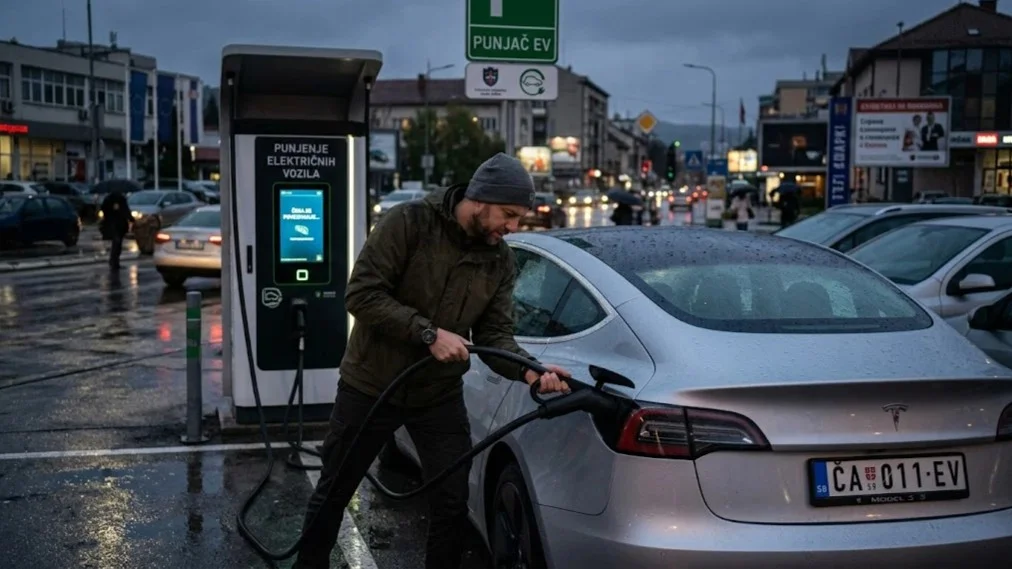
Electric car, plug-in hybrid, or mild hybrid: what are you actually driving and how should you charge it properly?
Vehicle electrification is no longer a topic of the future. Electric cars, plug-in hybrids, classic hybrids, and mild hybrids are increasingly common on the roads. The problem is that many drivers are still not sure what these labels actually mean, whether every “hybrid” vehicle is charged on a charger, and whether fast charging is harmful to the battery.
That is why it is important to start with the basics: not every car labeled as a hybrid is the same, just as not every electrified vehicle requires the same way of use, charging, and maintenance.
Electric car – a vehicle driven only by electricity
A fully electric car, often referred to as an EV or BEV, does not have a traditional internal combustion engine. It is powered by an electric motor, and its energy comes from a large battery that is charged at a home charger, public charger, fast charger, or ultra-fast charger.
In an electric car, there is no refueling, no engine oil change, no traditional exhaust system, clutch, or gearbox in the conventional sense. This does not mean the vehicle is “maintenance-free”, but rather that maintenance changes: the battery, braking system, tires, battery and electric motor cooling systems, software, and electronic systems become more important.
The greatest advantage of an electric car is quiet and smooth driving, low energy consumption in the city, and the possibility of charging at home. The biggest challenge is planning charging, especially on longer trips.
Plug-in hybrid – a car with two worlds
A plug-in hybrid, or PHEV, has both an internal combustion engine and an electric motor. However, unlike a regular hybrid, it has a larger battery that can be charged externally — from a socket, a wallbox charger, or a public AC charger.
In practice, this means that a plug-in hybrid can cover a certain number of kilometers using electricity only. When the battery is depleted, the vehicle continues to operate as a classic hybrid or as a car with a petrol engine, depending on the system.
A plug-in hybrid makes the most sense for drivers who cover shorter city or suburban routes every day and have the option of regular charging at home or at work. If a plug-in hybrid is not charged regularly, it loses a large part of its advantage: in that case, you are driving a more complex and often heavier vehicle, but without fully benefiting from electric driving.
Mild hybrid – it is not charged on a charger
A mild hybrid is the most common source of confusion. Many drivers hear the word “hybrid” and assume that the vehicle is charged from a socket. With a mild hybrid, this is not the case.
A mild hybrid has a small electric system that assists the internal combustion engine, most often when starting off, accelerating, or operating the start-stop system. However, a mild hybrid cannot drive on electricity alone and is not charged externally. Its battery is recharged while driving, most often through regenerative braking and engine operation.
In other words, a mild hybrid is primarily a more efficient version of a classic petrol or diesel vehicle, not an electric car.
The simplest difference
You drive an electric car exclusively on electricity, and you have to charge it.
A plug-in hybrid can be driven on electricity, but it also has a conventional engine. To make sense, it needs to be charged regularly.
A mild hybrid is not charged from a socket and cannot drive independently on electricity. The electric system only assists the conventional engine.
This difference is important not only when buying a vehicle, but also because of costs, usage habits, and maintenance.
Fast or slow charger – what is healthier for the battery?
The most common question asked by electric car drivers is: does frequent fast charging damage the battery?
The short answer is: for everyday use, slower AC charging is better, while fast DC charging should be used when necessary — on a trip, when you are in a hurry, or when you have no other option.
Batteries in modern electric vehicles have advanced protection systems. The vehicle itself controls the battery temperature, charging speed, and permitted voltage. That is why occasional fast charging is not a problem. A problem may arise if the vehicle is almost always charged on powerful DC chargers, especially at high temperatures, and from a very low or very high battery percentage.
Fast charging generates more heat and puts more stress on the battery than slow charging. This does not mean it should be avoided at all costs, but rather that it should be used wisely.
For everyday driving, the ideal scenario is home or workplace AC charging, most often overnight or while the vehicle is parked for several hours. Fast chargers are best for trips and situations where time is more important than ideal battery care.
Should the battery always be charged to 100%?
For most electric cars in everyday use, it is recommended that the battery stays approximately between 20% and 80%. This is the range in which the battery is under less stress and usually charges most efficiently.
Charging to 100% makes sense when you are going on a longer trip and need maximum range. But if you drive 30, 50, or 80 kilometers every day, there is no need to fully charge the vehicle every night.
In some models, especially those with LFP batteries, manufacturers may recommend occasional or regular charging to 100%, due to system calibration and the specific battery chemistry. That is why it is most important to check the manufacturer’s recommendation for the specific model.
The general rule is: do not worry too much, but do not constantly charge to 100% if you do not need to.
Home charging – can it be done from a regular socket?
Technically, many electric and plug-in hybrid vehicles can be charged from a regular household socket, using the appropriate cable with built-in protective electronics. But this does not mean that every household socket is suitable for long overnight charging.
Charging a car is not the same as charging a phone. An electric vehicle can draw a constant high load for hours. If the electrical installation is old, the socket is poor, the wires are too thin, the connection is unsafe, or an extension cable is used, the risk of overheating and overload is real.
That is why a regular socket can be used as a temporary or slower solution, especially for plug-in hybrids and smaller daily battery top-ups. However, for regular home charging of an electric car, a dedicated home charger, or wallbox, is a better solution.
What should be provided before home charging?
Before you start regularly charging an electric car at home, it is advisable to have an electrician check the installation. In particular, the condition of the cables, fuses, grounding, socket, phase load, and total available household power should be checked.
Ideally, the charger should have a dedicated electrical circuit, appropriate protection, and a properly dimensioned cable. With more powerful chargers, it is also necessary to check whether the household has enough approved power and whether a single-phase or three-phase connection is suitable for the desired charging method.
A wallbox is not only about speed. It provides greater safety, more stable charging, the ability to adjust charging power, charging schedule options for cheaper electricity tariffs, and better control of the load on the electrical installation.
How fast is home charging?
Charging speed depends on three things: the power of the charger, the capability of the vehicle, and the electrical installation.
A regular socket is the slowest solution. It is sufficient for lower daily mileage or a plug-in hybrid, but with a fully electric car, charging can take a very long time.
A home wallbox of around 7 kW is often more than enough for most users, because the vehicle is charged overnight. An 11 kW three-phase wallbox can be even more practical if both the vehicle and the installation support it. Chargers of 22 kW require additional conditions, and not all vehicles can fully use them.
That is why the fastest solution is not always the most rational one. For most drivers, the most important thing is that the car receives enough charge overnight for the next day.
How should an electric car be used properly?
Best practice is simple.
For everyday driving, charge more slowly, most often at home or at work. Do not always wait for the battery to drop to a minimum. You do not have to charge it to 100% all the time. Use fast chargers when you travel or when you really need a quick top-up.
If you drive a plug-in hybrid
Charge it regularly. Otherwise, you are not using its greatest potential.
If you drive a mild hybrid
Do not look for a socket — this vehicle is not charged externally, but only uses the electric system to assist the conventional engine.
What does AutoKonekt advise drivers?
Electrified vehicles bring a new logic of car ownership and use. It is no longer enough to think only about fuel consumption, oil changes, and regular servicing. Now it is necessary to understand the battery, charging method, condition of the electrical installation, software settings, and manufacturer recommendations.
Before buying a used electric or plug-in hybrid vehicle, it is especially important to check the condition of the battery, service history, previous usage habits, charging cables, and compatibility with home charging.
AutoKonekt helps drivers more easily find reliable service providers, expert inspections, and services that match their specific vehicle — whether they drive a classic car, a hybrid, a plug-in hybrid, or a fully electric vehicle.
An electric car is not complicated when you know the rules. And the most important rule is simple: do not adapt your life to the car — choose a charging and maintenance method that suits your actual driving habits.