
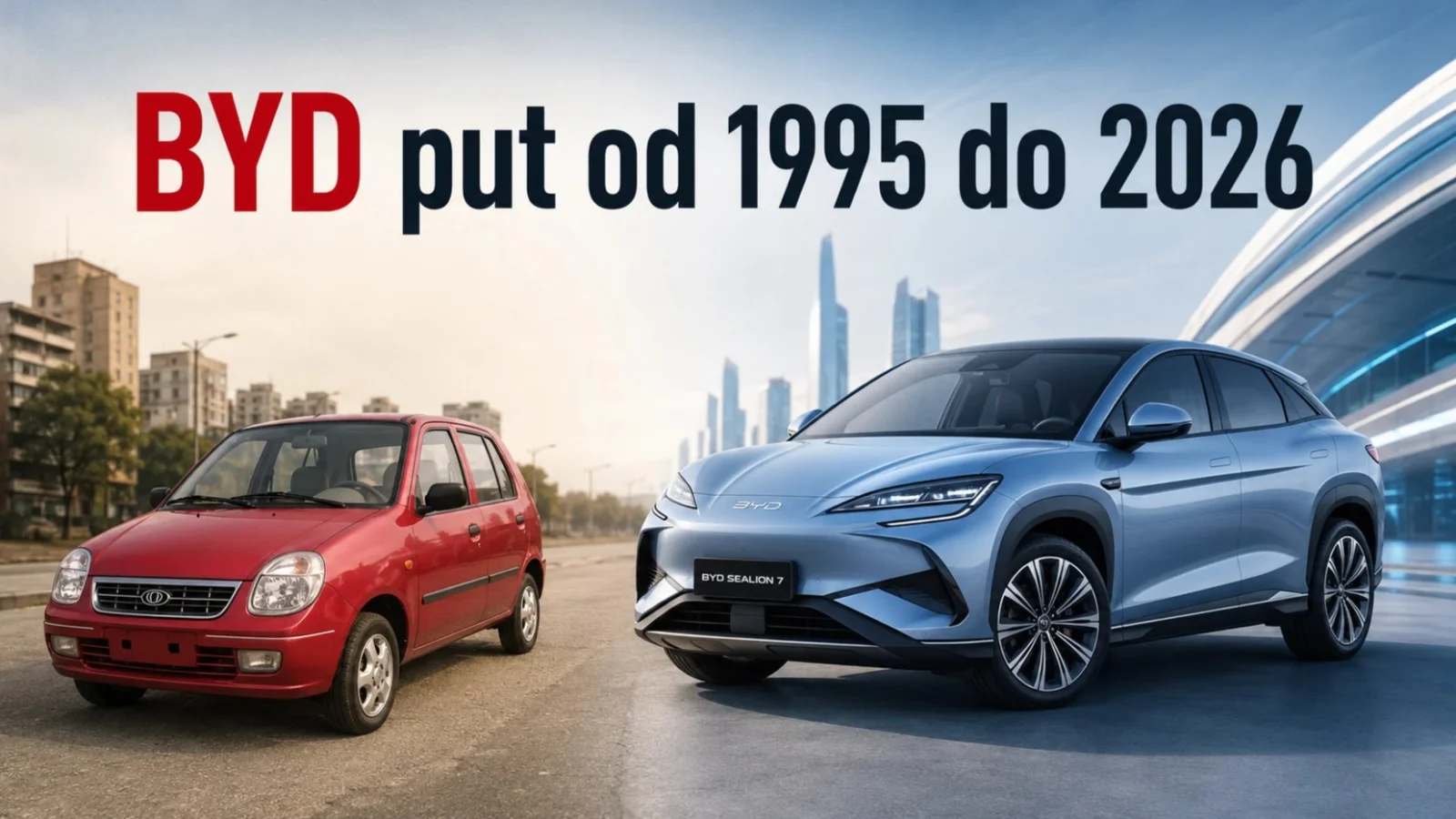
BYD: From Batteries to Cars That Are Changing the Rules of the Game
In the first two months of 2026, BYD more than tripled its sales in the European Union — from 10,491 to 29,291 registered vehicles — while its market share jumped from 0.7% to 1.8% in just one year. By May, it had become the leading electric vehicle brand in the United Kingdom, overtaking Tesla, BMW, and Volkswagen. This is no longer a story about yet another Chinese manufacturer trying to enter the European market — this is the story of a brand that is already conquering it.
But to understand why BYD matters, it is not enough to see it simply as another car manufacturer. The story of BYD does not begin with cars. It begins with batteries.
From Batteries to Cars
BYD was founded in 1995 in Shenzhen, one of China’s most important technology hubs, by engineer Wang Chuanfu, who started the company with only 20 employees. The company’s name comes from the phrase “Build Your Dreams.” Wang is still the chairman and the largest individual shareholder of BYD, although the company has been a publicly listed joint-stock company since 2002, listed on the Hong Kong and Shenzhen stock exchanges.
The company started with rechargeable batteries, not cars — and that is the key difference compared to traditional manufacturers. While Volkswagen, Toyota, or Mercedes spent decades building their expertise around internal combustion engines and gearboxes, BYD grew out of the world of batteries, electronics, and energy. It entered automobile production in the early 2000s, at a time when most of the industry still viewed electric vehicles as a distant future. The advantage BYD had was its understanding of what is now the heart of every electric vehicle — the battery. Range, price, weight, safety, and the long-term value of the car all depend on it.
One interesting fact says a lot about the confidence in this strategy: in 2008, Warren Buffett, through Berkshire Hathaway, invested $232 million for a 10% stake in BYD — at a time when the company was known to the world almost exclusively for batteries, not cars. Today, BYD is larger than Tesla by the number of electric vehicles sold globally, and Buffett’s bet has proven to be one of the best of his career.
More Than an Automotive Brand
Today, BYD operates in four areas: automobiles, including passenger vehicles, plug-in hybrids, buses, and trucks; batteries, including its own Blade Battery technology; electronics and new energy, including energy storage and energy infrastructure; as well as urban and rail transport, including SkyRail and SkyShuttle. The company now has more than 650,000 employees worldwide and more than 30 industrial parks, including facilities in Hungary, Brazil, India, and Japan.
Another interesting fact: BYD was the first major global car manufacturer to completely stop producing vehicles powered only by petrol or diesel engines — and it did so back in 2022, while Volkswagen, Toyota, and other giants were still announcing their plans for the transition to electric vehicles.
On the market, BYD vehicles are divided into two groups: fully electric vehicles, powered exclusively by an electric motor supplied by a battery, and plug-in hybrids, which BYD labels as DM-i, combining an electric motor with a conventional engine. It is precisely this combination that has enabled BYD to expand rapidly — plug-in hybrids are an excellent transitional solution in markets where charging infrastructure is still developing, including the Balkan region.
BYD Is Arriving in the Neighbourhood
BYD is also officially present in Serbia — TDV Automotive is the general importer and distributor for Serbia and Montenegro, with a showroom in Belgrade. But what makes this story even more relevant is that BYD is building its first European passenger car factory in Szeged, Hungary — practically on Vojvodina’s doorstep. Series production there is set to begin at the end of 2026.
This means that BYD vehicles will soon not only be arriving on our market — they will start being produced in our neighbourhood. For drivers, this is a signal that this brand is not here for the short term.
What This Means for Drivers and Service Providers
For drivers, BYD and similar brands raise questions of price, trust, and maintenance. An electric car has fewer traditional service points — there is no engine oil change and no exhaust system — but that does not mean there is no maintenance. The battery, its cooling system, brakes affected by regenerative braking, tyres under greater load, and software systems are becoming the new points of attention.
For service providers, the message is even clearer: the future of maintenance will not look like the past. Working with high-voltage systems, battery diagnostics, ADAS calibration, and understanding plug-in hybrid drivetrains are becoming part of regular work, not an exception. Servicing is no longer just a mechanical trade — it is becoming a combination of mechanics, electronics, and software.
Where AutoKonekt Fits In
For drivers, it will become increasingly difficult to assess on their own which service provider truly understands their vehicle — maintaining an older petrol car, a modern diesel, a plug-in hybrid, or a fully electric vehicle is not the same thing. For service providers, on the other hand, it will become increasingly important to clearly show what they know and which types of vehicles they are equipped to service.
That is exactly the space where AutoKonekt makes a difference: it connects drivers with service providers who are genuinely ready for their vehicle, instead of leaving that choice to chance.
Driving a BYD, another Chinese model, or any hybrid/electric vehicle?
Find a service provider on AutoKonekt that knows how to work with new technologies — before you actually need one.