The Yellow Teapot That Changed Formula 1: How Renault Went from Ridicule to a Turbo Revolution
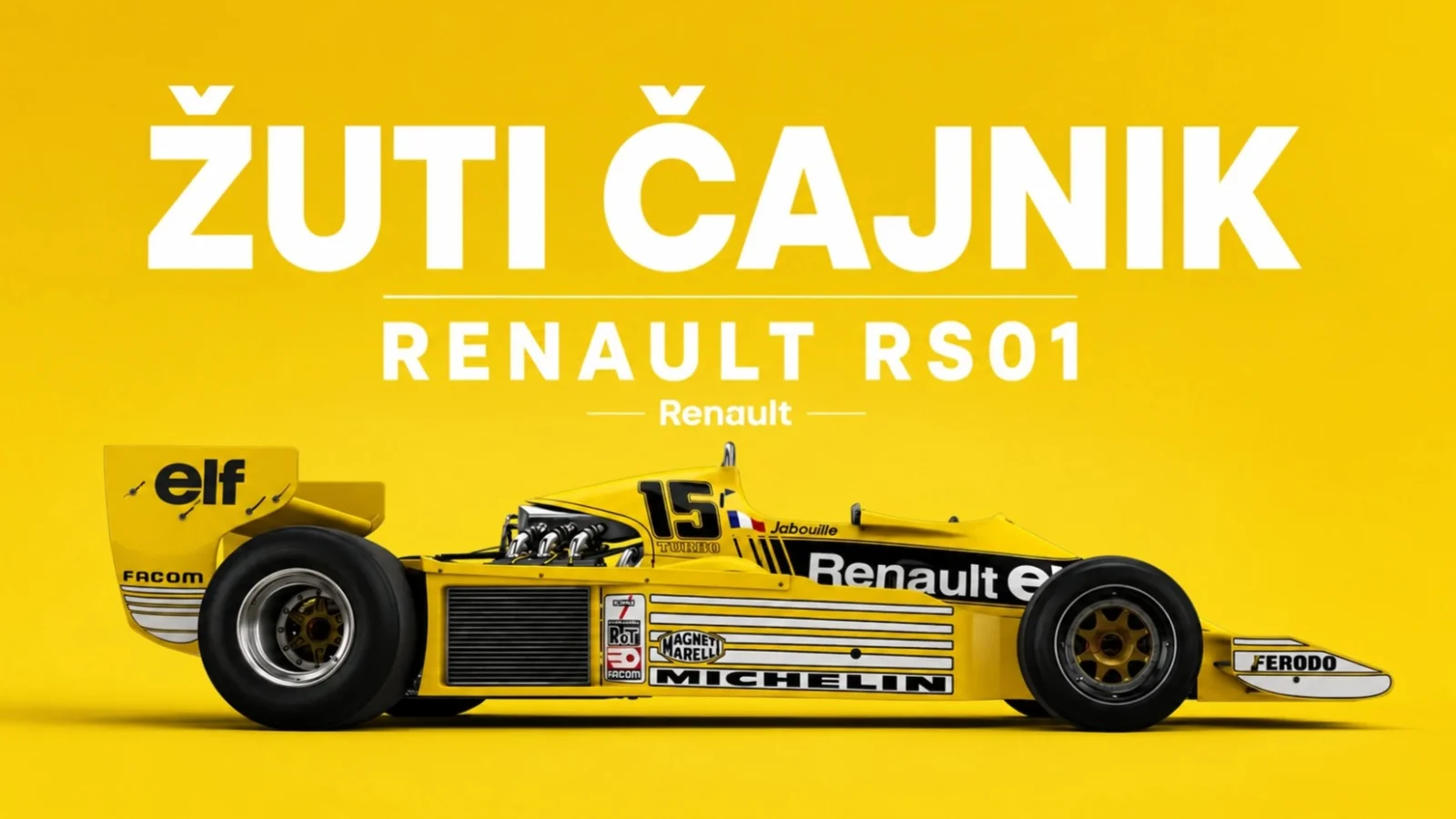
A car that hardly looked like the certain future of Formula 1 appeared on the grid for the British Grand Prix on 16 July 1977. The yellow Renault RS01 lined up with a small 1.5-litre turbocharged engine against rivals powered by large naturally aspirated units. After only 16 laps, it retired with a turbo failure. In the races that followed, mechanical problems and smoke often brought it to a halt. The paddock nicknamed it the “Yellow Teapot”. Two years later, the idea that many had mocked won a Formula 1 race.
Important note
The Renault RS01 was the first turbocharged car in Formula 1 history and the machine nicknamed the “Yellow Teapot”. However, the RS01 did not win a race. The first turbo victory was achieved by its successor, the Renault RS10, driven by Jean-Pierre Jabouille at Dijon in 1979.
A rule that existed, but no one used
Formula 1 in the 1970s was a world of large naturally aspirated engines. The conventional solutions displaced up to three litres and usually had eight or twelve cylinders. The regulations, however, allowed another option: a forced-induction engine with a maximum capacity of 1.5 litres.
For a long time, that option looked like little more than a theoretical footnote. A smaller turbocharged engine could produce enormous power, but it also created serious problems: high temperatures, extreme pressures, more complex mixture management and pronounced lag between pressing the throttle and receiving full power. In a racing car, where the driver must meter the throttle precisely when exiting a corner, that delay was not merely inconvenient — it could change the entire driving technique.
Renault nevertheless saw an opportunity. By the early 1970s, the company had already been testing turbo technology in rallying and endurance racing. Rather than entering Formula 1 with a solution everyone understood, it decided to attempt something no one had done before.
From secret tests to Renault’s first Formula 1 car
Development did not happen overnight. According to Renault’s official history, the first 1,500 cm³ V6 turbo engine was fired up on a test bench at Viry-Châtillon on 23 July 1975. During the same year, different versions of the engine were tested in a sports prototype, far from the attention that a proper Formula 1 car would have attracted.
Construction of the RS01 chassis began on 3 January 1977, and the car was officially presented in Paris on 10 May. Two months later came Silverstone and Renault’s first appearance in the Formula 1 World Championship.
The technical figures still sound bold today: the engine displaced 1,492 cm³, had six cylinders in a V configuration and, according to Renault’s The Originals museum, produced around 525 hp at 10,500 rpm. Power alone, however, was not enough. The first task was to deliver that power at the right moment — and to keep the car running all the way to the finish.
Renault RS01 — key facts
Formula 1 debut: British Grand Prix, Silverstone, 16 July 1977.
Engine: Renault V6 turbo, 1,492 cm³.
Output stated in Renault’s museum documentation: approximately 525 hp at 10,500 rpm.
Driver on debut: Jean-Pierre Jabouille.
Historical significance: the first turbocharged car to compete in a Formula 1 World Championship race.
Silverstone 1977: a future that lasted 16 laps
Jabouille started his debut race from 21st on the grid. Renault could not realistically have expected to fight for victory that weekend; the car was a mobile development laboratory, exposed in front of packed grandstands and the most experienced teams in the world.
After 16 laps, the turbo failed and the RS01 stopped. In terms of the result, it was a failure, but Renault had already achieved something important: it had shown that a 1.5-litre turbocharged engine was a serious enough idea to take its place on a Grand Prix starting grid.
The problem was that the next step — finishing a race, scoring points and proving the car’s speed — took far longer than the public was prepared to wait without ridicule.
How the “Yellow Teapot” nickname was born
The RS01 was painted in the distinctive yellow colours of Renault and its partner Elf. When the engine or turbo system failed, the car would often be left beside the track in a cloud of smoke. Renault’s official museum documentation states that these frequent failures and the smoke gave rise to the nickname “Yellow Teapot”.
The nickname was witty, but far from harmless. In Formula 1, reputations are built in front of rivals, sponsors and millions of viewers. Every failure looked like confirmation that Renault had chosen the wrong path.
Yet behind the smoke, development was taking place that was not always visible from the outside. The engineers were learning how to control temperature and pressure, improve engine response and turn turbo technology from a brief surge of power into something a driver could use throughout an entire race.
First points: a sign the joke was no longer entirely harmless
The failures did not disappear in 1978, but the results began to change. At the United States Grand Prix at Watkins Glen, Jabouille finished fourth. These were Renault’s first points in Formula 1 — and the first points ever scored by a turbocharged Formula 1 car.
Fourth place did not sound revolutionary, but it changed the tone of the story. The RS01 was no longer merely an interesting experiment smoking beside the track. It had shown that it could run with the best and finish high enough to score points.
Kyalami 1979: the fastest car that once again failed to finish
The real signal came in South Africa on 3 March 1979. In qualifying at Kyalami, Jean-Pierre Jabouille took pole position with a time of 1:11.800. For the first time, Renault’s turbo car was the fastest in an official Formula 1 qualifying session.
Yet once again, it did not finish the race. That weekend perfectly described Renault’s position: the concept already had the speed to take first place, but it still lacked the reliability needed to turn that speed into victory.
For the opposition, this was an important message. The car they had mocked was no longer slow and unreliable. It was fast and unreliable — and that is a much easier problem to solve than a lack of fundamental potential.
RS10: two smaller turbos instead of one large unit
During 1979, Renault made a crucial step by replacing one large turbocharger with two smaller units. The new car was designated RS10. The aim was not simply to increase power, but to improve response — reducing the delay between the driver’s command and the arrival of boost pressure.
Renault’s documentation states that the switch to twin turbos at Monaco represented tangible progress. The solution still demanded a great deal from the driver, but the car was becoming more usable, more predictable and a far more serious contender for victory.
It is therefore important to distinguish between the two cars. The RS01 opened the door, suffered the failures and earned the nickname. The RS10 took the idea, developed it and turned it into a winning package.
Dijon, 1 July 1979: the day the teapot stopped being a joke
The 1979 French Grand Prix was held at Dijon-Prenois. Renault arrived at its home race with two cars. Jabouille took pole position in qualifying, while his teammate René Arnoux qualified second. The yellow cars, once the subject of jokes, occupied the entire front row.
In the race, Jabouille achieved exactly what the project had been created to do: he won. After 80 laps, Renault recorded its first Formula 1 victory, while the turbocharged engine claimed its first win in the history of the championship.
Ironically, the victory itself is often overshadowed by what happened behind Jabouille. Arnoux and Ferrari’s Gilles Villeneuve fought a famous, extraordinarily close battle for second place, with repeated overtaking moves and contact in the closing laps. Villeneuve eventually finished second and Arnoux third. Formula 1 still regards their duel as one of the defining stories of the race.
But the most historically significant result was at the front: the turbocharged car was no longer an experiment. It was a winner.
Dijon 1979 — the result that changed perceptions
Pole position: Jean-Pierre Jabouille, Renault, 1:07.190.
Race winner: Jean-Pierre Jabouille, Renault, 80 laps.
Second place: Gilles Villeneuve, Ferrari.
Third place: René Arnoux, Renault.
Historical significance: Renault’s first Grand Prix victory and the first Formula 1 victory for a turbocharged engine.
Why the “Yellow Teapot” really changed Formula 1
Renault did not invent the turbocharger, nor was it the first manufacturer to use one in motor racing. Its historic contribution was different: the company proved that turbocharging could work in the most demanding category of single-seater racing, under the rules and at the pace of Formula 1.
After Dijon, turbocharging could no longer be dismissed as an unserious alternative. In the years that followed, the technology became a central focus of Formula 1 development and eventually the standard for the leading manufacturers and teams of that era.
The most important part of the story is therefore not the victory itself. It is the journey from a car that could not finish its debut race to a technology that rivals were forced to take seriously. Renault paid for development through very public failures, but in return it changed the direction of the entire sport.
From the racetrack to everyday cars
Renault soon transferred the turbo story to production cars. Less than two years after its first Formula 1 victory, it introduced the Renault 18 Turbo, the brand’s first turbocharged production model. It was followed by cars such as the Renault 5 Alpine Turbo, Fuego Turbo, Renault 11 Turbo, Renault 9 Turbo and, later, the Renault 21 2L Turbo.
A road car is not a Formula 1 car, of course, and development does not work by directly transferring parts from a racing machine to a family saloon. What transfers is experience: knowledge of temperature, lubrication, pressure, response and power control. Racing accelerates learning, after which the solutions are adapted to the reliability, comfort, emissions and cost requirements of everyday use.
Today, turbochargers are common in petrol and diesel engines across many vehicle classes. It is hard to believe that a technology which now seems completely ordinary once looked so unusual in Formula 1 that a car was nicknamed after a kitchen appliance.
Reliability does not appear overnight — it is developed
The story of the RS01 is particularly interesting because it challenges the simple division between a “reliable” and an “unreliable” car. Renault’s first turbo Formula 1 car genuinely was unreliable. That is neither a myth nor a marketing-sanitised version of events. But its unreliability was the starting phase in the development of an entirely new concept, not the final verdict on the technology itself.
Every failure revealed the next weak point. Every race produced data that a test bench could not fully simulate. As the problems of response and durability were gradually brought under control, the same fundamental idea demonstrated why Renault had believed in it.
That may be the most important lesson of the “Yellow Teapot”: innovation is not always recognised because it works perfectly from the start. Sometimes it is recognised because its potential survives even when the early results are poor enough to make most people give up.
From ridicule to the standard
Looking at the Renault RS01 today, it is easy to see only a charming historical episode: a yellow car, smoke and a nickname that has endured for almost half a century. Behind that image, however, lies a serious engineering story about risk, persistence and learning in public.
The RS01 never won. Its greatest achievement was making it possible for the RS10 to win. And the RS10 did not merely bring Renault a trophy — it proved that the future of Formula 1 could look completely different from everything that had previously been considered normal.
The “Yellow Teapot” is therefore not the story of a failed car. It is the story of a car that had to look like a failure before its idea could become a winner.
AutoKonekt tip
Turbo technology has progressed from experiment to everyday reality, but modern turbocharged engines still depend on the correct oil, an appropriate service interval and expert diagnostics. Follow the manufacturer’s maintenance schedule and plan an appointment with a trusted service centre through AutoKonekt.
Frequently asked questions
Why was the Renault RS01 nicknamed the “Yellow Teapot”?
Because of frequent engine and turbo-system failures during 1977 and 1978. When the yellow car retired in a cloud of smoke, the scene resembled a teapot releasing steam, so the paddock nicknamed it the “Yellow Teapot”.
Did the Renault RS01 win a Formula 1 race?
No. The RS01 did not win a Grand Prix. Its successor, the Renault RS10, delivered the first victory for a turbocharged engine in Formula 1 at the French Grand Prix in Dijon on 1 July 1979.
Who drove Renault’s first turbo Formula 1 car?
Jean-Pierre Jabouille drove the Renault RS01 on its debut at Silverstone in 1977 and played a crucial role during the project’s first seasons. He then won at Dijon in 1979 behind the wheel of the RS10.
What engine did the Renault RS01 use?
The RS01 used a 1,492 cm³ Renault V6 turbo engine. Renault’s The Originals museum lists an output of approximately 525 hp at 10,500 rpm.
Why was the victory at Dijon in 1979 so important?
It was Renault’s first Formula 1 victory and the first win for a turbocharged engine in the history of the Formula 1 World Championship. The result proved that a small forced-induction engine could defeat large naturally aspirated engines.
Did Renault transfer turbo technology to production cars?
Yes. Less than two years after the first Formula 1 turbo victory, Renault introduced the Renault 18 Turbo, followed by a range of other turbo models including the Renault 5 Alpine Turbo, Fuego Turbo and Renault 21 2L Turbo.
Sources and fact-checking
The article was prepared using official sources from Renault Group, the Renault The Originals museum, Formula 1 and Michelin Motorsport. It does not claim that the RS01 won: the official results confirm that the victory was achieved by its successor, the RS10.
Renault The Originals — Renault RS01 — the “Yellow Teapot” nickname, technical specifications, first points and the historical role of the RS01
Renault The Originals — Renault RS10 — twin turbos, reduced response lag and the victory at Dijon
Renault Group — From the track to the road — the transfer of turbo technology from motorsport to production models
Renault Group Media — 40 years of Renault in Formula 1 — engine-development dates, the start of RS01 construction and the car’s presentation
Renault Group Media — Renault’s 40 years in F1 — the 1977 debut, first points in 1978, twin turbos and the 1979 victory
Formula 1 — 1977 British Grand Prix race result — the Silverstone debut and retirement after 16 laps
Formula 1 — 1979 South African Grand Prix starting grid — Jabouille’s pole position at Kyalami
Formula 1 — 1979 French Grand Prix starting grid — Renault’s front-row lockout and Jabouille’s pole position
Formula 1 — 1979 French Grand Prix race result — Jabouille’s victory on 1 July 1979
Formula 1 — history of the French Grand Prix — the historic significance of Renault’s first victory and the first turbo victory, as well as the Arnoux–Villeneuve duel
Michelin Motorsport — Michelin’s first Formula 1 world titles — Renault’s victory at Dijon on Michelin tyres