
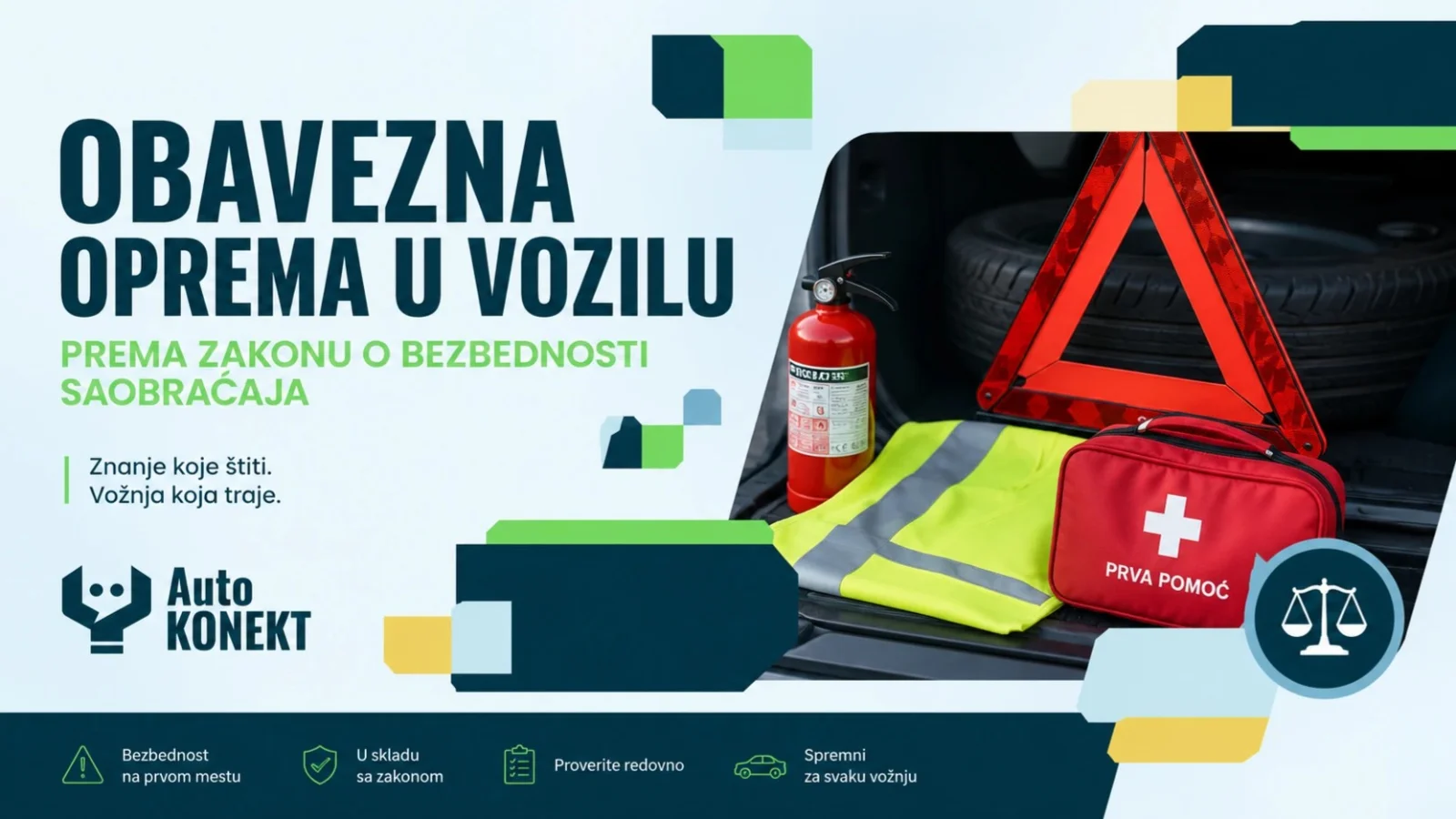
Mandatory Car Equipment in Serbia — and What Changes Once You Cross the Border
Mandatory equipment is one of the few legal obligations that is rarely checked in practice — right up until something happens that makes it get checked. By then it's too late to discover that your first aid kit expired three years ago, or that your hi-vis vest is buried under two suitcases in the boot.
Another part of the problem is that more misinformation circulates around this topic than around any other traffic obligation. Half of what you'll read on local websites refers to rules that were repealed years ago. In this article we separate what the law actually requires, what it doesn't require despite many claiming otherwise, and what changes the moment you cross the border.
What Serbian law prescribes as mandatory equipment
Mandatory equipment is governed by the Road Traffic Safety Act (Zakon o bezbednosti saobraćaja na putevima) and the Rulebook on the Classification of Motor and Trailer Vehicles and Technical Requirements for Vehicles in Road Traffic. For a passenger car (category M1) not used for public passenger transport, the list looks like this:
A warning triangle compliant with uniform technical requirements.
A size "B" first aid kit, in line with the SRPS Z.B2.001 standard, within its valid use-by date.
A hi-vis (reflective) vest compliant with the SRPS EN 471 standard, which must be kept in the cabin — within arm's reach, not in the boot.
A spare wheel of the same dimensions and load rating, or a means of temporary tyre repair (spray, foam, puncture repair kit). Vehicles with run-flat tyres are not required to carry a spare wheel.
A tow rope or tow bar — the rope must allow towing at a distance of 3 to 5 metres, the bar up to 3 metres. The requirement applies to passenger cars manufactured or first registered after 1 January 1984.
Winter equipment, during the period and under the conditions described below.
In addition, you should keep a European Accident Statement form in the vehicle. Formally it is not part of the vehicle's mandatory equipment but a document you need in the event of a minor accident — you can obtain it free of charge from your insurance company.
Three misconceptions that keep coming back
A fire extinguisher is not mandatory in a passenger car. The Rulebook requires one for vehicles used for public passenger transport, for goods vehicles and for buses — but not for a private passenger car. It is still sensible to carry one, and you will need it as soon as you head south (North Macedonia, Bulgaria, Greece, Romania), but for driving within Serbia the law does not require it.
Spare bulbs are no longer mandatory. They used to be, but the requirement was abolished because on a large number of newer cars a bulb cannot be replaced without a visit to a workshop. If you drive an older car with halogen lights, a set of bulbs and fuses is still a reasonable thing to keep in the boot — it is simply no longer a legal obligation.
A vest in the boot is the same as no vest at all. The point of the vest is to put it on before you step out of the vehicle onto the carriageway. If you have to get out, walk around the car and open the boot to find it, you have already spent the most dangerous ten seconds unmarked. The vest belongs in the door pocket or under the seat.
Winter equipment: what exactly applies from 1 November to 1 April
This is the part most often misinterpreted. The obligation is not calendar-based but conditional: between 1 November and 1 April, a vehicle must be fitted with winter equipment if weather conditions have left snow, ice or black ice on the carriageway. If the asphalt is dry, winter tyres are not a legal requirement during that period — which does not mean they are unnecessary.
Winter tyres (M+S, Snow, Winter and similar) on all wheels, with a tread depth of at least 4 mm.
Snow chains or other traction devices on at least two driven wheels. Within built-up areas, vehicles are not required to carry chains.
Studded tyres are not permitted.
One difference from parts of Europe is worth knowing: in Serbia the M+S marking is still recognised as a winter tyre, while some EU countries require the 3PMSF marking (the snowflake-in-mountain symbol). If you are travelling in winter, check which standard applies in your destination country.
Missing winter equipment under conditions where it is prescribed is treated as a technical defect of the vehicle. For individuals, the fine ranges from RSD 6,000 to RSD 20,000.
What the fines actually cost
The fine for a missing hi-vis vest is RSD 3,000. Missing winter equipment, when it is mandatory, falls into the technical-defect category — RSD 6,000 to RSD 20,000 for individuals, with the possibility of the vehicle being taken off the road.
If you have read a headline somewhere about a RSD 50,000 fine for mandatory equipment, two different things are being conflated. That amount relates to offences concerning conduct following a traffic accident, not to a triangle or a first aid kit in the boot. The distinction matters, because headlines like that create a false picture of what the police actually check.
Documents you need before crossing the border
Green Card. Since 2012 Serbia has participated in the registration-plate recognition system, so a Green Card is not required for European Union and European Economic Area countries. It is also not required for Montenegro, nor — since October 2020 — for Bosnia and Herzegovina. In the region it is still mandatory for North Macedonia and Albania — a detail that catches out a large number of drivers heading to Greece every summer.
International Driving Permit. Not required for countries in the region or for most of Europe; a valid Serbian driving licence is sufficient. Exceptions do exist, so for longer journeys it is wise to check before setting off.
Authorisation to drive someone else's vehicle. If the car is not registered in your name, you need a certified authorisation from the owner or a permit issued by AMSS (Auto-Moto Association of Serbia), valid for one year. Nobody is likely to ask for it at the border — but in the event of an accident, breakdown or theft abroad, the process becomes considerably more complicated without that document.
Country-specific requirements in the region
The basic rule: the equipment you carry from Serbia covers most requirements across the region. The differences come down to a few items — fire extinguisher, spare bulbs, Green Card and winter equipment rules. The table below covers the countries drivers from Serbia most often pass through.
Fire extinguisher — required in Bulgaria, North Macedonia, Greece and Romania; in Bosnia and Herzegovina only for LPG- and CNG-powered vehicles.
Green Card — only in North Macedonia.
Electronic vignette — in Bulgaria, also required for the main-road network.
Rovinieta — in Romania, required on all roads outside built-up areas.
First aid kit — strictly enforced in Austria and Greece.
The information is accurate as of the date of publication. Regulations change, and some countries apply rules differently to domestic and foreign vehicles. Before travelling, check the current situation with AMSS on 1987 or with the national automobile association of the country you are passing through.
One practical note: in most neighbouring countries you are expected to drive with dipped headlights on during the day as well. The rules vary by season and by country, so the simplest solution is to keep your lights on for the entire journey.
Pre-departure check: five minutes that pay off
Open the first aid kit and check the expiry date — the most common reason for a fine is not a missing kit but an expired one.
Move the hi-vis vest from the boot into the cabin.
Check the pressure in the spare wheel or the expiry date of the puncture repair spray.
If you carry a fire extinguisher, check whether its valid proof of serviceability has expired.
Measure your tyre tread depth — 4 mm is the threshold for winter use, not the 1.6 mm that applies as the absolute minimum.
Frequently asked questions
Do I have to carry a fire extinguisher in my car in Serbia?
No, not if it is a passenger car not used for public passenger transport. It is mandatory for goods vehicles, buses and public transport vehicles. It is recommended for everyone, and it becomes an obligation as soon as you enter North Macedonia, Bulgaria, Greece or Romania.
Are winter tyres mandatory throughout the winter period?
Not automatically. From 1 November to 1 April they are mandatory when there is snow, ice or black ice on the carriageway. From a safety standpoint, switching to winter tyres makes sense as soon as the temperature drops below seven degrees, regardless of what the law says.
Do I need a Green Card for Greece?
Not for Greece itself. But if you travel to Greece via North Macedonia — the most common route — you need a Green Card for transit through North Macedonia.
What if I don't have a spare wheel because my car didn't come with one?
That is fine, provided you carry a means of temporary tyre repair in the vehicle — a spray, pressurised foam or a puncture repair kit — or the vehicle uses run-flat tyres.
Is mandatory equipment checked at the roadworthiness test?
Yes, mandatory equipment is part of the inspection. Practice varies from station to station, but an expired first aid kit and worn tyres are among the most common reasons for a remark.
Check your equipment before someone else checks it for you. Through AutoKonekt you can book an appointment online at a roadworthiness testing station, a tyre service or a car workshop in your city — with verified partners, and with services and available times clearly displayed.
Book your appointment at autokonekt.rs