A car battery doesn’t die because of the cold. It fails much earlier — the cold simply reveals it.
The scenario is always the same.
Yesterday, the car started without any problems. This morning, it is minus three degrees, you turn the key, the engine cranks slowly — and stops.
The driver concludes that the cold killed the battery. That is the wrong conclusion, and it is why the same thing happens every winter.
The battery became weak much earlier. A cold morning is simply the first moment when it becomes noticeable.
Why does the problem always appear on the first cold morning?
Because two things happen at the same time, and both work against the battery.
• The battery can deliver less power. The chemical reaction inside a lead-acid battery slows down as the temperature drops. At around 0°C, available power falls by roughly one fifth to one third, while at −18°C it can drop to around half of the rated value.
• The engine needs more power. Engine oil thickens in cold weather, so considerably more current is required to turn the crankshaft than in July.
The curves move in opposite directions
On the coldest morning of the year, the engine requires the most current precisely when the battery is capable of delivering the least. That is why batteries practically never fail in July — not because they are necessarily healthy, but because the task is easier.
The real culprit is summer
This is the part that surprises many drivers. Most battery damage occurs in hot weather, not in cold weather.
Temperatures under the bonnet during summer are significantly higher than the outside temperature. Under these conditions, water in the electrolyte evaporates, the acid concentration increases, and the lead plates become more exposed. Grid corrosion and sulphation — the build-up of lead sulphate on the plates — accelerate.
The key difference is that this damage is irreversible. Adding water to batteries that allow topping up does not restore lost capacity. A battery that has survived a very hot summer may have aged faster than the calendar suggests.
None of this happens because of winter itself. Cold weather does not damage the battery — it simply creates a demand that a weakened battery can no longer meet.
Heat causes the damage. Cold weather simply reveals it.
Warning signs drivers regularly overlook
A battery almost never fails without warning. The warning signs can last for days or weeks, but they are subtle.
• Slow cranking when starting — the engine turns noticeably more slowly than usual, especially during the first start in the morning
• Dimmed lights during starting — the headlights and dashboard lighting become noticeably dimmer while you turn the key
• Clicking without starting — instead of the engine turning over, you hear a rapid clicking sound from the engine compartment
• Electronic systems reset — the clock, radio presets or other settings return to their factory defaults
• Deposits on the terminals — white or greenish deposits on the battery terminals reduce electrical conductivity
• Deformed battery casing — bulging sides indicate overheating and require immediate battery replacement
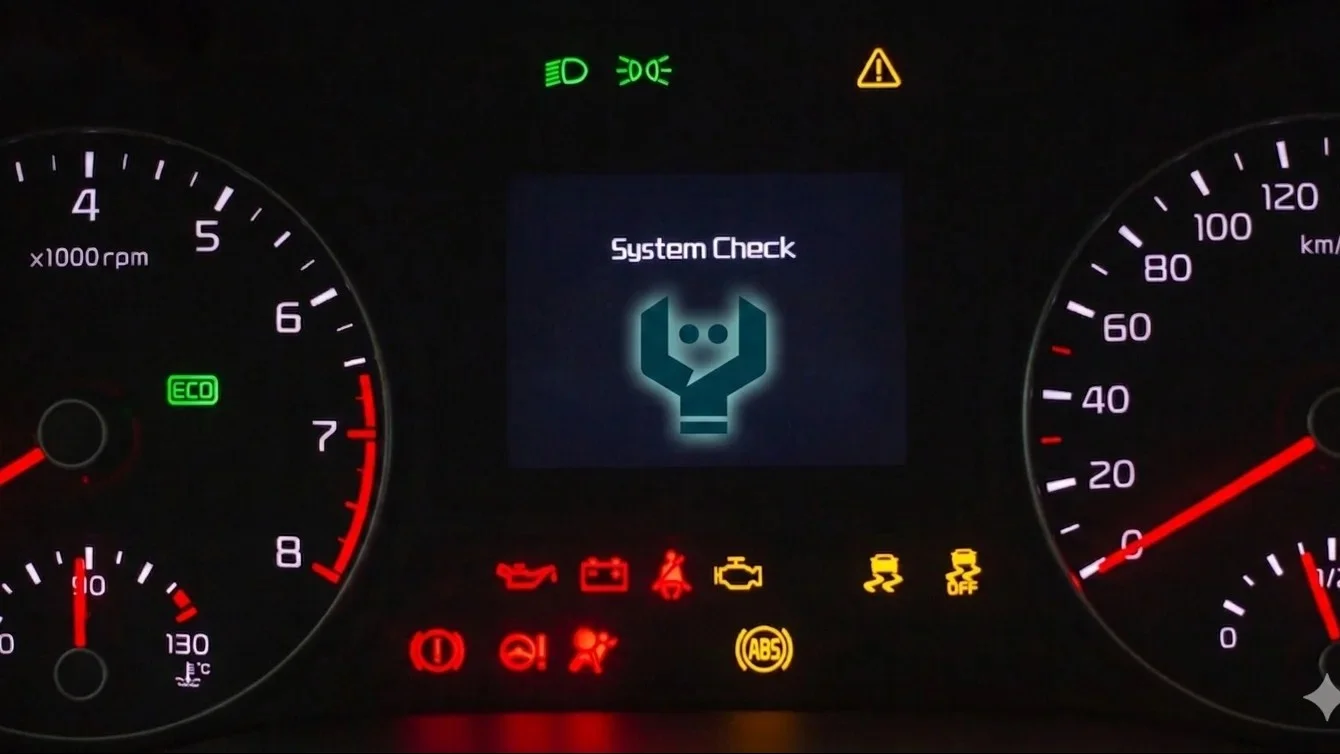
It is important to understand that the battery warning light on the dashboard does not indicate the condition of the battery itself. It indicates a problem with the charging system. It may come on because of an alternator or belt problem even if the battery is healthy — and conversely, a battery may be near the end of its life without the warning light ever coming on.
Short journeys wear out the battery faster than long drives
Starting the engine is the single greatest load placed on the battery. Afterwards, the alternator needs time to replenish the energy that was used.
If every trip is short — to work, to the shop and back — while heaters, wipers, lights and heated seats are also being used, the battery systematically returns to the garage with less charge than it had when the journey began.
This effect is strongest in winter because almost every electrical consumer is switched on while journey lengths remain the same.
Idling does not solve the problem
At idle, the engine charges the battery very inefficiently. To recharge it properly, you generally need to drive for around twenty to thirty minutes. Leaving the car running outside your building burns fuel while providing relatively little benefit to the battery.
How to properly check the condition of a battery
There are two levels of testing, and they are easily confused.
Resting voltage — a rough indication
This is measured using a voltmeter after the battery has been at rest for several hours. Approximate values for a standard 12 V lead-acid battery are:
• around 12.6 to 12.8 V — fully charged
• around 12.4 V — approximately three quarters charged
• around 12.2 V — around half charged
• below 12.0 V — discharged, and deteriorating more rapidly while left in this condition
Load test — the only reliable assessment
Resting voltage tells you how charged the battery is, but not how much current it can actually deliver.
A battery may show a perfectly normal voltage while its voltage drops sharply under load. That is why workshops use dedicated testing equipment to measure the battery's actual ability to deliver current.
Practical consequence: “I measured 12.5 V, so the battery must be fine” is not a valid conclusion. That measurement represents only one half of the assessment.
Start-stop vehicles are a special case
Vehicles equipped with start-stop systems undergo significantly more starting cycles and therefore use batteries of a special design — most commonly AGM or EFB batteries.
Installing a conventional battery in such a vehicle can result in a short service life and potentially cause problems with the start-stop system.
On most newer vehicles, battery replacement does not end with simply tightening the terminals. The new battery must also be registered with the vehicle's energy management system so that the charging strategy can be adapted to the condition of the new battery.
Without this procedure, the system may continue charging according to the parameters of the old, worn-out battery, which can shorten the life of the replacement.
Before buying a battery, check with a service centre whether your vehicle requires this procedure.
What you can do yourself — and what you cannot
You can
• clean and tighten the battery terminals and protect them with suitable terminal grease
• make sure all electrical consumers are switched off when leaving the vehicle
• park in a garage or sheltered area whenever possible
• take one longer drive per month if you normally drive only short distances
• measure the resting voltage using a voltmeter
You cannot
• determine the battery's actual current-delivery capability without suitable testing equipment
• properly check alternator operation and parasitic current drain while the vehicle is switched off
• register a new battery with the vehicle's energy management system on models that require this procedure
When is it time for replacement?
Under typical conditions in our region, the average battery life is roughly four to five years. It may be shorter in vehicles that are frequently driven over short distances or regularly parked in direct summer sunlight.
If your battery is more than four years old and shows any of the warning signs listed above, having it tested before winter is cheaper than needing roadside assistance.
The battery's manufacturing date is printed on the battery itself.
The right time to test your battery is before the first frost — not after it.
September and October are the months when a weak battery can be discovered without serious consequences.
In December, you usually discover it in a car park, early in the morning, when you are already running late.
A quick pre-winter checklist
1. Check the manufacturing date on the battery — if it is more than four years old, have it tested.
2. Measure the resting voltage. If it is below 12.4 V, request a load test.
3. Clean and tighten the battery terminals.
4. Pay attention to slow cranking during the first start of the morning.
5. If you normally drive only short distances, include one longer drive each month.
6. For start-stop vehicles, check the required battery type before buying a replacement.
Frequently Asked Questions
Does cold weather destroy a battery?
No. Cold weather reduces the amount of power the battery can deliver while increasing the amount of power the engine requires, but it does not permanently damage the battery.
Permanent damage is primarily caused by high temperatures, deep discharging and sulphation.
The car started normally yesterday, but today it will not start. How is that possible?
This is common.
A weakened battery can still cope with an easy demand but may fail when the demand becomes greater. The first cold morning is often the point at which the battery crosses that threshold.
How long does a car battery last?
Typically around four to five years.
Its lifespan can be shorter in vehicles frequently driven over short distances, regularly parked in strong summer sunlight or equipped with a large number of electrical consumers.
Does leaving the engine idling recharge the battery?
Only very slowly.
A drive of around twenty to thirty minutes is generally required for the charging effect to become significant.
My battery measures 12.5 V — does that mean it is healthy?
That measurement only indicates the battery's state of charge, not its ability to deliver sufficient current.
A proper load test at a service centre provides a much more reliable assessment.
Can I install a conventional battery in a start-stop vehicle?
You should not.
These vehicles normally require an AGM or EFB battery, and on most newer models the replacement battery also needs to be registered with the vehicle's energy management system.
Check your battery while the weather is still warm
A battery test takes only a few minutes and can be performed by any properly equipped automotive service centre.
On the AutoKonekt platform, you can find a trusted service centre in your city and book an appointment online — without phone calls or waiting.
Note: The voltage values and percentages of capacity loss mentioned above are approximate and may vary depending on the battery type and condition. For a specific vehicle, the manufacturer's specifications and professional testing results should always be considered authoritative.