What happens when a car sits unused for a long time, and how can you safely get it back on the road?
A car does not wear out only while it is being driven.
Although it may seem that a vehicle left stationary for weeks or months is protected from wear, certain parts of the car can actually deteriorate while it is standing. The battery gradually discharges, tyres lose pressure and may deform, brake discs corrode, fuel ages, while moisture, temperature changes and rodents can cause additional problems.
The British motoring organisation RAC states that a technically sound vehicle can generally remain parked for around two weeks without major consequences. After that, the risk of problems gradually increases, although much depends on the age of the vehicle, the condition of the battery, weather conditions and where the vehicle is parked.
For this reason, leaving a car in an airport car park for ten days is not the same as storing it in a garage for six months.
When you know in advance that you will not be using the vehicle for an extended period, proper preparation can prevent many problems. The reactivation procedure is equally important, because a car that has been standing for a long time should not simply be started and immediately driven onto the motorway.
How Long Can a Car Remain Parked?
There is no universal period after which every car will begin to develop problems.
A newer vehicle with a healthy battery, good tyres and no hidden faults will probably remain without consequences for several weeks. An older car with a weak battery, a slow loss of tyre pressure or increased electrical consumption may experience problems after only a few days.
As a practical guide, the following three periods can be used:
storage for up to two weeks;
storage from several weeks to three months;
storage for more than three months.
The longer the vehicle remains unused, the more thorough the preparation should be.
What Happens to a Car While It Is Stationary?
The Battery Gradually Discharges
Even when the car is switched off, certain electrical systems continue to consume energy.
The alarm, central locking, electronic control unit memories, telematics, keyless-entry systems and other electronics create a small but constant electrical drain. When the car is used regularly, the alternator replenishes the energy during driving. When the vehicle is stationary, there is no such replenishment.
For this reason, a discharged or weakened 12-volt battery is one of the most common problems after a vehicle has remained unused for an extended period. The AA states that 12 V battery failures are a leading cause of roadside assistance call-outs, particularly among vehicles that are used infrequently or only for short journeys. This issue does not affect only petrol and diesel cars, but hybrids and electric vehicles as well.
The risk is higher if the battery is already old, if the vehicle is parked outside during cold weather or if it has additional electrical consumers installed, such as alarms, cameras or tracking systems.
Occasionally Starting the Engine Is Not Always a Good Solution
One of the most common mistakes is starting the engine once a week and allowing it to idle for five or ten minutes.
Starting the engine requires a relatively large amount of electrical energy. A short period of idling is often not enough for the alternator to fully replace the energy used during starting, especially if the blower, lights, heated windows or other electrical consumers are switched on.
The engine may also fail to reach full operating temperature. Moisture and condensation can remain in the oil and exhaust system, meaning that briefly starting the engine may do more harm than good.
When the vehicle can be used safely, a normal drive long enough for the engine, oil, brakes and other systems to warm up is more beneficial. If driving is not possible, a suitable smart battery maintainer may be a better solution.
Tyres Lose Pressure
Tyres gradually lose pressure even when they have no visible damage.
During long periods of inactivity, the weight of the vehicle continuously loads the same area of each tyre. If the pressure is already low, this can cause more pronounced deformation of the contact area, known as a flat spot.
Once the vehicle is driven again, a temporary deformation may disappear as the tyre warms up. However, if the car has been standing for a very long time on underinflated tyres, the deformation may remain noticeable and cause vibrations.
In addition to checking pressure, inspect the tyres for cracks in the sidewalls, bulges, signs that the vehicle has been standing on a completely flat tyre and the overall condition of the rubber.
Brake Discs Corrode
A thin layer of surface corrosion on brake discs after rain, washing or several damp days is not unusual.
On a vehicle that is used regularly, this layer normally disappears during the first few braking applications. However, if the car remains stationary for weeks or months, the corrosion may become more severe.
Possible consequences include:
squeaking or grinding noises;
vibrations during braking;
uneven braking;
one or more wheels remaining partially locked;
brake pads or shoes sticking to the discs or drums.
Special attention should be paid to the parking brake. If it remains fully applied for a long period, the mechanism or brake linings may stick.
For long-term storage on a level and secure surface, wheel chocks and the correct transmission position may be used. However, the method used to secure the vehicle should always follow the instructions provided by the vehicle manufacturer.
Fuel Deteriorates Over Time
Fuel does not retain the same properties indefinitely.
Petrol can gradually lose some of its volatile components and become more difficult to burn correctly. Fuels containing ethanol can absorb moisture, which during very long storage periods may contribute to deposits or corrosion in the fuel system.
Diesel fuel may also degrade or become contaminated, particularly when it is stored for a long time in the presence of water and changing temperatures.
There is therefore no simple rule that applies to every car and every storage period. For a few weeks of inactivity, no special intervention is usually required. For storage lasting several months or an entire season, consult the manufacturer’s instructions and, where appropriate, consider using a suitable fuel stabiliser.
A fuller fuel tank is often recommended to reduce the space available for condensation, but this should not be treated as a universal recommendation for all vehicles and fuel types.
Engine Oil and Other Fluids Continue to Age
Low mileage does not mean that service intervals can be extended indefinitely.
Engine oil gradually loses some of its properties, and used oil may contain moisture, fuel, soot and combustion by-products. For this reason, manufacturers usually define oil-change intervals according to mileage or time, whichever comes first.
If the vehicle will remain parked for several months and the oil is already close to the end of its scheduled replacement interval, it may be worth carrying out a service before storage.
You should also check:
coolant;
brake fluid;
power-steering fluid, where applicable;
windscreen-washer fluid;
the condition of hoses, seals and connections.
For a vehicle stored outside during winter, it is particularly important that the coolant provides adequate protection against freezing.
Moisture Can Damage the Interior
A vehicle left dirty, wet or with damp carpets may develop unpleasant odours, mould and condensation.
Before long-term parking, clean the interior, dry the floor mats and remove food remains, bottles, packaging and other items that may attract insects or rodents.
The car should not be left with the windows open simply for ventilation, as this can allow moisture, dust and animals to enter the cabin.
For storage lasting several months in an enclosed space, a moisture absorber designed for vehicles may be used. It should be positioned securely so that it cannot tip over and spill.
Rodents Can Cause Serious Damage
A warm and sheltered engine compartment can be attractive to mice and other rodents.
They may build nests inside the air-filter housing, ventilation system or engine-bay insulation. An even greater problem is the possibility of damage to electrical wiring, cables, hoses and sound insulation.
The storage area should therefore be kept clean and free of food sources. During long periods of inactivity, it is advisable to inspect the space beneath the car and the engine compartment from time to time.
How Should You Prepare a Car for Up to Two Weeks of Inactivity?
A technically sound vehicle will not usually require any special measures.
Before parking, it is generally sufficient to:
make sure that all windows and doors are properly closed;
switch off the lights and additional electrical consumers;
unplug chargers and devices from the sockets;
check that no tyre is slowly losing pressure;
avoid leaving perishable food inside the cabin;
choose a safe and, where possible, covered parking location.
RAC states that a vehicle left for approximately two weeks will generally remain in good condition, with only a small risk to the battery, tyres, fuel and fluids. The actual risk nevertheless depends on the model, battery condition, climate and storage conditions.
How Should You Prepare a Car for Several Weeks or Months of Storage?
Wash and Dry the Vehicle
Dirt, insect remains, bird droppings, road salt and industrial deposits can damage the paint if they remain on the bodywork for a long time.
The vehicle should be washed, thoroughly dried and cleaned especially around the door edges, sills and wheel arches. If a protective cover is used, it should be clean, breathable and specifically designed for cars.
An unsuitable tarpaulin may trap moisture or scratch the paint when it moves in the wind.
Clean the Interior and Luggage Compartment
Remove food, paper, damp clothing, cloths and anything else that may retain moisture or attract animals.
Vacuum the interior, dry the floor mats and make sure no liquids have been spilled in the luggage compartment.
Check the Battery
If the vehicle has access to electricity and the manufacturer allows it, a high-quality smart charger with a maintenance function may be used.
Such a device does not continuously charge the battery at maximum output. Instead, it monitors the battery’s condition and maintains the correct level of charge when necessary.
Another option is disconnecting the battery, but this is not suitable for every modern vehicle. Disconnecting it may erase stored settings, disrupt electronic systems or require certain functions to be reinitialised afterwards.
Before disconnecting the battery, consult the owner’s manual or a qualified service centre.
Check Tyre Pressure
The tyres should be inflated according to the values specified by the vehicle manufacturer for the particular model and load.
They should not be arbitrarily overinflated beyond the permitted values simply because the vehicle will remain stationary for a long time.
Where possible, during storage lasting several months, the vehicle may occasionally be moved by part of a wheel rotation so that the same area of each tyre does not continuously carry the load. This only makes sense if the car can be moved safely and secured correctly afterwards.
Check the Service Schedule
If a regular service is due soon, it is often better to carry it out before long-term storage rather than leaving the engine with old oil and dirty filters.
This is particularly important for vehicles that will remain unused for several months.
Secure the Vehicle Against Movement
High-quality wheel chocks may be used on a level and stable surface.
A manual-transmission vehicle is usually left in the appropriate gear, while an automatic transmission is placed in P. The exact procedure depends on the vehicle design and should be checked in the owner’s manual.
The parking brake should not automatically be left fully applied throughout several months of storage if the manufacturer recommends a different procedure.
Do Not Leave the Vehicle on Grass or Bare Ground
Wet ground and grass increase moisture beneath the vehicle and may accelerate corrosion of the underbody, exhaust system, brakes and other metal components.
Dry concrete, asphalt or another firm and well-drained surface is a better option.
What Should You Do During Long-Term Storage?
If the car remains stationary for several months, it is useful to carry out occasional visual inspections.
Check:
whether any fluids are visible beneath the vehicle;
whether the tyres have lost pressure;
whether there are signs of animals in the engine compartment;
whether moisture has appeared inside the cabin;
whether the protective cover remains correctly positioned;
whether the battery maintainer is operating normally.
Do not start the engine simply for the sake of doing so, particularly if there is no possibility of taking the vehicle for a sufficiently long and safe drive afterwards.
How Can You Safely Reactivate a Car That Has Been Standing for a Long Time?
The longer the vehicle has been out of use, the more detailed the inspection should be before starting it.
After several weeks, basic checks may be sufficient. After several months, especially if the vehicle was stored outdoors, a more thorough inspection or professional service check is advisable.
1. Inspect the Area Beneath the Vehicle
Before opening the car, check whether there are any signs of:
engine oil;
coolant;
fuel;
brake fluid;
pieces of insulation;
animal activity;
obstacles around the wheels.
A small amount of clear water after the air-conditioning system has been operating is generally normal. Coloured, oily or strongly scented fluids require further investigation.
2. Inspect the Tyres
Check all four tyres and, where possible, the spare wheel.
Look for:
visibly low pressure;
cracks;
bulges;
cuts in the sidewalls;
deformation of the tread;
objects embedded in the tyre.
Tyre pressure should be measured with a gauge while the tyres are cold and adjusted according to the vehicle manufacturer’s recommendation.
If the car has been standing for a long time on a completely or almost completely flat tyre, do not simply inflate it and drive away. The internal structure of the tyre may have been damaged and it should be inspected by a tyre specialist.
3. Open the Bonnet
Before starting the engine for the first time, check:
the engine-oil level;
the coolant level;
the brake-fluid level;
the condition of visible hoses and belts;
the battery terminals;
signs of leakage;
damaged wiring;
nests or foreign material.
If the intake or exhaust openings were protected during storage, all protective materials must be removed before starting the engine.
4. Check the Battery
If the battery is weak, it is better to charge and test it properly than to make repeated unsuccessful starting attempts.
Repeated attempts may further discharge the battery and overheat the starter motor.
When using jump leads or a portable jump-starting device, follow the connection points and procedure specified by the manufacturer. Modern cars contain sensitive electronics, and incorrect connection can cause serious damage.
5. Switch on the Ignition Before Starting
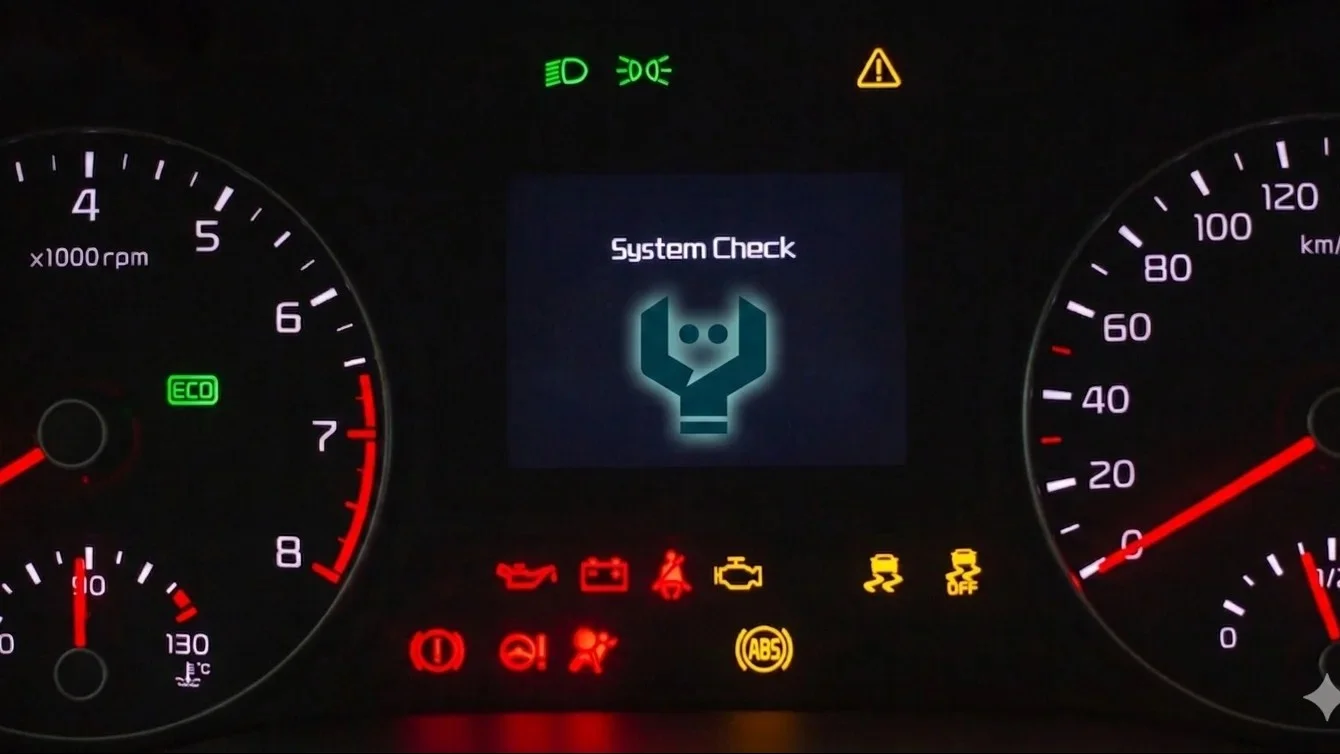
Before starting the engine, observe the instrument panel.
Check whether the warning lights illuminate normally and whether any unusual messages or warnings appear.
On a diesel engine, wait for the glow-plug indicator to switch off when weather conditions require glow-plug activation.
6. Start the Engine Without Raising the Revs
Once the engine starts, do not immediately press the accelerator or raise the engine speed.
Monitor:
the oil-pressure warning light;
the battery-charging warning light;
engine temperature;
the smell of fuel;
unusual exhaust smoke;
knocking, grinding or other unfamiliar noises;
any fluid leaking beneath the vehicle.
The oil-pressure warning light should switch off within the usual short period after starting. If it remains illuminated or the engine produces loud knocking noises, switch the engine off and have the vehicle inspected.
7. Check the Brake Pedal
Before moving the vehicle, press the brake pedal several times.
It should not sink to the floor or feel unusually soft. If there is any doubt about the braking system, the vehicle should not be driven on public roads.
8. Move the Vehicle Slowly at First
Check that the vehicle moves freely and that no wheel is locked.
Brake pads or shoes may have stuck to a disc or drum. Do not attempt to free the car by applying the accelerator aggressively, as this may damage the brakes, transmission or other components.
9. Carry Out the First Test Drive in a Safe Area
The first drive should be short and at a low speed.
Check:
whether the vehicle maintains a straight line;
whether the steering wheel vibrates;
whether unusual tyre noise is present;
whether the brakes operate evenly;
whether the vehicle pulls to one side;
whether the engine warms up normally;
whether any warning appears on the instrument panel.
Surface corrosion on the brake discs may cause slight grinding during the first few braking applications. The noise should gradually diminish. If it remains loud, the vehicle vibrates or the brakes operate unevenly, an inspection is required.
10. Inspect the Vehicle Again After the Drive
After a short test drive, park the vehicle on a clean surface and check:
whether any new leaks have appeared;
whether any wheel or brake is excessively hot;
whether there is a smell of fuel, oil or overheated brakes;
whether the tyres are retaining pressure;
whether fluid levels remain stable.
Only after the car has passed these checks should a longer journey be planned.
When Should You Avoid Attempting to Drive?
The vehicle should not be driven if any of the following symptoms are present:
the brake pedal sinks or feels very soft;
one or more wheels remain locked;
a tyre is cracked, deformed or has been standing flat for a long time;
a fuel leak is visible;
the oil-pressure warning light remains illuminated;
the engine produces loud knocking or metallic noises;
engine temperature rises rapidly;
serious wiring damage is visible;
warnings appear for the brakes, steering or other safety systems;
the vehicle pulls strongly to one side.
In these situations, it is safer to arrange an on-site inspection or transport the vehicle to a service centre.
What Is Different About Electric and Hybrid Vehicles?
With electric and hybrid cars, at least two energy systems should be considered:
the high-voltage traction battery;
the low-voltage system, usually 12 volts.
The high-voltage battery powers the vehicle, while the low-voltage battery supplies the electronic control units, central locking, lighting and systems required to activate the car.
An electric vehicle may therefore have sufficient energy in its traction battery but still fail to “wake up” if the 12 V battery is discharged.
The recommended traction-battery charge level during long-term storage is not the same for every manufacturer and model. Some manufacturers recommend leaving the vehicle connected to a charger, while others specify a particular charge percentage and periodic checks.
Tesla, for example, recommends for certain models that the vehicle remain connected during extended periods of inactivity, while avoiding unnecessary checking through the mobile application because this wakes the vehicle and increases energy consumption. For some models, Tesla recommends approximately 50% traction-battery charge during long-term storage. This is a manufacturer recommendation for specific vehicles and not a universal rule for all electric cars.
For electric and plug-in hybrid vehicles, it is therefore particularly important to consult the owner’s manual for the specific model.
Do not independently open, disconnect or repair any components of the high-voltage system.
Does a Low-Mileage Car Require Less Maintenance?
Not necessarily.
A car that covers few kilometres each year may wear out its tyres and brake pads more slowly, but time still affects:
engine oil;
brake fluid;
coolant;
the battery;
rubber hoses and seals;
tyres;
the air-conditioning system;
corrosion protection.
The maintenance schedule is therefore not based only on mileage. Most vehicles also have time-based service intervals.
The AA and RAC recommend regular checks of the oil, brakes, battery, tyres and other essential systems even when the vehicle covers little annual mileage.
Short Checklist Before Long-Term Storage
Before parking the vehicle:
wash and dry the car;
clean the cabin and luggage compartment;
check the service schedule;
charge and test the battery;
adjust tyre pressure;
check all fluid levels;
choose a dry and secure location;
secure the vehicle against movement;
remove food and items that retain moisture;
check the manufacturer’s manual for model-specific recommendations.
Short Reactivation Checklist
Before the first drive:
check for leaks beneath the vehicle;
inspect the engine compartment;
check the oil and other fluids;
inspect and inflate the tyres;
check the battery;
remove all protective materials fitted during storage;
start the engine without raising the revs;
check the warning lights;
test the brakes before entering traffic;
carry out a short test drive;
inspect the vehicle again after the drive.
Frequently Asked Questions
How Long Can a Car Remain Parked Without Being Driven?
A technically sound vehicle can generally remain parked for around two weeks without major consequences. After that, the risk gradually increases, particularly for the battery and tyres. The exact period depends on the age of the vehicle, battery condition, climate and where the car is parked.
Should You Start the Engine Once a Week While the Car Is Parked?
Briefly starting the engine while stationary often does more harm than good. Starting uses a significant amount of battery energy, while a short period of idling does not allow the engine to reach full operating temperature. As a result, moisture and condensation may remain in the oil and exhaust system. A sufficiently long normal drive or a smart battery maintainer is a better solution.
Does a Low-Mileage Car Require Less Servicing?
Not necessarily. Engine oil, brake fluid, coolant, the battery, hoses, seals and tyres continue to age even while the vehicle is stationary. For this reason, service intervals for most cars are based on time as well as mileage.
How Should an Electric Car Be Stored for a Long Period?
With electric vehicles, attention must be paid to both the high-voltage traction battery and the 12 V system. Recommendations differ between manufacturers: some advise leaving the vehicle connected to a charger, while others specify a particular charge level. Tesla, for example, recommends approximately 50% for certain models. Always check the instructions for the specific vehicle and do not open any high-voltage components.
What Should You Check First on a Car That Has Been Standing for a Long Time?
Before starting the vehicle, check for leaks underneath it, measure tyre pressure and inspect tyre condition, check the oil and other fluid levels, inspect the battery and look through the engine compartment for signs of rodents or damage. Start the engine without raising the revs, check the brakes before entering traffic and carry out a short test drive.
Conclusion
A car that remains stationary is not a car that is free from wear.
While it is unused, the battery may discharge, tyres may lose pressure, brakes may corrode, fuel and fluids may deteriorate, and moisture or rodents may cause damage that remains unnoticed until the car is started again.
Proper preparation does not always require a major expense. A clean and dry vehicle, a healthy battery, correctly inflated tyres, a suitable parking location and a few preventive checks can avoid many problems.
It is equally important not to return the vehicle immediately to full use after several months of inactivity. A visual inspection, checks of the fluids, tyres and brakes, a calm first start and a short test drive represent the minimum safe procedure.
If the car has been standing for several months, or if there are signs of leakage, starting problems, suspicious noises, deformed tyres or irregular brake operation, an inspection by a qualified service centre is safer and often less expensive than allowing a hidden issue to develop into a serious failure.
Returning Your Car to the Road After a Long Period of Inactivity?
Instead of driving the vehicle immediately after several months of storage, leave the inspection to professionals. Through the AutoKonekt platform, you can find a trusted vehicle service centre or tyre specialist in your city and book an inspection in advance—all in one place, without phone calls or waiting.
➜ Find a service centre and book an inspection through the AutoKonekt platform.
Sources: RAC, The AA, Michelin and official vehicle manufacturer owner’s manuals. Recommendations may differ depending on the model, so always consult the manufacturer’s instructions before long-term storage.