Importing Used Cars from the United States to Serbia: What You Need to Know
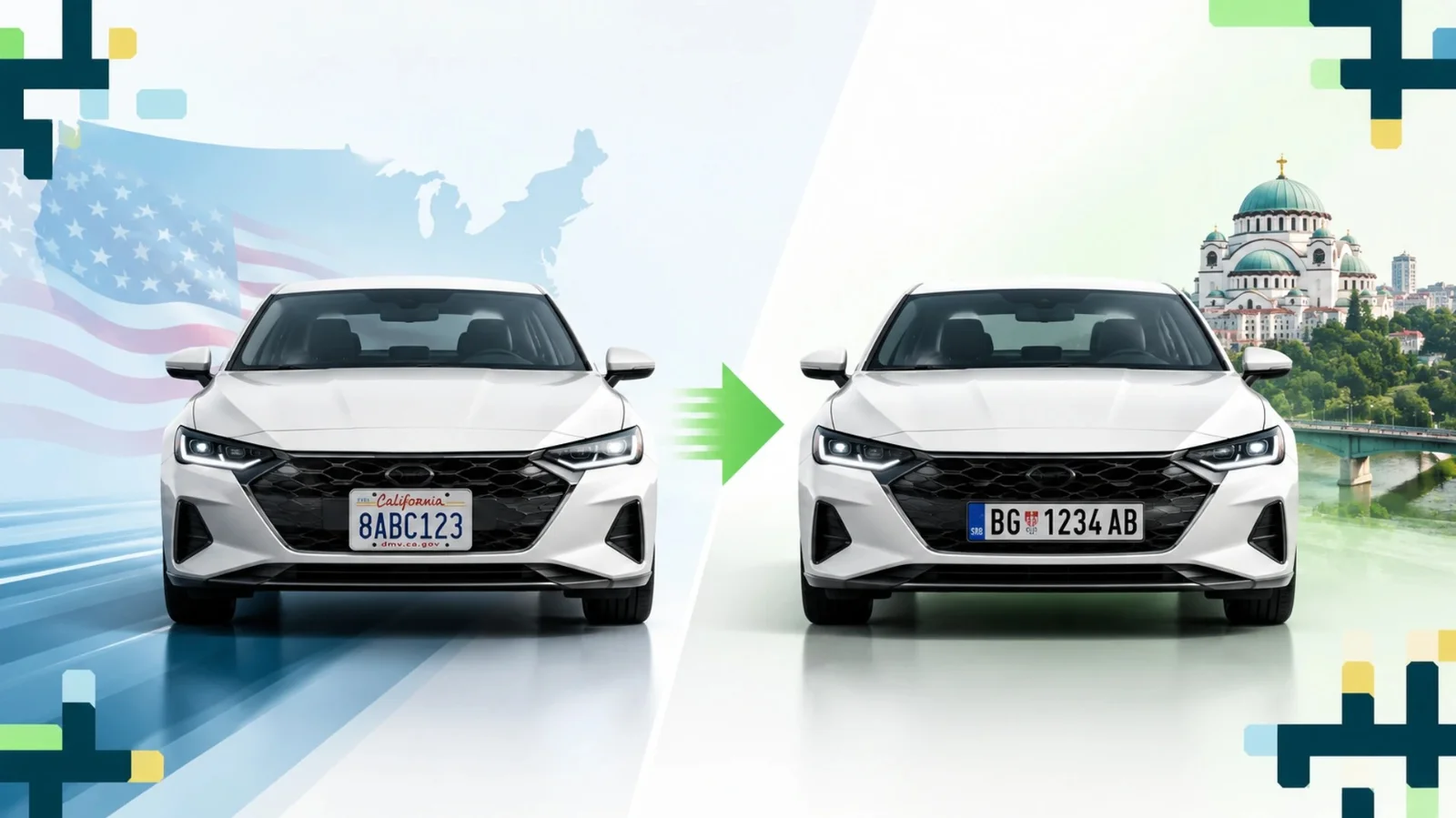
Since the amendments to the Rulebook on Vehicle Testing came into effect on September 30, 2023, used passenger cars and light commercial vehicles from the United States may be imported and registered in Serbia. However, this does not mean that every vehicle purchased at a U.S. auction can eventually receive Serbian licence plates. The decisive factors are the VIN, the type of U.S. title, the emissions standard, the vehicle’s condition, and whether it can be technically adapted to comply with European regulations.
This guide separates the three levels of checks every vehicle must pass and explains where the most common—and most expensive—mistakes occur.
Three Levels of Checks Before Purchase
Importing a vehicle from the United States is not a single procedure, but a process involving three separate filters. The vehicle must pass all three. Failure at any stage may mean that money has been invested in a car that cannot be registered.
Level one: Can the vehicle legally leave the United States?
This depends on the type of title and whether there are any outstanding liens or reported theft records.
Level two: Can the vehicle be imported, tested and issued a Vehicle Testing Certificate in Serbia?
At this stage, the emissions standard and the possibility of adapting the vehicle’s equipment are decisive.
Level three: Is the total cost—after transport, duties, modifications and testing—actually lower than the price of a comparable vehicle from the European market?
The mistake most buyers make is focusing only on the auction price, even though it is often the smallest part of the total cost.
U.S. Title Brands: What Can and Cannot Be Imported into Serbia
This is the most important part of the verification process and the area where buyers most often lose money. U.S. states assign vehicles so-called title “brands”—designations describing the vehicle’s current or previous condition.
Clean Title indicates that the vehicle has no recorded total-loss or write-off designation. It represents the lowest documentation risk, but it does not guarantee that the vehicle will pass testing in Serbia. The emissions standard and equipment are still checked separately.
Salvage Title means that an insurance company has declared the vehicle a total loss. This designation is not automatically disqualifying, but it requires extensive verification: the precise meaning of the designation in the issuing state, the extent and type of damage, whether the vehicle can be repaired safely, and whether it complies with Serbian technical and environmental requirements. Purchasing a salvage vehicle without a physical inspection or a detailed damage report is the highest-risk scenario in the entire process.
Rebuilt or Reconstructed Title indicates a salvage vehicle that has been repaired and inspected again in the United States. The quality of such repairs can vary dramatically.
Junk Title, Certificate of Destruction and Dismantled Title are designations that rule out registration in Serbia. Vehicles intended for scrap cannot receive a positive vehicle testing report and therefore cannot be issued a Vehicle Testing Certificate for a vehicle imported as used.
Special caution is required because of a practice known as title washing—moving a vehicle between states with different regulations until a negative title brand gradually disappears from the paperwork. For this reason, the physical title document shown by the seller is not sufficient proof. The history linked to the VIN itself must be checked.
KEY RULE
Do not buy a vehicle based only on photographs and the auction price. First verify whether the specific VIN can legally reach Serbian licence plates—through an NMVTIS check and consultation with an authorised testing laboratory.
VIN Checks to Complete Before Bidding
Several official databases are available for vehicles from the U.S. market. Each covers a different layer of risk, and no single database is sufficient on its own.
NHTSA VIN Decoder decodes the information contained in the seventeen-character VIN, including the manufacturer, production plant and basic vehicle specifications. This should be the first check, confirming that the VIN actually corresponds to the vehicle being advertised.
NMVTIS is a federal database overseen by the U.S. Department of Justice. It combines data from state motor vehicle agencies, insurance companies, salvage yards and auctions. It shows the current title, the history of brands such as “junk”, “salvage” and “flood”, recorded mileage readings and declared total losses. Once a state assigns a brand to a vehicle, it remains a permanent part of the NMVTIS record. This is the only check that can reliably reveal title washing.
NHTSA Recall Lookup shows outstanding safety recalls and service campaigns for a specific VIN.
NICB VINCheck is a free initial check for reported theft and salvage records submitted by participating insurance companies. NICB expressly warns that this is not a complete vehicle history report and that the absence of a result does not mean that the vehicle has no problematic history.
Coverage note: NMVTIS does not cover every U.S. state equally. Several states do not report all data, so the absence of a record should not be interpreted as confirmation of a clean history.
Emissions Standard: A Requirement That Cannot Be Proven by Model Year Alone
The Serbian Regulation on the Import of Motor Vehicles stipulates that a vehicle may be imported if it was manufactured in compliance with at least the Euro 3 standard. Despite years of announcements about a transition to stricter standards, the 2010 regulation remains in force at the time of writing.
For vehicles manufactured for the U.S. market, this is a specific challenge. The American emissions system does not correspond directly to the European system, so compliance must be demonstrated through factory emissions labels—primarily the EPA label or the appropriate California emissions label, where applicable.
A significant number of vehicles intended for non-European markets meet most of the required criteria but still fail to satisfy the import requirements, most commonly because of exhaust emissions. For these vehicles, modification is not a solution. Therefore, there is no rule stating that “every American vehicle manufactured after a certain year can be imported”. Eligibility is determined for each individual vehicle based on its VIN, factory labels and documentation.
The recommendation repeatedly stated in the guidance issued by the competent institutions is clear: contact an authorised vehicle-testing organisation before deciding to purchase the vehicle, not after the purchase has already been made.
REGULATORY NOTE
Import and emissions regulations may change from time to time, and announced changes have been postponed several times in Serbia. Before making a purchase decision, verify the current requirements with the Serbian Customs Administration and the Road Traffic Safety Agency.
Typical Modifications Required
The widespread assumption that replacing red turn signals is sufficient is incorrect. Factory-installed lighting and light-signalling devices do not necessarily have to carry European type-approval markings, but all their characteristics must correspond to those fitted to vehicles intended for the European market—including colour, installation position, orientation and visibility.
In practice, the most common modifications involve:
The speedometer and odometer, which must display kilometres per hour and kilometres.
Headlamps and the asymmetric dipped-beam pattern.
Rear turn indicators, which cannot be red or use the same light source as the brake lights.
A rear fog lamp, which must have a switch and an indicator light.
Position lamps and retro-reflectors.
Tyres and their markings.
The hazard warning light system.
The cost depends on the specific model, generation and design of the lighting assemblies. On vehicles with integrated LED assemblies, the modification may be disproportionately expensive compared with the value of the vehicle itself, because the entire assembly often needs to be replaced rather than only the light source.
Testing Procedure and Documentation
It is important to distinguish between two procedures that are often confused: customs clearance and the physical entry of the vehicle into Serbia are one process, while testing and obtaining the Certificate required for registration are another. A vehicle may be physically imported and customs-cleared but still be ineligible for registration.
The application for testing is submitted to the Road Traffic Safety Agency through authorised legal entities. For vehicles that do not comply with European technical requirements, the authorised bodies are the Motor Vehicle Centre of the Automobile and Motorcycle Association of Serbia and the laboratory of the Faculty of Mechanical Engineering in Belgrade.
According to the Rulebook on Vehicle Testing, the application must include at least the foreign ownership or registration document issued by the competent authority of the country in which the vehicle was purchased, as well as proof that the required fees have been paid to the Agency. For vehicles purchased at auction, appropriate export documents may also be accepted, provided that they allow the vehicle to be identified beyond doubt. If the technical specifications do not match the available databases, a Certificate of Conformity or manufacturer’s confirmation may be required, and in certain cases a translation certified by a court-appointed translator.
Based on a positive report issued by the authorised laboratory, the Agency issues a Vehicle Testing Certificate for a vehicle imported as used. The fee for issuing the Certificate is RSD 3,000, plus the applicable national administrative fee. Without this Certificate, the vehicle cannot pass the technical inspection or be registered.
Customs Duty, VAT and Vehicle Valuation
Vehicles from the United States do not receive the preferential treatment available to vehicles of European Union origin. For vehicles without proof of preferential origin, the full customs duty rate for passenger cars is 12.5 per cent. VAT of 20 per cent is then applied.
An important note regarding the taxable basis: the invoice is the starting point for determining the customs value, but the customs authority may challenge the declared value where there are justified doubts. The value may then be assessed using available prices from the Automobile and Motorcycle Association of Serbia catalogue, market prices or the Serbian Customs Administration database, with transport costs also included. A low auction price for a salvage vehicle therefore does not automatically mean a low customs value.
The exact tariff classification depends on the vehicle’s characteristics, so the final calculation should be obtained from a customs broker before the purchase, rather than after the vehicle arrives at the port.
Costs That Should Not Be Planned Using a Fixed Price List
Several expenses in this process vary so significantly that any published “price list for importing a vehicle from America” may become outdated within a few months. These include ocean freight, inland transport from the auction to the U.S. port, port and storage charges, laboratory testing fees, the cost of modifying lighting assemblies, and the cost of repairing a damaged vehicle.
Each of these costs depends on the vehicle’s location in the United States, the selected U.S. and European ports, the type of transport, the vehicle model, the extent of the damage and the design of the components requiring modification. The total duration of the process depends on the same factors, together with the pace of the customs procedure.
The practical approach is to obtain specific, dated quotations for every cost item before bidding and compare the total with the price of a comparable vehicle on the Serbian or European market. If the difference is not significant, the risks associated with importing from the United States are unlikely to be worthwhile.
When Importing from the United States Makes Sense
There are situations in which importing from the United States may be economically justified. These include models and powertrains that were never officially sold on the European market, vehicles with specific equipment packages, and certain market segments in which the U.S. market is considerably more liquid than the European market.
On the other hand, for a standard compact or mid-size vehicle that is widely available in Europe, the combined cost of customs duty, VAT, transport, modifications and testing will often eliminate the initial difference in purchase price.
There is another practical consequence: a vehicle imported from the United States will almost always require work before its first registration—from modifications to lighting assemblies and body repairs on salvage vehicles to glass replacement and preparation for the technical inspection. If you are planning such an import, it is worth arranging trusted service providers for this work in advance.
Check Service Partners Before the Vehicle Arrives
A vehicle imported from the United States will generally require work before its first registration. Through the network of verified partners on the AutoKonekt platform at autokonekt.rs, you can find a body repair shop, an automotive glass specialist and a technical inspection centre in your city in advance, and schedule an appointment before the vehicle leaves the customs warehouse.
An overview of available partners by city can be found at autokonekt.rs/lokacije.
Frequently Asked Questions
Can a vehicle with a Salvage Title be registered in Serbia?
A salvage designation is not an automatic obstacle, but it requires detailed verification. The decisive factors are the exact meaning of the designation in the issuing state, the extent of the damage, whether the vehicle can be repaired safely, and whether it complies with Serbian technical and environmental requirements. In contrast, vehicles carrying a Junk Title, Certificate of Destruction or Dismantled Title cannot receive a positive vehicle testing report.
How much customs duty is charged on a vehicle imported from the United States?
For vehicles without proof of preferential origin, the full customs duty rate for passenger cars is 12.5 per cent, followed by VAT of 20 per cent. The exact tariff classification depends on the vehicle’s characteristics, so the final calculation should be obtained from a customs broker.
What emissions standard is required for importing a used vehicle?
The Regulation on the Import of Motor Vehicles prescribes Euro 3 as the minimum standard. For vehicles from the U.S. market, compliance is demonstrated through factory emissions labels, primarily the EPA label. A significant number of vehicles intended for non-European markets do not meet this requirement, and modification is not a solution.
Who performs the testing of vehicles imported from the United States?
The application is submitted to the Road Traffic Safety Agency through authorised legal entities. For vehicles that do not comply with European technical requirements, the authorised bodies are the Motor Vehicle Centre of the Automobile and Motorcycle Association of Serbia and the laboratory of the Faculty of Mechanical Engineering in Belgrade.
How much does the Vehicle Testing Certificate cost?
The fee for issuing the Vehicle Testing Certificate for a vehicle imported as used is RSD 3,000, plus the applicable national administrative fee. The cost of the laboratory testing itself and any necessary modifications is charged separately.
Is replacing the turn signals enough for the vehicle to pass testing?
No. In addition to the rear turn indicators, modifications most commonly involve the speedometer, headlamps and dipped-beam pattern, a rear fog lamp with a switch and indicator light, position lamps, retro-reflectors and tyres. On vehicles with integrated LED assemblies, the cost may be disproportionate to the value of the vehicle.