
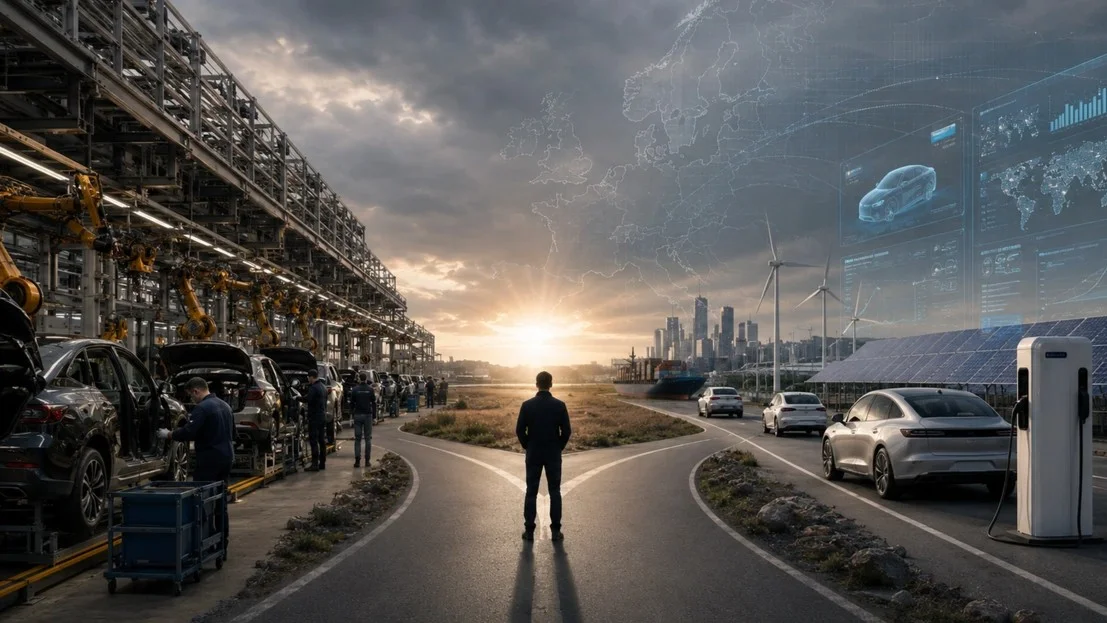
Is Europe Losing Its Automotive Industry? Five Scenarios That Will Shape Its Future
For decades, the European automotive industry represented a symbol of the continent’s technological strength, industrial discipline, and economic influence.
Volkswagen, Mercedes-Benz, BMW, Stellantis, Renault, Volvo, Jaguar, Land Rover, Iveco, and many other European brands did not merely manufacture vehicles. Entire industrial ecosystems developed around them: component manufacturers, transport companies, research and development centres, leasing companies, distributors, service centres, and hundreds of thousands of small and medium-sized businesses.
However, the European automotive industry is now undergoing what is probably the greatest transformation in its history.
Electrification, software, autonomous driving, Chinese competition, high energy costs, increasingly strict environmental regulations, and changing customer habits are all reshaping the rules of the game at the same time.
The question is therefore no longer simply who will manufacture the best car.
The real question is: who will control technology, batteries, software, data, distribution, and the relationship with the customer in the future?
Job Cuts Are Not the Cause of the Problem, but Its Consequence
In the public eye, the restructuring of the European automotive industry is most often reflected in announcements of factory closures and workforce reductions.
According to data from the European Association of Automotive Suppliers, CLEPA, automotive component manufacturers in Europe announced approximately 104,000 job cuts during 2024 and 2025. This represents an average of around 142 jobs lost every day. Citing a study by the consultancy Roland Berger, CLEPA estimates that unfair competition from lower-cost regions could put as many as 350,000 European jobs at risk by 2030.
The situation among suppliers is particularly concerning. According to a CLEPA survey published in March 2026, almost one-quarter of European automotive suppliers expected to record negative profitability during 2026.
Even the largest manufacturers are not protected. Volkswagen is considering a much deeper restructuring that, according to media reports from Manager Magazin and Reuters, could include the closure of four plants in Germany and a reduction of up to 100,000 jobs over the coming years. The company’s Supervisory Board discussed the plan on 9 July 2026, but the final decisions and their scope have not yet been confirmed. This is a plan still being negotiated with trade unions, rather than a decision that has already been adopted.
AutoKonekt Fact
142 jobs were lost every day in the European automotive industry during 2024 and 2025, according to CLEPA — a faster rate than during the COVID-19 pandemic.
These job cuts are not taking place solely because electric vehicles require fewer traditional mechanical components.
The problems are much broader:
European cars are becoming too expensive for some customers;
sales in China are declining;
the development of new electric platforms requires billions of euros;
European production is burdened by high labour and energy costs;
Chinese manufacturers are developing new models more quickly;
an increasing share of a vehicle’s value is shifting from mechanics to batteries, electronics, and software.
European manufacturers therefore have to finance the old and the new automotive industries simultaneously. They must continue producing petrol, diesel, hybrid, and electric vehicles while developing software, battery systems, digital sales channels, and new business models.
This is an exceptionally expensive transition.
Europe Still Produces Outstanding Cars, but It No Longer Controls Everything
European manufacturers still possess strong brands, well-developed production systems, expertise in safety, a high-quality engineering base, and extensive experience in managing global organisations.
The automotive industry remains the largest private investor in research and development in the European Union, with approximately €85 billion invested during 2023. This was around €12 billion more than in the previous year and more than double the amount invested by the second-largest private investor.
Nevertheless, passenger-car production in the EU fell to approximately 11.5 million vehicles during 2024, while commercial-vehicle production declined by almost 10%.
Europe’s problem is not a lack of technical expertise.
The problem is that the centre of power in the automotive industry is shifting.
In electric vehicles, a large part of the competitive advantage no longer comes solely from the engine, transmission, and mechanical construction. The following elements are becoming increasingly important:
battery cells and battery management;
vehicle electronic architecture;
semiconductors;
operating systems;
vehicle connectivity;
customer data;
the speed at which new functions are developed and introduced.
In many of these areas, Chinese companies have developed stronger supply chains and shorter development cycles.
Volvo, Jaguar, Land Rover, and Iveco: A Brand’s Nationality Is No Longer the Same as the Nationality of Its Capital
Changes in the ownership of well-known European brands are not a new development.
Volvo Cars has been owned by the Chinese company Zhejiang Geely Holding since 2010. Volvo retained its headquarters, a large part of its development operations, its Scandinavian identity, and its brand recognition, while gaining access to capital, the Chinese market, new platforms, and Geely’s large industrial system.
Jaguar Land Rover has been wholly owned by the Indian company Tata Motors since 2008. Although its owner is Indian, the company’s development and production identity has remained strongly connected to the United Kingdom.
In July 2025, Tata Motors also announced an agreement to acquire the commercial-vehicle business of Iveco Group in a transaction worth approximately €3.8 billion, excluding the company’s defence division.
According to the latest statements from Tata Motors management, made in June 2026, completion of the transaction is now expected during the second quarter of the company’s 2026/27 financial year, corresponding to the period between July and September 2026.
It is therefore more accurate to say that the acquisition of Iveco Group is in progress, rather than that it has already been completed.
These examples do not automatically mean that European brands are disappearing.
On the contrary, foreign ownership can sometimes bring capital, economies of scale, access to new markets, and accelerated investment in technology.
However, an important question arises: where will the key decisions be made in the long term, and where will the largest share of newly created value remain?
A vehicle may be designed in Sweden, developed on a shared global platform, use Chinese batteries and European software, contain components produced in Eastern Europe, and be assembled in Belgium.
In the new automotive industry, the origin of a vehicle is becoming increasingly difficult to determine from the flag represented by the badge on its bonnet.
Customers Are Not Switching to Electric Vehicles at the Same Speed
One of the greatest mistakes European manufacturers and regulators could make would be to assume that every market will develop in the same way.
During the first five months of 2026, battery-electric vehicles, or BEVs, reached a 20% share of new-car registrations in the European Union, compared with 15.3% one year earlier, according to data from the European Automobile Manufacturers’ Association, ACEA.
At the same time, growth differed significantly between countries. The largest increases were recorded in Italy, France, and Germany, while other markets grew considerably more slowly.
These differences depend on:
consumers’ purchasing power;
government subsidies;
the development of charging infrastructure;
electricity prices;
access to home charging;
the structure of corporate fleets;
tax policies;
the availability of more affordable models.
While some markets are rapidly transitioning to electric vehicles, others are relying more heavily on hybrids or will remain dependent on petrol and diesel engines for many years.
In addition, vehicles on European roads are becoming increasingly old. The average passenger car in the European Union is 12.7 years old, while electric vehicles account for only around 2.3% of the total vehicle fleet, according to ACEA data for 2024.
When a vehicle is already several years old, regular maintenance becomes even more important. Find service centres near you at autokonekt.rs/lokacije.
This demonstrates the significant difference between the new-vehicle market and the actual composition of the vehicle fleet.
Even if sales of new electric vehicles were to increase sharply, hundreds of millions of existing petrol, diesel, and hybrid vehicles would remain on the roads for many years.
Europe’s transition will therefore not be a simple move from one technology to another. It will be a prolonged period during which different powertrains, different levels of technology, and different customer requirements will exist at the same time.
Chinese Manufacturers Are No Longer Merely Exporters of Low-Cost Cars
Chinese companies are no longer entering Europe solely by competing on price.
They increasingly offer:
modern design;
generous standard equipment;
advanced screens and software;
developed electric-vehicle platforms;
rapid introduction of new models;
long warranties;
competitive financing offers.
Their advantage does not lie only in lower production costs. It also lies in speed.
While a traditional European manufacturer often requires a development cycle of several years to launch an entirely new vehicle, Chinese companies operate with considerably shorter deadlines, more frequent software updates, and faster changes to their product ranges.
In May 2026, registrations of electric vehicles, plug-in hybrids, and conventional hybrids in Europe continued to grow strongly, while Chinese manufacturers further increased their market presence. In May, they recorded a record European market share of 10.7%.
At the same time, the Chinese domestic market is experiencing a slowdown and an extremely aggressive price war. This gives Chinese manufacturers an additional incentive to increase exports and seek growth in Europe, Southeast Asia, the Middle East, and Latin America.
Pressure on European manufacturers is therefore unlikely to decrease.
Five Possible Scenarios for the European Automotive Industry
Scenario 1: A European Comeback
In the most favourable scenario, European manufacturers succeed in accelerating development, simplifying their organisations, reducing costs, and offering electric vehicles that a broader group of customers can afford.
At the same time, the European Union develops battery production, secures more affordable energy, accelerates the construction of infrastructure, and enables a more realistic transition aligned with actual market behaviour.
Europe retains its leading and premium brands while also regaining a stronger position in more affordable vehicle segments.
In this scenario, it will not be possible to preserve every job or every factory. However, the largest part of the production, development, and technological system will remain in Europe.
The European Commission has already defined an action plan covering innovation and digitalisation, clean mobility, supply-chain resilience, skills development, and the creation of fairer competitive conditions.
The key question is whether these measures will be sufficiently fast and concrete.
Scenario 2: Europe Remains Strong in the Premium Segment but Loses the Mass Market
This is one of the most realistic scenarios.
European companies could retain strong positions in premium, luxury, sports, and specialised vehicles, while a large part of the affordable mass market shifts to Chinese, Korean, and other manufacturers.
In that case, Europe would manufacture fewer vehicles but generate greater value per vehicle.
The problem is that the premium segment alone cannot support the entire existing network of factories, suppliers, and employees.
The consequences would be particularly serious for companies manufacturing traditional components for engines, transmissions, exhaust systems, and fuel-injection systems.
Scenario 3: European Brands Remain, but Become Part of Global Groups
In this scenario, we can expect a new wave of mergers, strategic partnerships, and acquisitions.
Some European brands could remain European in terms of design, tradition, and market identity, while using platforms, batteries, software, and capital provided by global, Chinese, Indian, or Middle Eastern groups.
The examples of Volvo Cars and Jaguar Land Rover demonstrate that foreign ownership does not automatically destroy a brand.
Nevertheless, the most important development and management functions could gradually move outside Europe.
Europe might retain its factories, design centres, and familiar brands, while losing control over technology, intellectual property, and long-term strategy.
Scenario 4: Chinese Manufacturers Become European Manufacturers
Chinese companies are unlikely to remain merely exporters of vehicles manufactured in China.
Tariffs, political pressure, logistics costs, and the need to be closer to customers will encourage them to build or acquire factories in Europe.
In that situation, a Chinese vehicle will not necessarily be manufactured in China.
It may be developed on a Chinese platform and use batteries of Asian origin, but be assembled in Hungary, Spain, Italy, or another European country, using European suppliers and employees.
Such developments could preserve some industrial jobs in Europe, but they would change the ownership structure and the distribution of profits.
For a factory worker, the most important issue may simply be whether the factory continues to operate. For governments and European industrial policymakers, the important questions will be who owns the technology and who makes the strategic decisions.
Scenario 5: A Long Period of Technological Diversity
It is possible that the transition will not be nearly as fast or as linear as previously expected.
Customers may retain their existing vehicles for longer, while hybrids, plug-in hybrids, electric vehicles, and vehicles with internal-combustion engines continue to coexist for many years.
Manufacturers will therefore have to maintain several technologies simultaneously. This increases costs, but it also reduces the risk of their product ranges completely failing to meet actual market needs.
In this scenario, the winners will not necessarily be the companies that abandon older technologies most quickly, but those that can respond flexibly to different customer requirements.
What Does All of This Mean for Vehicle Repair and Maintenance Businesses?
The transformation of the automotive industry does not end at the factory gate.
It will also profoundly change the vehicle maintenance and repair market.
A fully electric vehicle has fewer moving parts. It does not require engine-oil changes, fuel-filter replacement, a clutch, a traditional exhaust system, or many of the components associated with internal-combustion engines.
However, this does not mean that vehicle servicing will disappear.
The structure of the work is changing.
The following areas will become increasingly important:
diagnostics;
electronics and software;
high-voltage systems;
batteries and thermal management;
ADAS cameras and sensors;
system calibration;
air-conditioning systems and heat pumps;
tyres, brakes, and suspension;
digital service documentation;
cybersecurity and access to vehicle data.
At the same time, the average age of Europe’s vehicle fleet shows that traditional repair businesses will continue to have a large volume of work for many years.
Service centres will have to maintain vehicles from many different generations: from older diesel and petrol models, through hybrids, to the latest electric and software-defined vehicles.
AutoKonekt Advice
Regardless of the type of powertrain your vehicle uses, regular maintenance and the right service partner remain essential for safety and for preserving the value of the vehicle.
Through the AutoKonekt platform, you can easily find verified service centres equipped to work on both conventional and electric vehicles.
The greatest risk for service businesses will not be the complete disappearance of the need for maintenance.
The greatest risk will be a lack of knowledge, equipment, data, and properly qualified employees.
What Must the European Automotive Industry Do?
Europe cannot defeat Chinese competition through tariffs alone.
Tariffs may temporarily reduce pressure, but they cannot replace a competitive product.
The European automotive industry needs:
more affordable models;
faster vehicle development;
more reliable automotive software;
European production of batteries and key components;
cheaper and more stable energy;
less complex regulatory procedures;
stronger technical education and training;
better cooperation between manufacturers, suppliers, and technology companies.
Above all, Europe must recognise that protecting the current situation is not the same as protecting the industry.
Attempting to preserve every factory, every production process, and every existing job indefinitely may only postpone change.
The real objective should be to create new products, technologies, and jobs that will retain their value over the next twenty years.
Will European Cars Disappear?
Most likely, they will not.
However, the European automotive industry as we know it today will almost certainly change.
There will be fewer independent companies, more partnerships, more shared platforms, and more foreign capital. Some factories will close or be repurposed. The production of certain components will move elsewhere, while demand will increase for specialists in software, electronics, batteries, and data.
Some well-known European brands may have Chinese, Indian, or other global owners. At the same time, Chinese companies will open factories and research and development centres in Europe, becoming part of the European industrial system.
The boundary between a “European” and a “Chinese” vehicle will become increasingly unclear.
For this reason, the greatest danger for Europe is not the arrival of Chinese cars.
The greatest danger is that Europe may spend too long defending the industry of the past instead of building the industry of the future.
The question is not whether the automotive industry will change.
The question is whether Europe will manage that change — or merely observe it.
While this story is being written at the level of factories and governments, every vehicle owner still has one simple responsibility: to maintain their vehicle, regardless of its powertrain, through a reliable service provider.
That is precisely what AutoKonekt enables — fast and simple access to verified service partners for every type of vehicle.
Frequently Asked Questions
Will European Car Manufacturers Disappear Because of Chinese Competition?
It is unlikely that European manufacturers will disappear entirely.
A more realistic scenario is one in which Europe loses part of the mass market while retaining its strength in the premium segment, or enters into partnerships and ownership arrangements with global groups, including Chinese and Indian companies.
Why Are European Manufacturers Cutting Jobs if Demand for Electric Vehicles Is Growing?
The job cuts are the result of broader structural pressures, including high labour and energy costs, the need to finance the production of conventional and electric vehicles simultaneously, weaker demand in certain markets, and faster competition from Chinese manufacturers.
They are not caused solely by a general decline in demand for vehicles.
Does Buying a Vehicle from a Chinese Manufacturer Mean That It Was Made in China?
Increasingly, it does not.
Chinese manufacturers are building or acquiring more factories in Europe. A vehicle may therefore be developed in China but assembled in a European country using European suppliers and employees.
Will Electric Vehicles Be Cheaper to Maintain Than Petrol and Diesel Vehicles?
Electric vehicles have fewer moving parts and do not require certain types of maintenance associated with internal-combustion engines.
However, they require new knowledge and equipment for batteries, high-voltage systems, and software. Vehicle maintenance is therefore not disappearing; its structure is changing.
How Long Will Petrol and Diesel Vehicles Remain on European Roads?
Considering that the average vehicle in the EU is 12.7 years old, and that petrol and diesel vehicles still represent the vast majority of the existing fleet, they are expected to remain in use for many years.
This will remain the case even if sales of new electric vehicles continue to grow rapidly.