
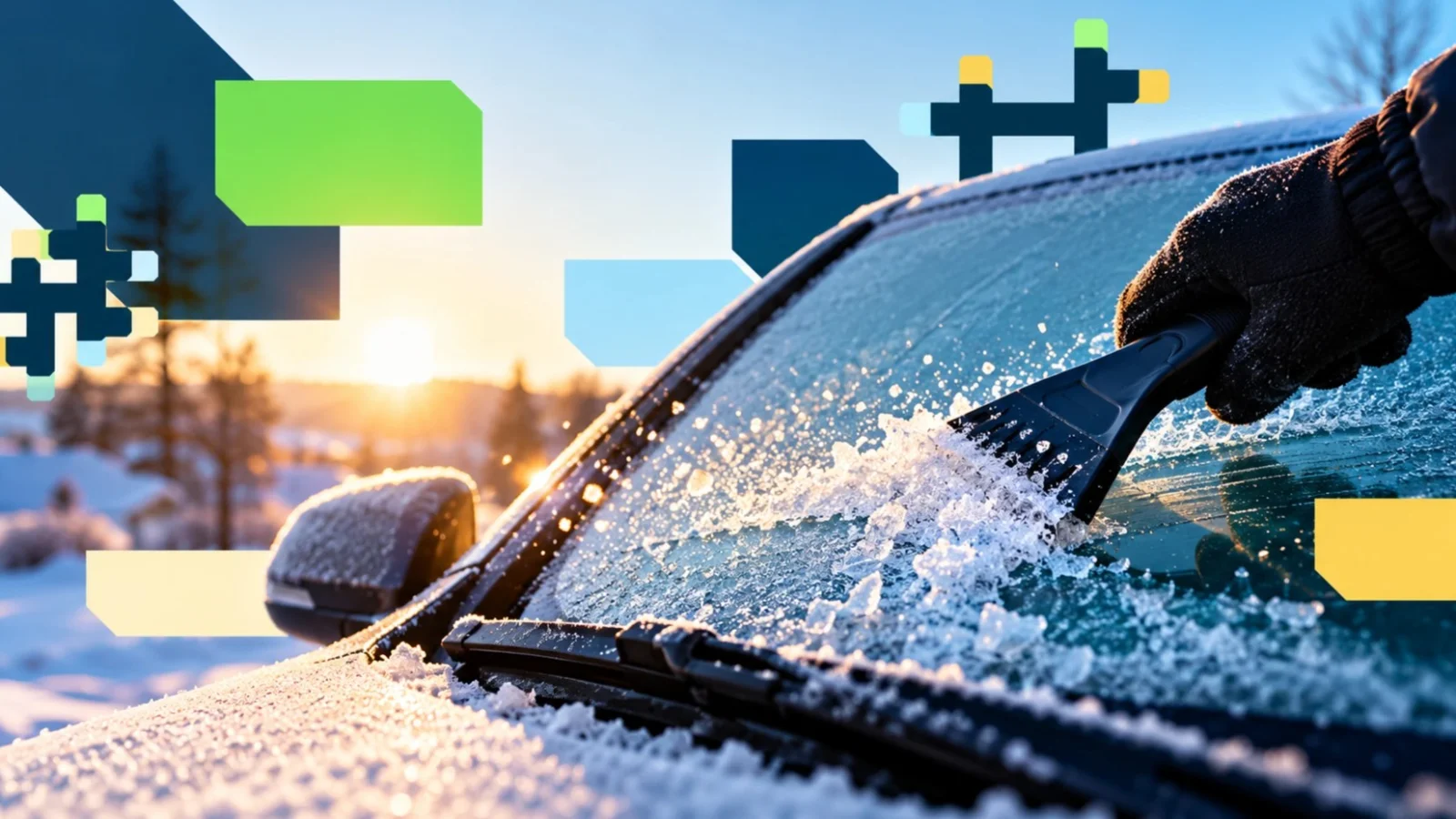
Icy Windshields and Wiper Blades in Winter: What Really Helps and What Causes Damage
The first morning frost catches most drivers in the same situation: an ice-covered windshield, running late for work, and a pot of water within reach. No one ever really taught us how to defrost a windshield properly, when wiper blades need replacing, or why windshield washer fluid needs to be changed before temperatures drop below freezing. We usually learn these lessons only after the first crack in the glass or a frozen washer fluid reservoir.
This guide explains what actually happens to your windshield, wiper blades, and washer fluid in winter, and which habits protect both your visibility and your wallet.
Why Winter Visibility Is a Safety Issue, Not a Matter of Comfort
Reduced visibility poses the greatest danger to road users who are already the hardest to see. Road safety experts point out that the headlights of other vehicles may still be visible through an icy windshield, but pedestrians or cyclists without lights can become practically invisible.
Winter also brings more driving in darkness, while road salt, mud, and freezing rain constantly dirty the glass. Serbia's Road Traffic Safety Law requires drivers to adjust their speed to visibility conditions (Article 42), which becomes difficult when part of the windshield is covered in ice or smeared with dirt.
Myth: "Lukewarm Water Is Safe for an Icy Windshield"
Most people know that pouring boiling water onto an icy windshield is a bad idea. What is less widely known is that even lukewarm water is not safe. The German automobile club ADAC warns that the crucial factor is not the water temperature itself, but the temperature difference between the water and the cold glass.
When outdoor temperatures are well below freezing, even water at around 30°C can cause thermal shock: the heated part of the glass expands while the colder part resists, creating stress within the glass.
The risk is greatest when the windshield already has minor damage, such as a stone chip. In winter, such a small defect can easily develop into a crack. In addition, water quickly refreezes in subzero temperatures — on the windshield, the wiper blades, and the pavement beneath the vehicle.
If a crack extends into the driver's field of vision or the area in front of a driver assistance system camera, replacing the windshield on newer vehicles also requires camera calibration. We covered this in greater detail in our article [LINK: Windshield Replacement and ADAS Calibration].
What Actually Works: The Right Sequence to Protect Your Windshield
1. Start the engine and activate the windshield defrosting function, directing airflow toward the glass so that it warms up gradually.
2. Use a brush to remove snow from the entire vehicle, including the roof, lights, and license plates. Snow left on the roof can slide onto the windshield when braking.
3. Soften the ice with a windshield de-icing spray, which melts it without sudden heating.
4. Remove the remaining ice with a plastic scraper. Metal objects, keys, and bank cards can scratch the glass or break.
5. Do not start driving until your entire field of vision is clear — not just a small "window" in front of the steering wheel.
Wiper Blades: A Component That Wears Out Even When You Don't Use It
Wiper blade rubber deteriorates due to sunlight, ozone, and temperature fluctuations. It hardens and cracks even on vehicles that are rarely driven.
Summer often causes more damage to wiper blades than winter, but winter is when that damage becomes most noticeable: frost, road salt, and freezing rain expose every imperfection.
How to Tell When Your Wiper Blades Need Replacing
They leave streaks or a thin film of water that spreads across the windshield.
They skip or judder instead of gliding smoothly.
They squeak.
They leave an unwiped section of glass within your field of vision.
The rubber is visibly cracked, chipped, or separating from its frame.
Replacement intervals depend on climate, usage, and blade quality, so rather than following a fixed schedule, use one simple rule: check your wiper blades before every winter and replace them as soon as any of these warning signs appear.
Three Winter Habits That Destroy Wiper Blades
1. Operating the wipers on an icy windshield. Vehicle manufacturers' manuals clearly state that snow and ice should be removed before activating the wipers. Otherwise, the wiper and washer system may be damaged. The rubber can tear against the ice, while the wiper motor and linkage are placed under excessive strain.
2. Pulling off a frozen wiper blade. If a blade is frozen to the windshield, wait until the defrosting system releases it. Forcing it loose will often tear the rubber.
3. Using wipers as ice scrapers. Wipers are not designed to remove ice or thick snow, nor to operate on dry glass. If the washer fluid reservoir is empty and you activate the washer and wipers together, the blades scrape across the dry windshield.
Leaving Wiper Blades Raised Overnight: Yes or No?
This is one of the most common winter driving questions, and the correct answer is: it depends on the vehicle.
Engineers involved in wiper system development recommend raising the wiper blades when a car is parked outdoors overnight in winter, to prevent them from freezing to the windshield.
On many newer vehicles, however, the wipers are concealed beneath the edge of the hood and cannot be lifted until they are moved into the service position, following the procedure described in the owner's manual.
If strong winds are forecast, raised wiper blades are exposed to gusts. In that case, a better solution is a windshield cover or a piece of cardboard placed over the glass and secured by the lowered wipers.
Not sure which wiper blades your vehicle needs?
Replacing them takes only a few minutes, but the correct type and length depend on the vehicle model. Have them checked during routine maintenance by a trusted service provider.
→ Find a service center on autokonekt.rs
Windshield Washer Fluid: A Small Expense That Can Prevent Costly Damage
Summer washer fluid and tap water freeze at subzero temperatures. As ice expands, it can damage the reservoir, pump, hoses, or washer nozzles — and those repairs cost more than a bottle of winter washer fluid.
How to Choose and Use Winter Washer Fluid
Check the freezing protection temperature indicated on the packaging. Choose a product suitable for the lowest temperatures in your area, not just an average winter morning.
Dilute concentrated washer fluid exactly according to the instructions. Adding extra water reduces its freeze protection.
If summer washer fluid is still in the reservoir, do not simply top it up with winter fluid, as the resulting mixture provides weaker freeze protection. Use up the summer fluid first, then refill with winter fluid.
Do not operate the washer pump when the reservoir is empty. Vehicle manufacturers warn that doing so can damage the pump.
In extremely low temperatures, avoid spraying cold glass until the defrosting system has warmed it. The fluid may freeze on the windshield and obstruct your view.
If the washer fluid has already frozen, do not activate the pump until the ice has melted. Park the vehicle in a warm location or wait for temperatures to rise, then check the system for leaks.
What to Do When Windows Fog Up on the Inside
Interior window fogging indicates excessive moisture inside the cabin. In winter, this moisture is commonly introduced through wet clothing, footwear, and snow carried in on floor mats.
Turn on the air conditioning together with the heating. Air conditioning removes moisture from the air even in winter, helping the windows clear more quickly.
Turn off air recirculation until the windows are clear, as recirculation keeps the same humid air circulating inside the cabin.
Remove wet floor mats and allow them to dry overnight.
Keep the inside of the windshield clean. Condensation forms and lingers more easily on greasy or dusty surfaces.
If the windows continue to fog up despite these measures and airflow from the vents is weak, the cause is often a clogged cabin air filter or a malfunctioning air conditioning system. This requires professional attention.
Cabin Air Filter and Air Conditioning Service
Weak ventilation and persistently fogged windows can often be resolved by replacing the cabin air filter or servicing the air conditioning system — ideally before severe frost arrives.
→ Find a nearby service center: autokonekt.rs/lokacije
What Serbian Law Says About Visibility
Serbia's Road Traffic Safety Law requires vehicle owners to ensure that vehicles used in traffic are technically roadworthy (Article 5).
The Regulation on the Classification of Motor Vehicles and Trailers and Their Technical Requirements includes "devices that ensure normal visibility" among the mandatory vehicle equipment.
Worn-out wiper blades or a malfunctioning windshield washer system are therefore more than just an inconvenience.
The law also requires vehicle lights to remain unobstructed and sufficiently clean to be visible to other road users (Article 78), while driving speed must be adjusted to visibility conditions (Article 42).
Snow covering lights or license plates, as well as uncleared windows, may result in fines.
From November 1 to April 1, vehicles must be equipped with winter equipment whenever snow, ice, or black ice is present on the road surface.
We will cover the regulations and the choice of winter tires in the next article in this series.
Quick Checklist Before the First Frost
Wiper blades checked: no streaking, skipping, or cracked rubber.
Washer fluid reservoir filled with winter fluid suitable for local temperatures.
Snow brush and plastic ice scraper in the vehicle, plus optional de-icing spray.
Windshield defrosting system and rear window defroster functioning properly.
Ventilation providing strong airflow, with no unexplained window fogging.
No stone chips on the windshield that could develop into cracks during winter.
All vehicle lights clean and working properly.
If anything on this list needs attention, it is better to deal with it now than on the first morning when the temperature drops below freezing.
Frequently Asked Questions
Can I Pour Lukewarm Water on an Icy Windshield?
It is not recommended. What matters is not simply the water temperature, but the difference between the water and the cold glass. In extremely low temperatures, even lukewarm water can cause thermal shock. It can also quickly refreeze.
A safer approach is to use the vehicle's defrosting system, followed by a de-icing spray and a plastic scraper.
How Often Should Wiper Blades Be Replaced?
There is no universal replacement interval because blade lifespan depends on climate, usage, and quality.
Check them before every winter and replace them as soon as they begin leaving streaks, skipping, squeaking, or showing visible cracks in the rubber.
Is It Better to Leave Wiper Blades Raised Overnight?
On vehicles designed to allow it, raising the wiper blades prevents them from freezing to the windshield.
For vehicles with concealed wipers, use the service position according to the owner's manual.
If strong winds are forecast, protecting the windshield with a cover or cardboard is a safer option.
What Should I Do If My Windshield Washer Fluid Has Frozen?
Do not activate the washer pump until the ice has melted, as this could damage it.
Wait for temperatures to rise or park the vehicle in a warm location. Then refill the reservoir with winter washer fluid and check for leaks.
Why Do My Car Windows Fog Up on the Inside?
Excess moisture inside the cabin is usually the cause, most often from wet shoes, clothing, and floor mats.
Turn on the air conditioning together with the heating and switch off air recirculation.
If the problem persists and ventilation airflow is weak, have the cabin air filter and air conditioning system checked at a service center.
SOURCES FOR VERIFICATION (INTERNAL — DO NOT PUBLISH)
Serbian Road Traffic Safety Law, Articles 5, 42, 78: paragraf.rs/propisi/zakon_o_bezbednosti_saobracaja_na_putevima.html
Regulation on the Classification of Motor Vehicles and Trailers and Their Technical Requirements, Article 5: mgsi.gov.rs (PDF of the Regulation)
Winter equipment requirements, November 1 – April 1: AMSS, as reported by biznis.rs, 021.rs, and telegraf.rs (primary legal provisions to be verified in the upcoming article on winter tires).
Lukewarm water and temperature differences: ADAC, as reported by 021.rs.
Pedestrian visibility through icy windshields and raised wiper blades: Škoda Storyboard (road safety and wiper development specialists).
Operating wipers on icy glass, washer fluid in freezing temperatures, and empty reservoirs: Kia and Volvo vehicle owner's manuals.