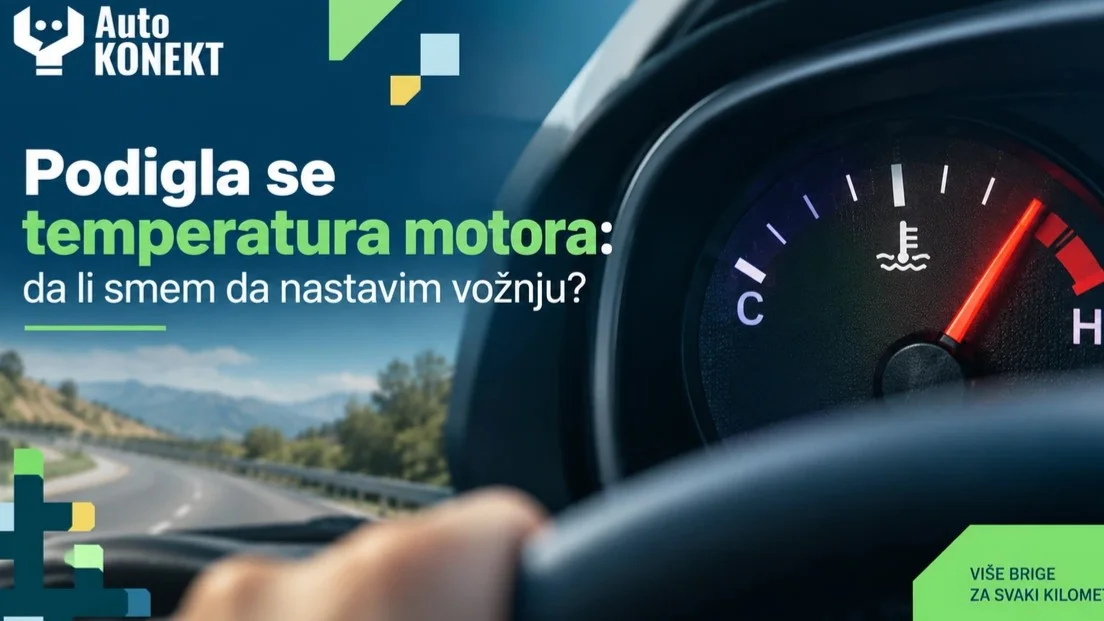
Engine Temperature Has Risen: Can I Keep Driving?
IF YOU’RE READING THIS AT THE SIDE OF THE ROAD
Temperature is rising slightly: turn off the A/C → set the heater to maximum → stop at the first safe place → turn off the engine.
Red zone or red warning light: stop safely → turn off the engine → do not open the cooling system cap.
Steam, coolant leak or loss of power: do not continue driving → call a towing service.
Engine Temperature Has Risen: Can I Keep Driving?
A temperature gauge that has moved away from its usual position is not necessarily the beginning of the problem. In many modern cars, it means the problem is already well underway.
Most drivers have never been given a clear explanation of what that movement actually means or how much time they have to react. The dashboard gives you one signal, but the decision you need to make depends on five or six things that cannot be seen on the instrument panel: whether the coolant is circulating, whether the fan is working, and how much coolant is still left in the system.
That is why the short answer comes first. The explanation follows below.
The Short Answer
1. The gauge is slightly above its normal position, with no warning light
Conditionally, yes — but only as far as the first safe place to stop. Turn off the air conditioning, set the heater to maximum and drive without hard acceleration. This is not the time to think, “I’ve only got another fifty kilometres to get home.”
2. The gauge is in the red zone or the red temperature warning light is on
No. Stop as soon as it is safe to do so. In this situation, the red warning light is not telling you that something might happen — it is telling you that something is already happening.
3. Steam from under the bonnet, a sweet smell, loss of power or knocking from the engine
No. This is a situation for a towing service, not for driving to a repair shop. If steam is coming out, do not immediately approach the front of the vehicle and do not attempt to open the cooling system cap. Wait until the steam has stopped and the engine has cooled down.
If the cabin heater suddenly starts blowing cold air even though the engine is very hot, treat that as an equally serious warning sign.
Why the Temperature Gauge Reacts Later Than You Might Expect
There are two reasons, and both are intentional design features rather than faults.
The System Operates Under Pressure
The cooling system is closed and pressurised — the expansion tank cap commonly maintains pressure of around 1.1 to 1.5 bar.
That pressure raises the boiling point of the water-antifreeze mixture well above 100°C. That is precisely the point: it allows the engine to operate at higher temperatures without the coolant boiling.
The practical consequence for the driver is less reassuring.
The coolant may be well above 100°C without showing any visible signs of boiling. The moment system pressure drops — through a hose, a seal or an opened cap — the coolant can begin boiling almost instantly.
The Gauge Is Deliberately “Calmed Down”
In many modern vehicles, the temperature gauge is damped: it remains around the middle over a relatively wide range of actual coolant temperatures so that normal fluctuations do not alarm the driver.
This means that when the gauge finally starts moving, you are often not seeing the beginning of the temperature increase, but a later stage of it.
Even One Temperature Rise Is Already a Finding
If the temperature has risen even once — even if it later returned to normal by itself — that is information worth investigating. The cooling system should be inspected rather than waiting for the problem to happen again.
You can find car repair shops with available appointments and book a service at autokonekt.rs.
The First 60 Seconds: What to Do
The order is intentional. The first two steps help remove heat from the engine and cost nothing.
1. Turn off the air conditioning.
The A/C compressor places additional load on the engine, while the air-conditioning condenser sits in front of the radiator and heats the air reaching it.
2. Set the heater to maximum and the cabin fan to maximum.
It may be uncomfortable, especially in summer, but the cabin heater effectively acts as a small additional radiator and can remove heat from the cooling system.
3. If you cannot stop safely immediately:
Head towards the first safe place to stop. Maintain a steady speed, avoid hard acceleration and do not climb hills at full throttle.
4. Start looking for a safe place to stop immediately, not when the situation gets worse. The first safe stopping place is better than a more convenient one five kilometres farther down the road.
5. As soon as you have stopped safely — turn off the engine.
If your vehicle manufacturer’s manual specifies a different procedure, follow the manufacturer’s instructions.
What You Should Never Do
• Do not open the radiator cap or expansion tank cap while the engine is hot.
Opening the cap causes an immediate drop in pressure. The coolant can turn to steam almost instantly and erupt from the system. Burns caused in this way can be severe.
Wait at least 30 minutes, and significantly longer after serious overheating. If you are not certain whether the system is still pressurised, do not open it.
• Do not pour cold water into a hot engine.
The sudden temperature difference can cause thermal shock, potentially cracking the cylinder head or engine block — exactly the kind of damage you are trying to avoid.
• Do not drive “just a little farther to get home.”
That may be the most expensive sentence in this article. The difference between replacing a hose and removing the cylinder head can sometimes be measured in kilometres.
• Do not treat plain water as a permanent solution.
As an emergency measure on the road — yes. As something you leave in the car for months — no. Water has a lower boiling point, provides no corrosion protection and freezes in winter.
• Do not relax just because the gauge has dropped.
A falling temperature reading can sometimes mean the coolant level has dropped below the sensor, leaving the sensor with nothing to measure.
How to Stop Safely — What the Law Requires
A vehicle breakdown is one of the limited circumstances in which stopping in the emergency lane is permitted.
Procedures for emergency stopping on a motorway are regulated by Article 105 of the Serbian Road Traffic Safety Act.
• Turn on the hazard warning lights.
• Place the warning triangle at least 100 metres behind the vehicle.
• Put on a high-visibility vest before stepping onto the roadway. This is why the vest should be kept inside the passenger compartment rather than in the boot — by the time you reach the boot, you have already left the vehicle.
• Exit the vehicle on the right-hand side and move behind the safety barrier. Standing next to a vehicle in the emergency lane is one of the most dangerous places to be on a motorway.
In urban conditions, the same basic principle applies on a smaller scale: move as far to the right as possible, get the vehicle out of the traffic lane whenever possible, and position the warning triangle behind the vehicle.
When Towing Is Cheaper Than Driving
Driving another ten kilometres with an overheating engine can mean the difference between a repair that takes a few hours and an engine rebuild that takes days.
Towing services in different cities are available at autokonekt.rs/lokacije.
When It Happens: A Guide to the Possible Cause
The situation in which the temperature rises often tells you more than the fact that it rose at all.
The information below is intended only as guidance and as a starting point for a conversation with a mechanic — none of these symptoms is, by itself, a diagnosis.
What the Symptoms May Indicate
When it happens: Temperature rises in traffic or while waiting at traffic lights, then drops when you reach an open road
What it may indicate: Radiator fan, fan relay or sensor; on older vehicles, the viscous fan coupling
When it happens: Temperature rises on the open road, under load or when driving uphill
What it may indicate: Low coolant level, water pump or blocked radiator
When it happens: Temperature rises suddenly, together with the battery warning light and heavy steering
What it may indicate: A broken or detached auxiliary belt — on engines where the same belt drives both the water pump and alternator
When it happens: The cabin heater blows cold air even though the engine is very hot
What it may indicate: Low coolant level or air trapped in the cooling system
When it happens: The temperature gauge moves up and down without a clear pattern
What it may indicate: Thermostat or temperature sensor
When it happens: White vapour from the exhaust, a sweet smell or milky residue on the oil filler cap
What it may indicate: Possible coolant entering the engine; the cylinder head gasket is one of the things that should be checked
When it happens: Coolant level in the expansion tank keeps falling, but there is no visible puddle under the vehicle
What it may indicate: Hidden/internal leak, heater core leak or coolant being burned inside the engine
Why It Pays to Stop Immediately
There are no specific prices here because repair costs vary significantly between vehicle models. However, the order is generally the same, and the differences between these groups are often multiples rather than percentages.
• Group One: Sensor, thermostat, hose, cap seal.
Usually the least expensive repairs and often completed the same day.
• Group Two: Water pump, radiator, cooling fan, belt.
More expensive, but still standard repair operations.
• Group Three: Cylinder head gasket.
This involves removing the cylinder head, so the repair cost rises significantly compared with the second group.
• Group Four: Warped or cracked cylinder head, damaged engine block.
On older vehicles, the repair cost can sometimes approach the market value of the car itself.
The difference between moving from the first group to the third can sometimes be measured in kilometres rather than months.
That is the reason this article insists so strongly on stopping the vehicle.
How to Prevent This
• Check the coolant level when the engine is cold.
Once a month and always before a longer journey. The check takes less than a minute.
• Coolant has a service life.
Replace it according to the vehicle manufacturer’s instructions rather than simply topping it up indefinitely. Old coolant gradually loses its anti-corrosion properties.
• Inspect hoses and the cap.
Hoses should not be hard and cracked, nor unusually soft and spongy. The cap seal is a wear item, and when it fails the entire cooling system can lose pressure.
• Clean the radiator and A/C condenser.
Leaves, insects and dirt on the outside reduce airflow. Cleaning is especially useful after summer and before autumn.
• Check the cooling fan.
With the air conditioning switched on and the engine idling, the radiator fan should normally activate. If you never hear or see it running, that is something worth checking.
It is also worth remembering that a standard vehicle roadworthiness inspection does not include an in-depth diagnosis of the cooling system. A visual check for leaks is not the same as testing the water pump, thermostat or cooling system pressure.
Frequently Asked Questions
Can I drive another few kilometres if the temperature has risen?
If the gauge is only slightly above its normal position and no warning light is illuminated, you may drive as far as the first safe place to stop — with the air conditioning switched off and the heater set to maximum.
If the gauge enters the red zone, a warning light comes on or steam is visible, stop driving immediately and call a towing service.
How long should the engine cool before I open the cap?
At least 30 minutes, and significantly longer after severe overheating — until the engine has cooled completely.
If you are unsure whether the cooling system is still pressurised, do not open it.
Coolant should only be added when the engine is cold.
Can I use ordinary water instead of coolant?
As a temporary emergency solution on the road — yes, provided the engine has cooled and the water is added gradually.
As a permanent solution — no.
Water boils at a lower temperature, does not protect the cooling system against corrosion and can freeze in winter. At the first opportunity, the system should be flushed and filled with the correct coolant.
Why does my engine overheat only in the city but stay normal on the open road?
This is a typical pattern associated with a problem involving the radiator fan, fan relay or sensor.
On the open road, airflow naturally passes through the radiator, which can hide the problem. In slow-moving traffic there is little natural airflow, making the cooling fan essential.
Can the air conditioning cause the engine to overheat?
Air conditioning does not normally cause a healthy cooling system to fail, but it does place additional load on the engine and heats the air passing towards the radiator.
If the engine overheats only when the A/C is operating, it often means the cooling system is already compromised and the additional load from the air conditioning is simply revealing an existing problem.
Can I drive the car to a repair shop myself, or do I need a tow truck?
It depends on how far the temperature rose and whether the situation stabilised after the engine cooled.
If the engine entered the red zone, steam was coming from the engine bay or the coolant level is visibly falling, towing is the safer and cheaper option.
In all other cases, it is best to call the repair shop, describe the symptoms and ask for guidance before setting off.
CMS Note
Mark this FAQ section with FAQPage JSON-LD schema (mainEntity → Question → acceptedAnswer).
Questions should be placed in <h3> elements and answers in <p> elements within the same container. The wording in the structured data should be identical to the wording displayed on the page.
Sources
• Serbian Road Traffic Safety Act (ZOBS), Article 105 — emergency stopping on motorways, warning triangle placement and high-visibility vest requirements.
• Rulebook on the Classification of Motor Vehicles and Trailers and Technical Requirements for Vehicles in Road Traffic — mandatory equipment requirements, including the warning triangle and SRPS EN 471 high-visibility vest.
• Rulebook on Vehicle Roadworthiness Inspections — scope of inspection and mandatory equipment.
• Serbian Road Traffic Safety Agency — recommendations for procedures following an emergency stop.
• RAC Drive, “What should I do if my car is overheating?” — procedures for engine overheating and warnings regarding opening a pressurised cooling system.
• AAA — recommendations for dealing with an overheating engine while on the road.
• Vehicle manufacturers’ owner manuals — procedures for handling cooling systems and recommended coolant replacement intervals.