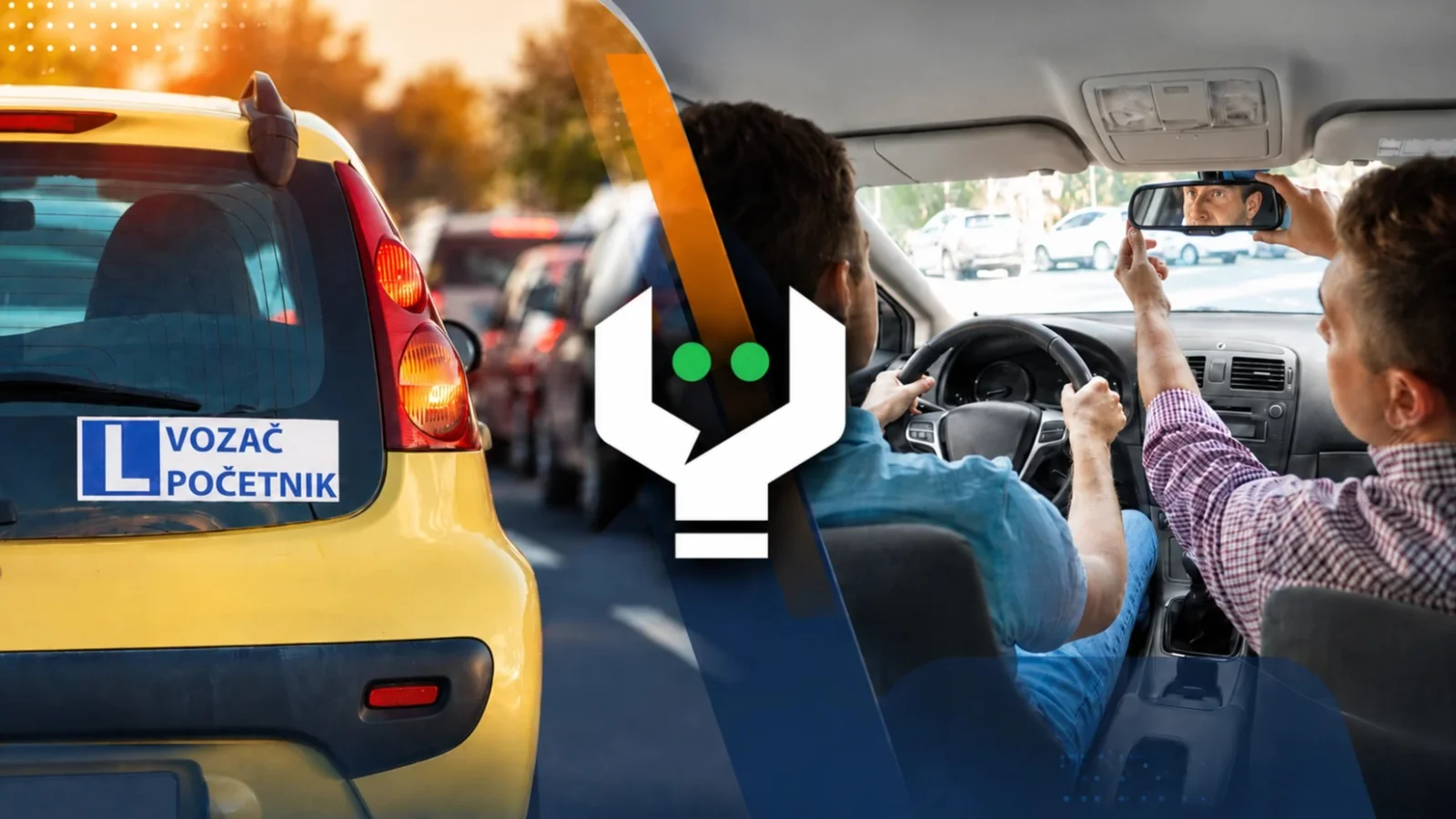
The first 20.000 km of every driver
How to Become a Safe and Competent Driver
A driving licence is not a diploma. It is permission to continue learning.
What happens between the moment you leave driving school and the moment you complete your first 20,000 kilometres is the period in which you become the kind of driver you will be for the next thirty years. During this time, novice drivers develop habits—both good and bad—that tend to stay with them. They rarely change later.
This guide is not a list of restrictions. It is an overview of what driving school does not have enough time to teach you: how to approach your vehicle, the road and other road users, what the rules for probationary driving licences actually require, and how to maintain your first car.
KEY TAKEAWAYS
The risk faced by novice drivers does not decrease evenly—the period between 8,000 and 20,000 kilometres is statistically the most sensitive.
A probationary driving licence in Serbia means: 0.00 blood alcohol level, a maximum speed of 110 km/h on motorways, no driving between 11:00 p.m. and 6:00 a.m., and a maximum vehicle power of 80 kW without supervision.
The most common cause of accidents involving novice drivers is not speeding, but the incorrect assessment of traffic situations.
A probationary licence is revoked after nine penalty points—twice as strict as the limit for drivers with a full licence.
Why the First Years Are the Most Sensitive for Novice Drivers
The Serbian Road Traffic Safety Agency clearly explains why.
For an experienced driver, actions such as changing gear, checking the mirrors, assessing a situation and reacting gradually become automatic. For a novice driver, each of these actions requires conscious mental effort, which takes attention away from the road.
As a result, a young driver can easily become overwhelmed, while their ability to perform several tasks at the same time remains relatively limited.
This is not a question of intelligence or talent. It is a question of kilometres driven.
Data from the Serbian Ministry of the Interior for 2025 show that drivers with probationary licences caused 2,282 road accidents—approximately seven percent of the total number.
The most frequently cited contributing factors were the incorrect assessment of traffic situations, speed that was not adjusted to road conditions, and driver inexperience.
Pay attention to the wording: incorrect assessment of the situation.
Not “driving too fast”. Not “failing to understand the rules”.
A novice driver looks, but does not always see.
That is a skill that must be learned.
Looking at the broader picture, according to the Road Traffic Safety Agency, one in four people killed in road accidents in Serbia belongs to the 15-to-30 age group.
Stage 1: The First 2,000 Kilometres—Get to Know the Vehicle, Not the Road
One of the biggest mistakes novice drivers make is thinking of a car as a tool.
A car is an instrument.
The difference is the same as the difference between an axe and a violin.
Before you even start driving:
Adjust the seat before adjusting the mirrors—always in that order. Your knees should remain slightly bent when the clutch pedal is fully depressed. When you stretch out your arms while keeping your back against the seat, your wrists should rest on top of the steering wheel.
The head restraint is not a decorative feature. Its upper edge should be level with the top of your head, not your neck. A poorly adjusted head restraint can make the difference between a minor neck strain and a lifelong injury.
Your side mirrors should be adjusted further outward than you may think. If you can see the side of your own car in the side mirror, the mirror is incorrectly positioned. You are using part of your field of vision to look at something you already know is there.
Learn where all the controls are without looking at them. Wipers, lights, indicators and the demister. If you have to look down to turn on the wipers, you are effectively driving blind at that moment.
IMPORTANT: During the first few weeks, drive along the same routes. A familiar road frees up mental capacity, allowing you to focus on traffic rather than navigation.
AUTOKONEKT TIP
A new driver does not have to be a mechanic—but they must know who to contact.
On AutoKonekt, you can find verified repair shops, tyre services and vehicle inspection centres in your city, with clearly presented services and locations.
Explore partners near you.
Stage 2: From 2,000 to 8,000 Kilometres—Learn to Read Traffic
This is where your real driving education begins.
You stop merely reacting and start anticipating.
The Vision Rule: Look Far Ahead, Not at the Bonnet
Novice drivers tend to focus on the vehicle directly in front of them.
Experienced drivers look through it, beyond it and further ahead—approximately 12 to 15 seconds into the future.
In urban traffic, this usually means looking towards the next junction. On an open road, it means looking towards the top of a hill or the exit of a bend.
When you look far ahead, the car naturally stays in its lane.
When you focus too close to the vehicle, you constantly make small corrections and drive more nervously.
The Two-Second Rule—and When It Becomes Four
Choose a fixed point beside the road—a pole, road sign or tree.
When the vehicle in front passes that point, count: “twenty-one, twenty-two”.
If you reach the same point before you finish counting, you are following too closely.
On wet roads, double the distance.
On snow and ice, triple it or increase it even further.
Assume That Nobody Has Seen You
This is one of the most useful mental habits in driving.
A vehicle entering from a side road, a pedestrian near a crossing or a driver changing lanes—assume they have not seen you until you receive confirmation that they have.
That confirmation may come through eye contact, slowing down or the use of an indicator.
This assumption will not make you slower.
It will create a valuable safety margin.
Watch for Two-Wheeled Vehicles
Motorcycles and mopeds are physically small and can easily disappear into blind spots.
The Road Traffic Safety Agency specifically urges passenger-car drivers to pay additional attention to two-wheeled vehicles when changing lanes.
For a novice driver, the rule is simple:
Look over your shoulder every time, without exception.
The mirror alone is not enough.
Stage 3: From 8,000 to 20,000 Kilometres—The Most Dangerous Period for Young Drivers
This is the stage in which a driver begins to feel confident.
Statistically, it is also the stage in which more serious mistakes begin to occur.
The reason is well known: driving skill improves quickly, while risk assessment develops more slowly.
A sense of control appears before it is fully supported by experience.
The Road Traffic Safety Agency notes that young drivers are more likely to overestimate their driving abilities and give in to negative peer pressure.
Specific risks during this stage include:
Driving with friends in the car. The risk increases with each additional passenger from the same age group. The problem is not the passengers themselves—it is what the driver may be trying to prove.
Night-time and weekend driving. The Road Traffic Safety Agency reports that a large number of accidents involving young drivers occur at night and during weekends.
Alcohol. According to research conducted by the Road Traffic Safety Agency as part of the “On the Road to Zero, with Zero Alcohol” campaign, approximately 16 percent of respondents admitted that they had driven under the influence of alcohol during the previous 30 days. For drivers with a probationary licence, the legal limit is 0.00. There are no exceptions.
Mobile phones. Drivers with probationary licences are not allowed to use a mobile phone, even with a hands-free system.
If you maintain the same discipline during this stage that you had during your first thousand kilometres, you will come out of it as a competent driver.
If you lose that discipline, you may become part of the statistics.
Probationary Driving Licence in Serbia: All Restrictions in One Place
Serbia has one of the more restrictive probationary driving licence systems in the region.
The following rules currently apply:
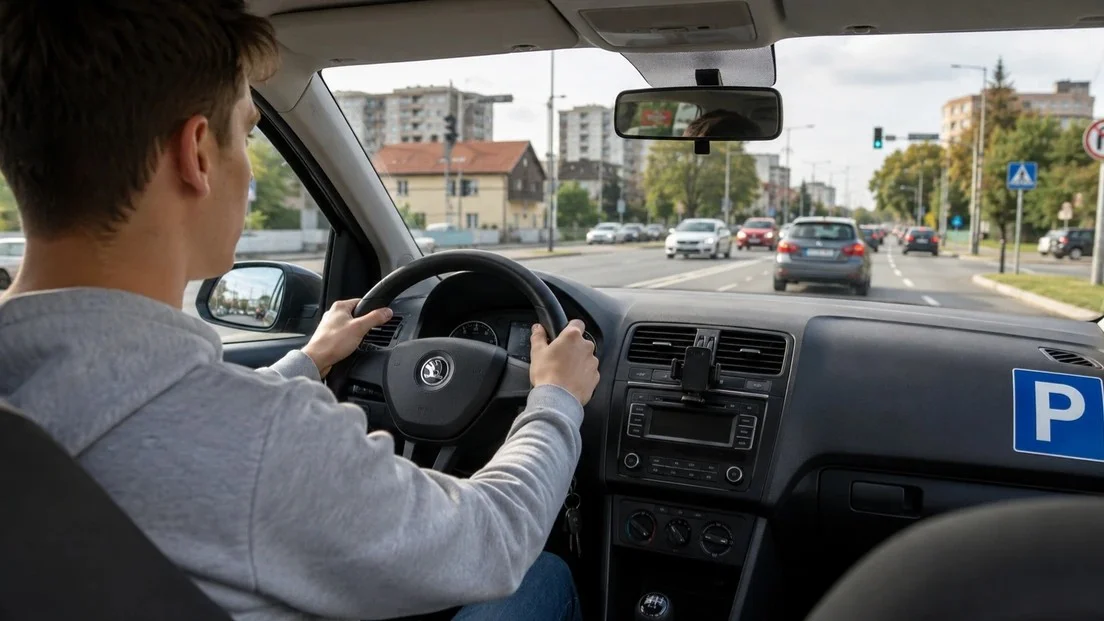
RestrictionRuleDurationTwo years if the driver passed the test at the age of 19 or older, or until the age of 21 if the driver passed earlierMotorway speedMaximum 110 km/hExpressway speedMaximum 90 km/hOther roads90% of the speed limit applicable to that section of roadAlcohol0.00Night drivingIndependent driving prohibited between 11:00 p.m. and 6:00 a.m.Engine powerMaximum 80 kW without supervision“P” signMandatory on the front and rear of the vehiclePenalty pointsLicence revoked after nine penalty points
Where supervision is legally required, the accompanying person must have held a Category B driving licence for at least five years.
A friend who passed their driving test last year does not qualify.
Bear in mind that possible amendments to the Serbian Road Traffic Safety Act, including changes to the probationary licence system, are occasionally announced publicly.
Always check the latest information on the website of the Serbian Ministry of the Interior.
Vehicle Maintenance for Novice Drivers: What You Should Do Yourself and What You Should Leave to Professionals
A novice driver will often also be driving the oldest car in the family.
That combination requires discipline.
The minimum you should check yourself includes:
Tyre pressure—once a month. An underinflated tyre increases braking distance, raises fuel consumption and may fail at higher speeds. The correct values are usually shown on a sticker inside the driver’s door frame.
Tread depth. The legal minimum is not necessarily the same as a safe level. Below 3 mm, braking distances on wet roads become noticeably longer.
Oil level—every few refuelling stops. An engine without sufficient oil can fail within minutes.
Windscreen washer fluid and wipers. A worn wiper blade in winter means you cannot see properly. There is no cheaper piece of safety equipment.
All vehicle lights. Ask someone to stand behind the vehicle while you check the brake lights and indicators.
The following should be left to professionals:
Brakes, clutch, timing belt, cooling system and dashboard warning-light diagnostics.
Improvisation in these areas costs more than professional servicing.
BOOK THROUGH AUTOKONEKT
Not sure who you can trust with your first car?
AutoKonekt connects drivers with verified partners, including repair shops, tyre services, car washes, vehicle inspection centres, windscreen specialists, towing services and roadside assistance providers.
Everything is available in one place, with transparent information.
Explore the AutoKonekt partner network.
Breakdowns and Road Accidents: What to Do Step by Step
Every driver will eventually experience a breakdown on the road.
The only question is when.
If your vehicle breaks down while driving:
Turn on your hazard warning lights and move as far away from the carriageway as possible.
Put on your reflective safety vest before leaving the vehicle—not afterwards.
Position the warning triangle at the legally required distance.
Move all passengers behind the safety barrier. Never leave anyone sitting inside a stationary vehicle on a motorway.
Only then should you call for assistance.
If you are involved in an accident with no injuries, complete the European Accident Statement.
Keep a copy in the glove compartment together with your insurance documents.
Photograph the positions of the vehicles before moving them.
If anyone is injured, do not move the vehicles and call 192 for the police and 194 for emergency medical assistance.
What Does It Really Mean to Be a Competent Driver?
It is not someone who drives fast.
It is not necessarily someone who drives slowly either.
A competent driver is someone whose passengers barely notice the journey—there is no sudden braking, no unexpected movement and no jerking.
It is a driver who resolved the situation ten seconds before it had the chance to become a problem.
You do not achieve that through courage.
You achieve it through kilometres—and through paying attention during those kilometres.
Your first 20,000 kilometres are not merely mileage.
They are training.
Use them wisely.
Useful Links for New Drivers
Find verified repair shops and service partners through the AutoKonekt platform, or browse partner locations by city—from tyre services and vehicle inspection centres to towing companies and roadside assistance providers.
Frequently Asked Questions About Novice Drivers
1. How long does a probationary driving licence last in Serbia?
It lasts for two years for drivers who passed their driving test at the age of 19 or older.
For those who passed before the age of 19, it remains valid until they turn 21.
Students attending vocational secondary schools for professional motor-vehicle drivers receive a probationary licence valid for one year.
2. What is the maximum speed for a driver with a probationary licence?
The maximum speed is 110 km/h on motorways and 90 km/h on expressways.
On other roads, the limit is 90 percent of the speed normally permitted on that section.
For example, if the road sign shows a limit of 100 km/h, the maximum permitted speed for a probationary driver is 90 km/h.
3. How much alcohol is permitted for a driver with a probationary licence?
None.
The limit is 0.00.
Any measured amount of alcohol represents an offence and may result in penalty points.
4. When should I first service a newly purchased used car?
Immediately after purchasing a used vehicle, it is advisable to arrange a complete inspection, including the brakes, oil and filters, tyres, belts and fluids—regardless of what the previous owner claimed.
After that, follow the regular servicing intervals stated by the vehicle manufacturer.
5. What happens if I accumulate nine penalty points while holding a probationary licence?
Your driving licence will be revoked.
To regain the right to drive, you must undergo a special medical examination, attend a mandatory road-safety improvement seminar organised by the Serbian Road Traffic Safety Agency and pass a knowledge assessment.
You do not have to repeat the standard driving test at a driving school.
Once your right to drive is restored, you receive a new probationary driving licence and its validity period starts again from the beginning.
Sources
Serbian Road Traffic Safety Agency—research on young drivers as a high-risk group
Ministry of the Interior of the Republic of Serbia—road accident statistics for 2025
Road Traffic Safety Act of the Republic of Serbia, Article 182
Automobile and Motorcycle Association of Serbia—conditions for issuing probationary driving licences
Road Traffic Safety Agency campaign “On the Road to Zero, with Zero Alcohol” (2026)