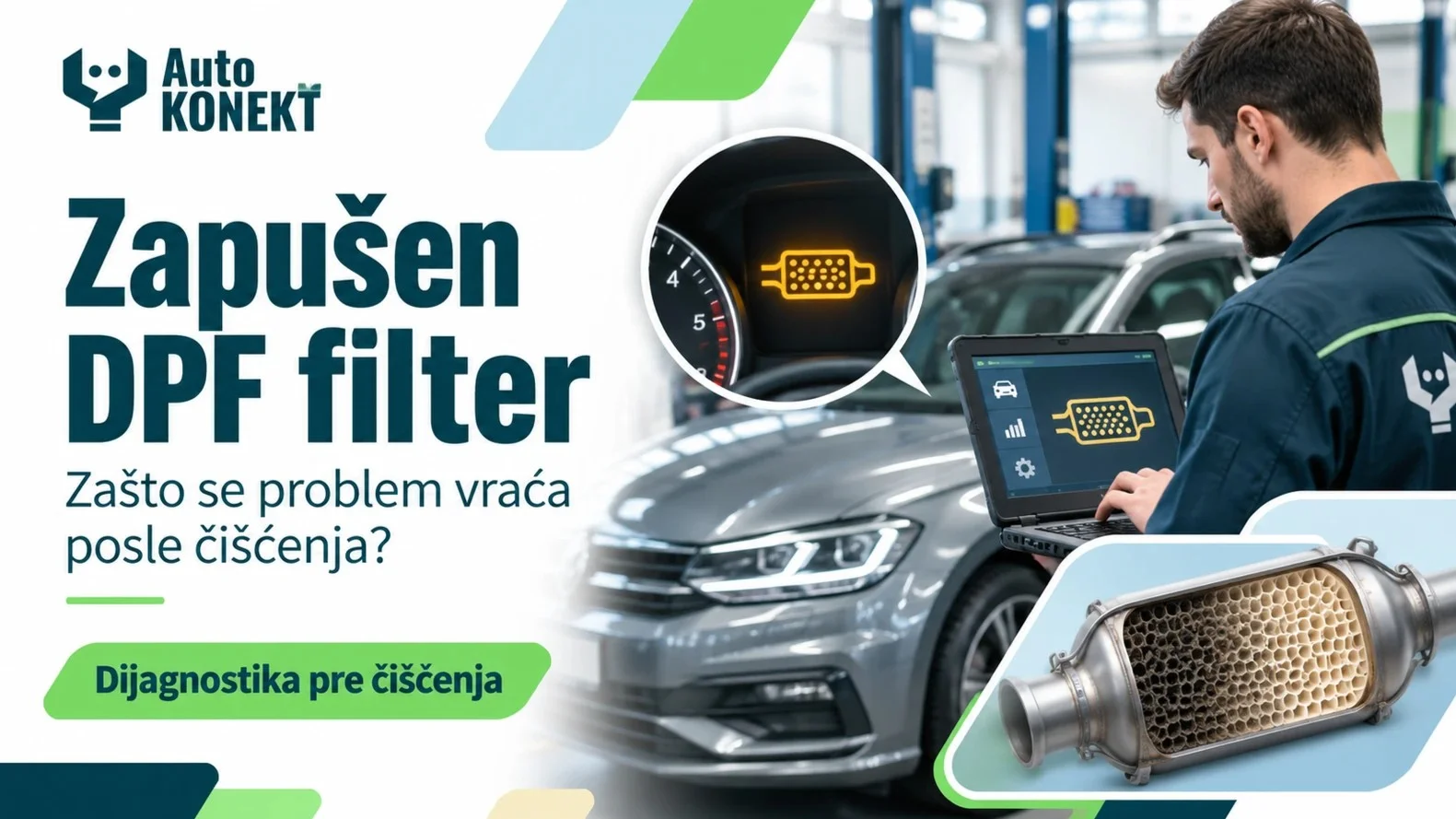
Clogged DPF Filter: Symptoms, Causes, and Why the Problem Returns After Cleaning
You've had your DPF cleaned. The warning light went out, your car regained its normal performance, and you thought the problem was solved. Then, a few weeks or months later, the same warning light came back on.
Was the cleaning ineffective? Possibly. But there's another explanation: a DPF often becomes clogged because something else in the vehicle isn't working properly. Until the underlying cause is identified, cleaning may only provide a temporary solution.
In this article, we'll explain how to recognise a clogged DPF, why the problem keeps coming back, and what you should check before paying for another cleaning.
In brief: The DPF traps soot and ash from exhaust gases. Soot burns off during regeneration, while ash remains. If the filter becomes clogged again shortly after cleaning, the cause often lies elsewhere: driving habits, sensors, the EGR valve, fuel injectors, or the turbocharger. That's why proper diagnostics should always come before cleaning.
What Does a DPF Do, and Why Does It Become Clogged?
A DPF (Diesel Particulate Filter) is a ceramic filter installed in the exhaust system of a diesel engine. Exhaust gases pass through its tiny channels, while soot particles are trapped in the filter walls. The filter is designed to collect particles. That's its job.
To prevent excessive clogging, the system periodically cleans the filter through a process called regeneration.
At higher exhaust gas temperatures, typically during longer journeys on open roads, accumulated soot gradually burns off. This is known as passive regeneration.
When passive regeneration isn't sufficient, the engine control unit initiates active regeneration, increasing the temperature inside the filter through additional fuel injection to burn off the soot.
Some vehicles also use a special additive that lowers the temperature required to burn soot. Where such a system is fitted, the additive reservoir must be refilled according to the manufacturer's maintenance schedule.
Soot vs. Ash: Why Driving on the Motorway Doesn't Always Solve the Problem
This is a distinction many drivers are unaware of, yet it determines which solution will actually work.
Soot consists primarily of carbon particles produced by incomplete fuel combustion. During regeneration, soot burns and is converted into gases.
Ash is a mineral residue, mainly originating from additives in engine oil, which engines inevitably consume in small quantities.
Ash cannot be burned off during regeneration. Instead, it gradually accumulates inside the filter over the years, permanently reducing its capacity.
That's why not every clogged DPF can be restored by driving on the motorway or performing a service regeneration.
If the filter is heavily loaded with ash, professional cleaning or replacement is necessary.
Ash accumulation after high mileage doesn't necessarily mean something is faulty. It's part of the filter's natural ageing process.
How to Recognise a Clogged DPF
Symptoms usually develop gradually:
DPF warning light on the dashboard. Often the first indication that the engine control unit has detected excessive filter loading. On some vehicles, the check engine light or glow plug warning light may illuminate instead.
Reduced engine performance. Throttle response becomes slower, particularly during acceleration or when driving uphill.
Limited engine operation (limp mode). When the filter becomes severely clogged, the engine control unit may restrict power and engine speed to protect the engine.
Increased fuel consumption. Greater exhaust backpressure can affect engine efficiency, while frequent regenerations consume additional fuel.
Signs of frequent regeneration. The cooling fan continues running after the engine is switched off, idle speed is higher than usual, the start-stop system becomes temporarily unavailable, or a strong smell of hot exhaust gases is noticeable.
Unusual increase in engine oil level. The oil level rises noticeably even though no oil has been added. We'll explain this in more detail below.
Black smoke from the exhaust is more commonly associated with a damaged or removed DPF than with a clogged one.
Why Does the DPF Become Clogged Again After Cleaning?
A clogged DPF isn't always a problem with the filter itself.
If the warning light returns shortly after cleaning, the following potential causes should be investigated:
Driving habits. Short city journeys often don't allow enough time for regeneration to finish. Each interrupted cycle leaves soot behind in the filter.
EGR valve. When the Exhaust Gas Recirculation valve doesn't operate correctly, for example due to carbon deposits, the engine may produce more soot than the DPF can effectively remove.
Fuel injectors. Poor fuel atomisation increases soot formation during combustion.
Turbocharger oil leaks. Oil entering the exhaust system contributes to additional deposits and ash accumulation.
Differential pressure sensor. This sensor measures the pressure difference before and after the filter, helping the engine control unit estimate how heavily the DPF is loaded. A faulty sensor or damaged pressure hose can provide incorrect readings. As a result, the control unit may indicate that the filter is clogged when it isn't, or fail to initiate regeneration when needed.
Exhaust gas temperature sensors. Without accurate temperature readings, regeneration may fail to start or may be interrupted.
Thermostat. If the engine cannot reach its normal operating temperature, regeneration may not begin.
Incorrect engine oil. Vehicles equipped with a DPF require engine oil that meets the manufacturer's specifications, typically low-SAPS oil with reduced levels of sulphated ash, phosphorus, and sulphur. Using unsuitable oil can accelerate ash accumulation in the filter.
Natural ash accumulation. After high mileage, the filter may simply reach the limit of its capacity.
There's also an important final step.
After cleaning or replacing the DPF, some vehicles require a specific diagnostic procedure to update the filter condition data stored in the engine control unit, in accordance with the manufacturer's instructions.
This procedure isn't the same for every vehicle.
Before paying for another cleaning, request diagnostics to determine why the filter keeps becoming clogged. On AutoKonekt, you can find verified service centres in your city and book an appointment.
Engine Oil Level Rising? When Should You Be Concerned?
In some diesel engines, a portion of the additional fuel injected during active regeneration can enter the crankcase and mix with the engine oil.
For this reason, a small increase in oil level can be a normal consequence of regeneration in certain vehicles, as manufacturers often explain in their owner's manuals.
The problem arises when regeneration cycles are repeatedly interrupted.
More fuel can accumulate in the oil, diluting it and reducing its ability to lubricate the engine effectively. This may accelerate wear on bearings, the turbocharger, and other engine components.
An unusual increase in oil level deserves attention, particularly if it rises above the MAX mark.
Other possible signs of oil dilution include noticeably thinner oil or an unusual smell of fuel.
In these situations, the vehicle should be checked by a service professional rather than driven further in an attempt to complete regeneration.
The service centre should inspect the condition of the engine oil, replace it if necessary, and determine why regeneration cycles are being interrupted.
When Should You Avoid Attempting DPF Regeneration Yourself?
Many vehicle manufacturers recommend continuing to drive at a specified speed when the DPF warning light comes on, allowing the regeneration process to finish.
However, this recommendation generally applies when the DPF warning light appears without other signs of a malfunction.
Do not attempt regeneration yourself. Contact a service centre if:
the engine has entered limp mode and power is restricted;
the check engine warning light is illuminated or flashing alongside the DPF warning light;
the engine oil level is rising unusually or exceeds the MAX mark;
the DPF warning light repeatedly returns within a short period;
you notice a burning smell or unusual exhaust smoke.
In these circumstances, forcing regeneration through continued driving may place additional strain on the filter and engine and, in some cases, damage the filter's ceramic structure.
DPF Cleaning: What Separates a Good Procedure from a Bad One?
There is no single cleaning method suitable for every situation.
The correct approach depends on what has accumulated inside the filter.
Service or forced regeneration: Performed using diagnostic equipment, this process burns off soot but does not remove accumulated ash.
Chemical cleaning: Chemical treatments applied without removing the filter may help with mild soot deposits but generally have limited effectiveness against ash.
Professional off-vehicle cleaning: Specialised cleaning processes, including thermal treatment or controlled washing and drying, can remove soot and accumulated ash. A reputable service provider should check the filter's flow performance after cleaning and provide a test report.
Filter replacement: Necessary when the ceramic structure is cracked or melted, or when cleaning can no longer restore sufficient exhaust flow.
Washing a DPF isn't necessarily a bad procedure.
The problem is improper cleaning, such as using excessively high-pressure water jets or failing to dry the filter correctly.
Poor cleaning methods can damage the ceramic structure, leave deposits behind, or allow moisture to remain inside the filter.
Ask the service centre which cleaning method it uses, whether it measures flow before and after cleaning, and whether it will carry out any engine control unit procedures required by the vehicle manufacturer.
DPF Removal and Regulations in Serbia
When DPF problems keep returning, some vehicle owners consider removing the filter altogether.
Before making that decision, there are several important things to understand.
According to Serbia's Rulebook on the Classification of Motor Vehicles and Trailers and Technical Requirements for Vehicles in Road Traffic, the implementation of stricter requirements relating to certain vehicle equipment during roadworthiness inspections has been postponed until 5 July 2027.
The relevant provision explicitly concerns catalytic converters on vehicles first registered in Serbia on or before 5 July 2021.
However, this postponement should not be interpreted as general permission to remove a factory-installed DPF system.
Before making any modifications, it is important to check the technical and legal requirements applicable to the specific vehicle.
Removing the DPF changes the vehicle's original emissions control configuration and may cause problems during roadworthiness inspections or when selling the vehicle.
If you're buying a used diesel car, make sure the DPF is still installed.
Source: Rulebook on the Classification of Motor Vehicles and Trailers and Technical Requirements for Vehicles in Road Traffic, consolidated text, Legal Information System of the Republic of Serbia. Legal status checked: November 2026.
What Should You Do If the DPF Warning Light Comes Back On?
1. Check your owner's manual. If there are no other signs of a malfunction, complete the regeneration process by driving as recommended by the vehicle manufacturer.
2. If the warning light returns soon afterwards, don't immediately book another cleaning. Arrange a diagnostic inspection first.
3. Ask the service centre to check the fault codes, differential pressure, estimated soot and ash levels, and regeneration history.
4. Have the EGR valve, fuel injectors, turbocharger, sensors, and thermostat checked.
5. Only once the underlying cause has been identified should you decide whether the DPF needs cleaning or replacement.
How to Make Your DPF Last Longer
Proper vehicle use and regular maintenance can significantly reduce the risk of premature DPF clogging. However, natural ash accumulation cannot be prevented entirely.
Here are five habits that can help, even if your vehicle currently has no DPF problems.
1. Take longer drives under suitable conditions from time to time.
If you mostly drive in the city, occasionally take your vehicle on a 20–30-minute journey on an open road, maintaining a steady speed with the engine fully warmed up.
You don't need to drive fast. The important thing is to allow sufficient uninterrupted driving time.
2. Follow the manufacturer's regeneration recommendations.
If your vehicle indicates that regeneration is in progress, or you recognise the signs of regeneration, avoid switching off the engine before the process finishes whenever reasonably possible.
3. Use the correct engine oil.
Vehicles equipped with a DPF generally require low-ash engine oil that meets the exact specifications stated in the owner's manual.
This also applies when topping up engine oil between scheduled services.
4. Address engine problems promptly.
A faulty EGR valve, fuel injectors, turbocharger, or sensor can do more than affect engine performance. These problems can also shorten the DPF's service life.
On vehicles equipped with a DPF additive system, make sure the additive is replenished on schedule.
5. Never ignore warning lights.
A DPF or engine warning light that remains illuminated for weeks is unlikely to disappear without attention.
The sooner you respond, the greater the chance that regeneration will be sufficient, rather than requiring professional cleaning or filter replacement.
Frequently Asked Questions
How Long Does DPF Regeneration Take?
Regeneration typically takes approximately 10–30 minutes, although it can take longer depending on the vehicle and driving conditions.
Always follow the manufacturer's recommendations.
Can I Drive with the DPF Warning Light On?
If only the DPF warning light is illuminated and the vehicle is otherwise operating normally, many manufacturers recommend driving under suitable conditions to allow regeneration to finish.
However, if the engine has entered limp mode, the check engine light is also illuminated, or the oil level exceeds the MAX mark, driving should be kept to a minimum and the vehicle should be inspected by a service professional.
How Can I Check Whether the DPF Has Been Removed?
The most reliable approach is a diagnostic inspection combined with a physical examination at a service centre.
On vehicles with a removed DPF, the differential pressure sensor may show unusually low readings. Alternatively, the system may have been disabled through software modifications, preventing the engine control unit from displaying DPF data.
Exhaust smoke opacity can also be measured, and the filter housing can be physically inspected.
If you're buying a used diesel car, this check is well worth carrying out.
When Is DPF Cleaning No Longer Worthwhile?
Cleaning may no longer be effective when the filter's ceramic structure is cracked or melted, or when extensive ash accumulation after high mileage prevents the filter from regaining adequate flow capacity.
Cleaning also offers little long-term benefit if the filter keeps clogging because the underlying cause hasn't been resolved.
In that situation, even a new DPF may not last very long.
How Often Should a DPF Be Cleaned?
A properly functioning DPF system in a vehicle regularly driven outside urban areas may not require professional cleaning for many years.
If cleaning becomes necessary every few months, it's a strong indication that an underlying problem needs to be investigated.
Don't pay for DPF cleaning without knowing what's causing the problem. Find out why the filter keeps clogging first. On AutoKonekt, you can find a service centre offering diesel engine diagnostics and book an appointment.