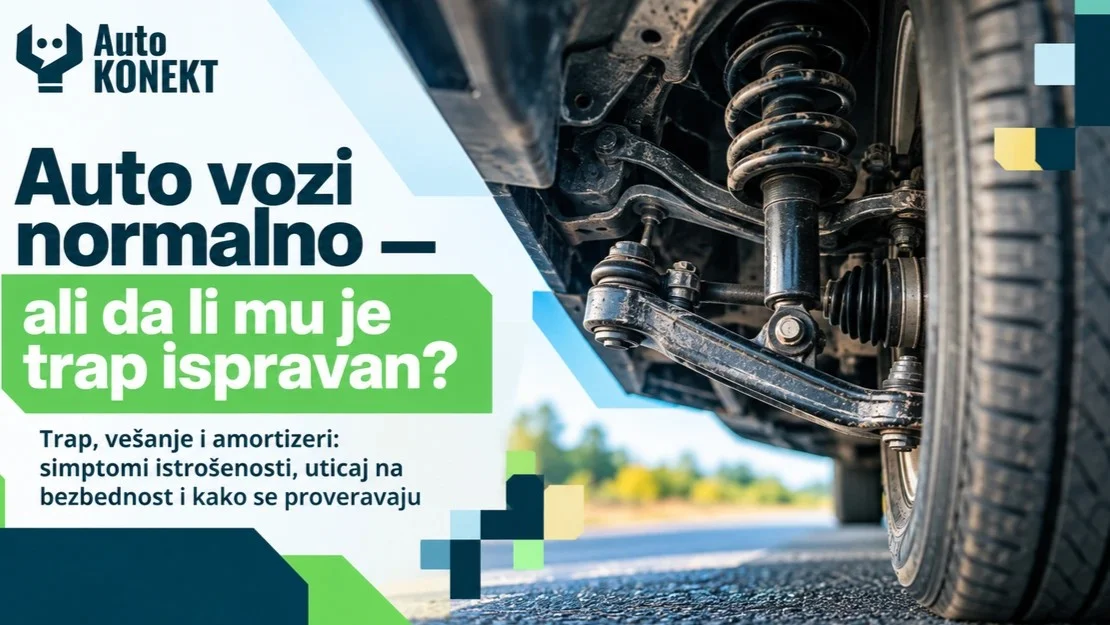
The Car Drives Normally — But Is Its Suspension Really in Good Condition?
Suspension, steering and shock absorbers: signs of wear, their impact on safety and how they are inspected
When a bulb burns out, you notice it. When a warning light appears on the dashboard, you see it. But when a shock absorber wears out or play develops in a tie-rod end, nothing dramatic happens. The car still drives, the steering wheel still turns, and the changes happen so gradually that the driver often gets used to them before noticing anything is wrong.
That is why the suspension and steering system is one of the most underestimated parts of a vehicle. Its condition is not simply a matter of comfort — it determines how well the tyres stay in contact with the road when you brake, turn or hit a pothole. In this article, we explain what the suspension system actually consists of, how its condition affects the wear of other components and vehicle safety, and how it is inspected today — not only “by eye”, but with equipment that can actually measure its performance.
What Do We Actually Mean by Suspension and Steering?
In everyday language, what drivers often refer to as the vehicle’s “running gear” includes virtually everything between the body and the wheels that plays a role in wheel movement and steering. Technically, it consists of three closely connected systems:
• Suspension links and joints connect the wheel to the vehicle body and guide it along a precisely defined path. These include control arms, rubber bushings, ball joints, the anti-roll bar and its links.
• Springs and shock absorbers support the weight of the vehicle and control suspension movement, allowing the wheel to settle as quickly as possible after every bump.
• Steering components — including the steering rack, tie rods and tie-rod ends — transfer steering-wheel movement to the wheels. Wheel bearings are also commonly considered part of the same overall system.
The Job of the Entire System in One Sentence
To keep every tyre in contact with the road, at the correct angle, at all times.
Everything else — from comfort and quietness to steering precision — depends on how well the suspension and steering system performs this task.
Why Worn Suspension Components Can Be Difficult to Notice
Suspension components rarely fail overnight. Instead, they gradually lose their effectiveness over thousands of kilometres.
A shock absorber that has lost some of its efficiency still works — just not as well. A rubber bushing that has started to crack still holds the control arm in place — but with some play.
Drivers unconsciously adapt to these gradual changes: they brake slightly earlier, make more steering corrections and enter corners a little more slowly.
Modern cars can hide the problem even further. Sound insulation absorbs knocking noises, while electronic stability systems compensate for behaviour that would have been immediately noticeable in an older vehicle.
As a result, the problem often becomes obvious only in a situation where the suspension can no longer respond properly — hard braking, a wet road or a pothole in the middle of a corner.
How Suspension Condition Affects Safety
Longer Braking Distances
Shock absorbers are not there just for comfort.
Their main task is to bring the tyre back into firm contact with the road as quickly as possible after every bump. A worn shock absorber allows the wheel to “bounce”, and a tyre that is not firmly in contact with the road cannot brake effectively.
Comparative tests carried out by the German TÜV at the request of a shock absorber manufacturer showed that a vehicle with shock absorbers worn by approximately 50% required several additional metres to stop when braking from 80 km/h. In some tests, the difference was approximately the length of one car.
That can be the difference between stopping before a pedestrian crossing and stopping on it.
ABS and ESP Can Only Work With What the Suspension Gives Them
Anti-lock braking and electronic stability systems regulate braking force at each wheel individually.
If a tyre temporarily loses contact with the road because of a worn shock absorber, these systems have less grip available through which to transfer braking or corrective forces to the road.
Electronics cannot compensate for a tyre that is not in contact with the surface.
Corners, Rain and a Fully Loaded Car
The difference between a healthy and a worn suspension becomes most noticeable when the vehicle is under additional stress: on wet roads, when cornering over uneven surfaces, in strong crosswinds or when the car is fully loaded with passengers and luggage.
Worn shock absorbers increase body roll and the sensation of the vehicle “floating”, while play in suspension and steering components slows the vehicle’s response to steering inputs.
Play in the Steering System Is More Than Just an Annoyance
Worn tie-rod ends and ball joints often first appear as knocking noises and imprecise steering.
If ignored for long enough, they can lead to serious failure, where the wheel is no longer securely connected to the rest of the vehicle.
A defective steering system is also one of the faults that is not tolerated during a roadworthiness inspection.
Human error remains the main cause of road accidents, but vehicle condition is far from irrelevant. According to a 2012 European Commission estimate, technical defects in vehicles were responsible for approximately 6% of all road accidents involving passenger cars.
It is one part of the safety equation that drivers can influence directly.
The Chain of Wear: How One Worn Component Affects the Others
Suspension and steering components work as a system, which means wear in one component can place additional stress on neighbouring parts:
• A worn shock absorber allows more impact energy to be transferred to the springs, mounts and bearings, while also causing uneven, “cupped” tyre wear.
• A cracked rubber bushing or worn ball joint can change the angle at which the wheel sits, moving the alignment outside the manufacturer’s specifications and causing the tyre to wear more heavily on one side.
• Play in tie-rod ends transfers shocks and vibrations to the steering rack and can accelerate its wear.
• Incorrect wheel alignment means the vehicle is constantly pulling slightly to one side, while the driver compensates with the steering wheel. The tyre then scrubs against the road and wears more quickly.
This is why a repair that is postponed rarely remains the same repair.
Replacing one component in time is usually much simpler than replacing that same component, a pair of tyres and another two or three neighbouring parts several months later.
Road conditions can accelerate this process even further. Potholes after winter, speed bumps, kerbs during parking and stretches of damaged asphalt put much greater loads on the suspension than smooth motorway driving.
If you would like to understand the difference between wheel alignment and wheel balancing, take a look at our previously published article:
[INTERNAL LINK: wheel alignment vs. wheel balancing]
CHECK YOUR SUSPENSION BEFORE IT REMINDS YOU
Do not wait for knocking noises, pulling to one side or uneven tyre wear. Find a workshop for a suspension inspection on AutoKonekt and book your appointment online.
Signs That Your Suspension Needs Attention
These are some of the most common warning signs. Some of them only appear once wear has already become significant, so it is better not to wait until the vehicle begins showing obvious symptoms.
• knocking noises or dull impacts when driving over potholes, railway tracks or speed bumps
• the car pulls to one side, or the steering wheel is not centred when driving straight
• vibrations through the steering wheel at certain speeds, although these may also be caused by unbalanced wheels, tyres or other components
[INTERNAL LINK: wheel alignment vs. wheel balancing]
• uneven tyre wear, particularly on the inner or outer edge
• the body continues to bounce after a bump or dives heavily under braking
• traces of oil on the shock absorber body
• squeaking or cracking noises when turning the steering wheel while stationary
How Suspension Is Inspected Today: From “Shaking the Wheel” to Actual Measurement
A traditional suspension inspection involves lifting the vehicle, manually moving the wheels and visually inspecting the components.
That approach still has value, but it also has limitations.
When a wheel is lifted, it is no longer carrying the weight of the vehicle, and some types of play only become visible when the components are under load and subjected to forces similar to those experienced while driving.
That is why an increasing number of workshops in Serbia now use equipment for dynamic suspension inspection and shock absorber testing.
Play Detector: Simulating Driving Forces While the Car Stands Still
The vehicle is positioned on moving plates that shift the wheels forwards and backwards, from side to side and diagonally, simulating the forces generated during braking, acceleration and cornering.
While the plates are moving, a mechanic observes each joint and bearing from underneath the vehicle, using a light.
Play in a tie-rod end, ball joint, rubber bushing or wheel bearing may only become visible when force is applied to the component.
This type of equipment makes that possible in a repeatable way, while the vehicle remains loaded with its full weight.
Shock Absorber Tester: How Well Does the Tyre Really Stay in Contact With the Road?
One of the most widespread methods for testing shock absorbers while they are installed on the vehicle is the so-called EUSAMA method, developed by the European Shock Absorber Manufacturers Association.
A plate beneath the wheel vibrates and causes the suspension to oscillate. The equipment then measures how much the force with which the tyre presses against the surface falls at the least favourable point compared with the static weight carried by that wheel.
The result is expressed as a percentage and can be interpreted approximately as follows:
• below 20%: the shock absorber is not performing its function adequately
• 20–40%: acceptable, but the condition should be monitored
• above 40%: good
• above 60%: very good
How to Interpret the Result
This scale is indicative and is based on the EUSAMA recommendation.
Some testing equipment uses a different method or rating scale, so the result should always be interpreted together with the workshop’s explanation.
The percentage also does not measure the shock absorber alone. It reflects the behaviour of the entire suspension assembly at that wheel, and tyre pressure can also affect the result.
That is why a proper test should begin with checking tyre pressures.
Another important figure is not only the individual percentage for each wheel, but also the difference between the left and right wheel on the same axle.
A large difference means that the vehicle may respond differently on the left and right side during braking and cornering.
The greatest advantage of this type of inspection for the driver is that it provides a measured result rather than an assessment made only “by eye”.
That makes it easier to discuss with the mechanic what genuinely needs to be replaced and what can still wait.
Where Can This Type of Inspection Be Carried Out in Serbia?
If you want the inspection to go beyond a simple visual check, look for a workshop equipped with a suspension play detector and/or a shock absorber tester.
One of the workshops available through AutoKonekt that has specialised equipment for inspecting suspension systems and shock absorbers is Auto Centar Anđelković in Belgrade.
It is a family-run workshop whose tradition dates back to 1961 and which was formerly an authorised service centre for Škoda and Zastava vehicles.
Workshop profile and online booking:
Auto Centar Anđelković on AutoKonekt
FIND A WORKSHOP IN YOUR CITY
Browse AutoKonekt partner workshops, tyre centres and roadworthiness inspection stations and choose the one closest to you.
How Often Should the Suspension Be Checked?
There is no universal mileage interval after which suspension components should be replaced, because their lifespan depends on road conditions, vehicle load and driving style.
That is why it makes more sense to inspect and measure than to guess.
A suspension inspection is worth considering:
• when changing tyres seasonally, twice a year
• after hitting a large pothole or kerb
• before a long journey, especially with a fully loaded vehicle
• when buying a used car
• as soon as you notice any of the symptoms listed above
A Roadworthiness Inspection Is Not a Full Suspension Diagnosis
Drivers often say:
“I passed the roadworthiness inspection, so my suspension must be fine.”
A roadworthiness inspection is a mandatory check that verifies whether a vehicle meets minimum safety requirements at the time of inspection, typically once a year.
Its purpose is to keep unsafe vehicles off the road — not to determine how worn individual components are or estimate how much service life they have left.
Between two inspections, a car may travel thousands of kilometres over potholes, speed bumps and damaged roads.
A shock absorber that was close to the acceptable limit during the inspection may fall below it only a few months later.
Conclusion
Suspension components rarely fail all at once.
More often, the driver gradually gets used to a car that no longer responds the way it did when everything was working properly.
That is why you should not wait until knocking noises or poor vehicle behaviour become obvious.
Periodic inspection of the suspension and shock absorbers can help preserve your tyres, other vehicle components and, most importantly, your car’s contact with the road.
Frequently Asked Questions
What Is the Suspension System on a Car?
In everyday use, the term refers broadly to the suspension, damping and steering components that connect the wheels to the vehicle body.
These include control arms, rubber bushings, ball joints, shock absorbers, springs, tie rods, tie-rod ends and wheel bearings.
How Can I Tell If My Shock Absorbers Are Worn?
Common signs include excessive body movement after a bump, heavy front-end dive during braking, uneven tyre wear and traces of oil on the shock absorber.
A more reliable answer can be obtained using a shock absorber tester, which provides a measured percentage indicating suspension performance.
How Long Do Shock Absorbers Last?
There is no universal mileage figure because shock absorber lifespan depends on road conditions, vehicle load and driving style.
For that reason, regular inspection is more useful than replacing them solely according to mileage.
Should Shock Absorbers Be Replaced in Pairs?
Yes.
As a general rule, both shock absorbers on the same axle should be replaced together so that the left and right wheels have similar damping characteristics and the vehicle behaves predictably during braking and cornering.
Is Wheel Alignment Necessary After Suspension Repairs?
After replacing components that affect wheel position — such as tie rods, tie-rod ends or control arms — the wheel geometry should be checked and adjusted.
This helps prevent uneven tyre wear and ensures that the vehicle tracks correctly.
How Much Does a Suspension Inspection Cost?
The price depends on the workshop and the type of inspection.
Some workshops perform a conventional inspection with the vehicle on a lift, while others use suspension play detectors and shock absorber testing equipment.
Before booking, check exactly what the inspection includes.
What Is a Suspension Play Detector?
It is a testing device with moving plates that shift the vehicle’s wheels in different directions and simulate the forces generated while driving.
While the plates are moving, a mechanic inspects the suspension from underneath the vehicle and checks for play in joints, rubber bushings, steering components and wheel bearings.