How to Top Up Antifreeze: 6 Steps and 5 Mistakes to Avoid
Coolant is one of the few things under the bonnet that you can check yourself in just two minutes. Yet it is surrounded by more bad advice than almost any other fluid in your car: that stronger antifreeze is always better, that its colour tells you what type it is, and that topping it up solves every problem.
Here is everything you need to know, step by step: how to check the level, what to add, the five most common mistakes, and the signs that it is time for a garage rather than another bottle of antifreeze.
What Does Coolant Do (and Why Is It Not Just for Winter)?
Coolant is a mixture of water, glycol and additives. Its main job is to carry heat away from the engine, but that is not all. Glycol lowers the freezing point and raises the boiling point, while additives protect metal components in the cooling system against corrosion. With the correct mixture, the boiling point can reach around 135°C, which is why your engine needs coolant in summer as well as in freezing weather.
Additives deteriorate over time. As a result, coolant may lose its corrosion protection even when the level looks normal. The level is the first thing to monitor; the condition of the coolant is the second.
How to Check Your Coolant Level, Step by Step
You do not need any tools for this check. All you need is a cold engine and good lighting.
Step 1: Let the Engine Cool Down Completely
Check the level when the engine is cold, ideally in the morning before driving or after the car has been parked for several hours. When the engine is warm, the coolant expands and the level appears higher than it really is.
Important: never open the expansion tank cap while the engine is hot, even if it is switched off. The system is pressurised, and hot coolant and steam can suddenly escape, causing serious burns.
Step 2: Park on Level Ground
On a slope, the coolant sits at an angle inside the tank, making the reading inaccurate.
Step 3: Locate the Expansion Tank
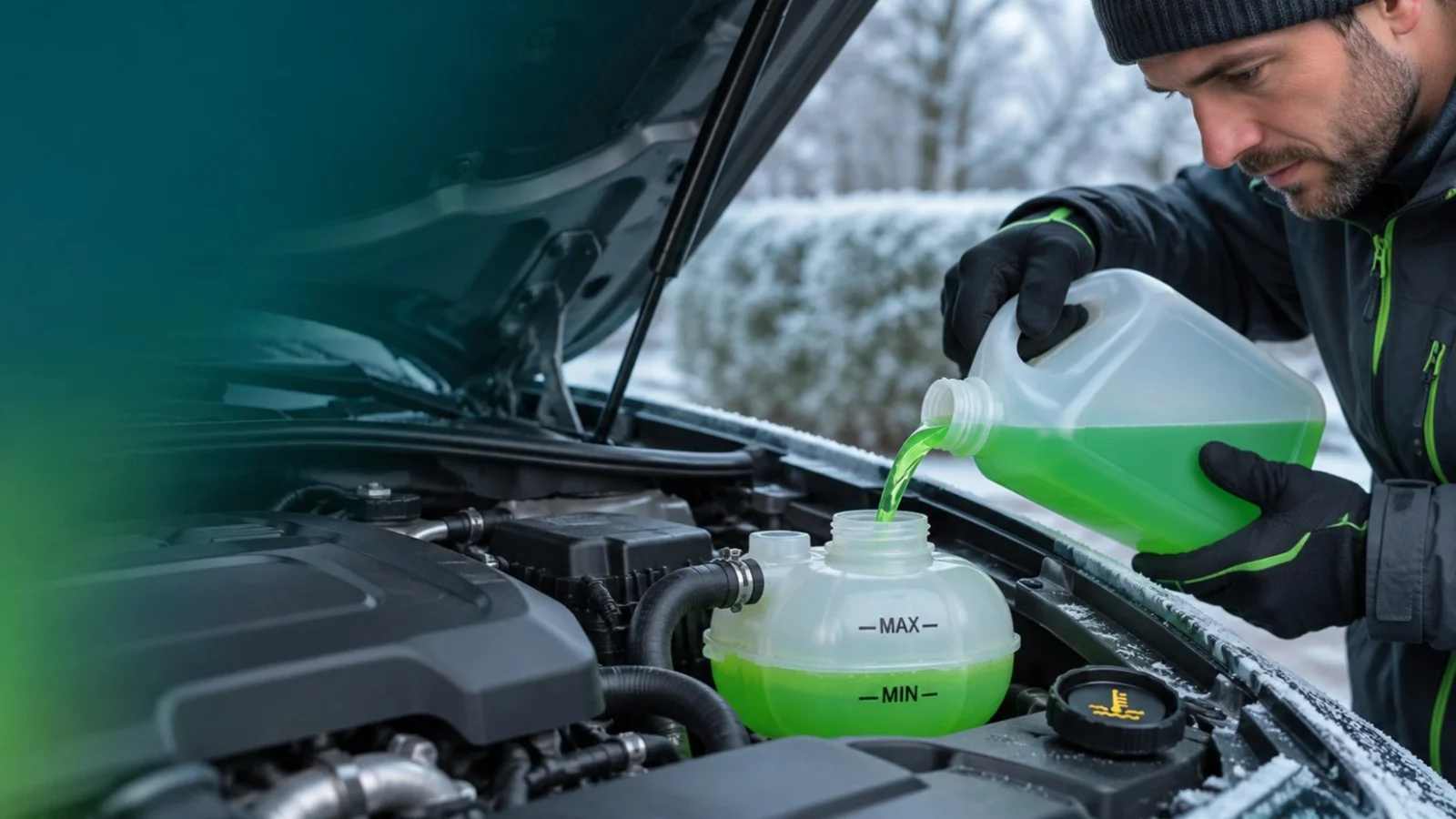
This is a translucent plastic tank in the engine compartment, marked MIN and MAX on the side (or L and F on some cars). The cap usually carries a thermometer symbol above wavy lines. Do not confuse it with the windscreen washer reservoir, which has a windscreen-and-spray symbol. Antifreeze must not be poured into that reservoir.
Step 4: Check the Level and Inspect the Coolant
With the engine cold, the level should be between the MIN and MAX marks. Look at the coolant itself too: it should be clear. Brown or rusty colouring, sediment, an oily film or foam are signs that a garage should inspect the system.
If your car has a warning light or message for low coolant, do not wait for it to appear. A quick check once a month and before every long journey costs nothing.
Which Coolant Should You Add?
Specification, Not Colour
The most important rule is to use the coolant specified by the vehicle manufacturer. You will find this information in the owner’s manual, usually in the maintenance section or technical specifications. Then look for the same specification on the antifreeze packaging, such as VW TL 774 or the relevant manufacturer approval for your vehicle.
Colour will not help you here. It is not governed by a universal standard: different manufacturers dye the same type of coolant differently, and many products are sold as “universal”. Green coolant from one manufacturer may have little in common with green coolant from another.
What Do G11, G12, G13 and G12evo Mean?
The designations G11, G12, G12+, G12++, G13 and G12evo come from the Volkswagen system, but they have become widely used shorthand for antifreeze types:
• G11 is an older type with inorganic additives (silicates), mainly intended for older vehicles.
• G12 and G12+ are organic-acid technology (OAT) coolants without silicates.
• G12++ and G13 are so-called low-hybrid (lobrid) coolants: organic formulations with a small amount of silicates and a long service life.
• G12evo (VW TL 774-L specification) is the newest designation, intended for newer VW Group vehicles. Manufacturers label many coolants meeting this specification as compatible with G12+, G12++ and G13, but that compatibility must be stated on the packaging.
These designations are no substitute for the specification in your owner’s manual, particularly if your car is not part of the VW Group.
Can Different Types of Antifreeze Be Mixed?
The safest option is to add the same coolant that is already in the system. If that is not possible, follow one simple rule: only mix coolants whose compatibility is confirmed by both the vehicle manufacturer and the coolant manufacturer. General “what can be mixed with what” charts are unreliable because compatibility depends on the specific products.
Mixing incompatible types carries greater risks. Deposits may form and block narrow passages in the radiator and engine. If you do not know what is currently in the system, it is better to have a garage replace the coolant than to guess.
Ready-Mixed Coolant or Concentrate?
You can buy ready-mixed coolant, which can be poured straight in, or concentrate, which must be diluted with water. Ready-mixed coolant is easier for topping up because it removes the risk of using the wrong ratio. Concentrate must be mixed exactly as directed on the packaging. Manufacturers recommend distilled or demineralised water because tap water can leave limescale deposits.
Not Sure Which Antifreeze Is in Your Car?
Or not sure what freezing temperature it currently protects against? A garage can check this in a few minutes and tell you whether a top-up is enough or a full coolant change is needed.
Find a garage at autokonekt.rs →
How to Top Up Antifreeze in 6 Steps
1. Make sure the engine is cold and the vehicle is parked on level ground.
2. Place a cloth over the expansion tank cap and unscrew it slowly to release any remaining pressure.
3. Add coolant slowly, a little at a time, up to the level specified for a cold engine, without exceeding the MAX mark.
4. Refit the cap and tighten it fully. A cap that is not properly closed can cause the engine to overheat while driving.
5. Wipe up any spills. Antifreeze is poisonous and its sweet taste can attract animals. Keep any unused coolant sealed and out of reach of children and pets. Do not pour old coolant down a drain or onto the ground; take it to a garage for proper disposal.
6. After your next drive, let the engine cool down again and recheck the level. If it has dropped again, topping up has not solved the problem.
If the expansion tank was empty, air may have entered the system. On many vehicles, the cooling system then needs to be bled, which is best left to a garage.
Hybrid and electric vehicles often have several separate cooling circuits, for example for the battery and electronics, with different tanks and specialist fluids. Only top them up in accordance with the owner’s manual.
5 Mistakes to Avoid
1. “The More Antifreeze, the Better the Protection”
More antifreeze does not automatically mean better engine protection. In some mixtures, a higher concentration can lower the freezing point further, but it also makes the fluid less effective at transferring heat. Undiluted antifreeze freezes at around −13°C, so “pure antifreeze” is not the answer even in winter.
That is why car manufacturers specify an acceptable concentrate-to-water ratio, often around 50:50, with an upper limit of 60% antifreeze for many vehicles. What matters is the vehicle manufacturer’s guidance, not the assumption that a stronger mixture must always be better.
2. “The Colour Tells You Which Antifreeze It Is”
As we have already explained, it does not. When buying coolant, check the specification on the packaging rather than the colour in the bottle or expansion tank.
3. Opening the Cap and Topping Up a Hot Engine
There is a risk to the engine as well as a risk of burns. If the engine has overheated because the coolant level is low, suddenly adding cold fluid may cause cracks. Wait until the engine has cooled down, then add the coolant slowly and gradually.
4. “Just Add Water — It Will Be Fine”
In an emergency, if you do not have the correct coolant, ADAC advises adding water rather than a different type of coolant, and that is sound advice. Distilled water is best, but if none is available, a small amount of clean tap water can be used in a genuine emergency to get you home or to a garage. Have the mixture checked afterwards. The problem begins when topping up with water becomes a habit. Every 100 ml of water dilutes the mixture and reduces its protection against freezing and corrosion. If you have added water during the year, have the coolant’s freezing protection checked before winter. Water alone is never a substitute for proper coolant.
5. Topping Up Without Investigating the Cause
The cooling system is closed. When it is working properly, the level should barely change over the course of months. If you need to top it up repeatedly, the coolant is going somewhere. Topping up merely delays the repair; it does not solve the problem.
When Topping Up Is Not Enough
Take your car to a garage if you notice any of the following:
• the level drops again a few days or weeks after topping up;
• coloured drops or a puddle appear beneath the car, or deposits are visible around hoses and connections;
• you notice a sweet smell around the engine or inside the cabin;
• the cabin heater is less effective than before;
• white exhaust smoke with a sweet smell persists after the engine warms up (a little white vapour on a cold morning is normal);
• the coolant is brown or rusty, with an oily film;
• light-coloured, milky foam appears under the oil filler cap together with a drop in coolant level (foam alone may also be caused by condensation during frequent short journeys, especially in winter, and does not prove a head-gasket failure);
• the level is above MAX when the engine is cold, even though you have not topped it up;
• the temperature gauge rises higher than usual or the temperature warning light comes on.
The causes range from relatively simple problems, such as a split hose, a loose hose clamp or a faulty expansion tank cap, to more serious issues involving the water pump, radiator or cylinder-head gasket. A leak is not always visible from the outside because coolant can also escape inside the engine. A garage can identify the cause by pressure-testing the cooling system. The sooner you act, the less likely the leak is to lead to overheating and much more expensive damage.
Why short journeys cause condensation and engine wear: [[LINK: Short City Journeys]]
If the temperature gauge is already climbing, read what to do immediately: [[LINK: Engine Temperature Is Rising — Can I Keep Driving?]]
Coolant Level Dropping, but No Visible Leak?
A garage can pressure-test the cooling system and locate the leak before the engine overheats. Choose an AutoKonekt partner garage in your city.
Garages in your city: autokonekt.rs/lokacije →
When Should Coolant Be Replaced?
There is no single replacement interval. Older coolant types typically needed changing every few years. Modern long-life coolants can last a very long time in many vehicles, provided they are not contaminated, and some manufacturers do not specify routine replacement at all. Follow the interval in your vehicle’s service schedule. Coolant should be replaced sooner if it becomes contaminated with oil or rust, and when replacing the water pump or radiator.
Before winter, check not only the level but also the lowest temperature against which the coolant provides protection. A garage can do this in a few minutes using a refractometer or coolant tester. This check is especially important if you have added water during the year.
What else should be checked before winter: [[LINK: Winter Vehicle Check]]
Frequently Asked Questions
How Often Should I Check the Coolant Level?
Once a month and before every long journey is enough, always when the engine is cold. If you have recently topped it up, check more frequently until you are sure the level remains stable.
Can I Add Water Instead of Antifreeze?
In an emergency, yes. Distilled water is best, but if none is available, a small amount of clean tap water can get you to a garage. It is not a long-term solution because water dilutes the mixture, reducing protection against freezing and corrosion. Have the mixture checked afterwards.
Can I Mix Antifreeze of Different Colours?
Colour is not a reliable guide. Check the specifications on the packaging and in the owner’s manual. The best option is to use the same type already in the system.
Why Does the Coolant Level Keep Dropping if I Cannot See a Leak?
A leak is not always visible. Coolant can evaporate when it reaches hot engine components or escape internally. A garage can find the cause by pressure-testing the system.
What if the Level Is Above MAX?
If you have just added too much, the excess can be removed. If you have not topped it up but the level is above MAX with the engine cold, take the car to a garage.
Can I Drive if the Coolant Level Is Below MIN?
A level below MIN should be topped up as soon as possible. If the expansion tank is empty or the temperature gauge is rising, do not continue driving.
In Brief
Check the level with the engine cold, use coolant that meets the required specification rather than choosing by colour, and do not assume a stronger mixture is always better. If the level keeps falling, the problem is not the bottle of antifreeze — it is the cooling system, and that is when you need a garage.