Hit a pothole? Here’s what could be damaged even if your tyre looks fine
A dull thud, a brief jolt through the steering wheel — and it’s over. You pull over and look at the wheel: the tyre is holding air and there isn’t a scratch on the rim. It’s only natural to think everything is fine.
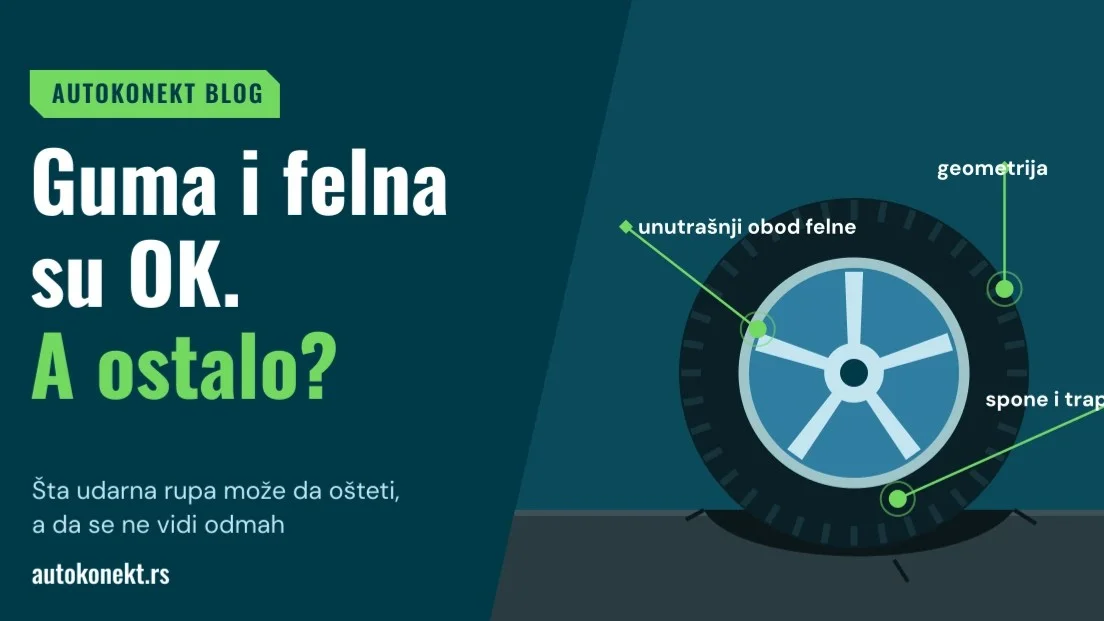
But after a hard impact, a visual check is not enough. The force does not stop at the tyre and rim. It travels through the suspension and steering system, and some damage may not become apparent for days or weeks. That is why a harder impact calls for extra caution, even if the tyre is still holding pressure: drive gently until the car can be inspected and pay attention to any new symptoms.
In this article, you’ll learn what can be damaged without any obvious signs, what to watch for in the days ahead, what to do immediately after hitting a pothole, and who is responsible for pothole damage in Serbia.
Why pothole damage is often invisible at first
A pothole has a sharp edge. When a wheel drops into it, the tyre strikes the far edge and is compressed almost all the way to the rim in a fraction of a second. The force then travels through the hub to the suspension arms, steering tie rods, shock absorber and spring.
A hard impact can bend or deform individual suspension and steering components even when there is no visible damage. Sometimes a small change in wheel alignment is enough to make the tyres wear unevenly. Such changes usually cause no noise and trigger no dashboard warning light, so the car may feel perfectly normal over the first few kilometres.
Potholes tend to form most often during the colder months. Water enters cracks in the asphalt, freezes and expands. When it thaws, a void remains, and traffic soon turns it into a pothole. On a wet road, a pothole is often filled with water and looks like an ordinary puddle; at night it may be almost invisible. Even the most careful drivers can hit one.
What can be damaged even when the tyre and rim look fine
The tyre’s internal structure
A tyre can hold pressure and look normal from the outside while its internal structure is damaged. Michelin explains that impact damage, such as a broken belt or damaged carcass, may be invisible externally, and that an impact-damaged tyre can fail suddenly a day, a week or even months later. That is why Michelin recommends a professional inspection after any significant impact, including removing the tyre from the rim to check its interior. You can read more in Michelin’s tyre damage guide (in English).
If a bulge appears on the tyre sidewall, it means the carcass cords have already been damaged. A tyre with this kind of bulge cannot be repaired and must be replaced. Remember that drivers usually inspect only the outward-facing side of the tyre. The inner sidewall, facing the car, is much harder to see without turning the steering wheel or lifting the vehicle.
The inner edge of the wheel rim
When we say “the rim looks fine”, we usually mean the side we can see. Yet a pothole impact can often bend the inner edge of the rim, the side facing the vehicle. A bent rim may therefore go unnoticed from the outside. Even a small deformation can interfere with the seal between tyre and rim, causing a slow air leak, or create vibrations at higher speeds. An alloy wheel may also develop a hairline crack that cannot be detected until the wheel is removed and carefully examined.
Wheel alignment
A hard impact can alter the wheel alignment angles. The effects may be subtle and gradual: the car pulls slightly to one side, the steering wheel is not quite straight when driving in a straight line, and the tyres wear unevenly. If the problem goes unnoticed, you may end up replacing the tyres prematurely. We explain the difference between alignment and wheel balancing in our article “Wheel alignment vs wheel balancing: what’s the difference and when do you need each?”.
Tie rods, ball joints and suspension bushings
A strong impact can bend a steering tie rod or put excessive stress on the ball joints and rubber bushings in the suspension arms. Even a slightly bent tie rod changes wheel alignment, while damaged joints may later cause knocking noises and less precise steering.
Shock absorbers, springs and anti-roll bar
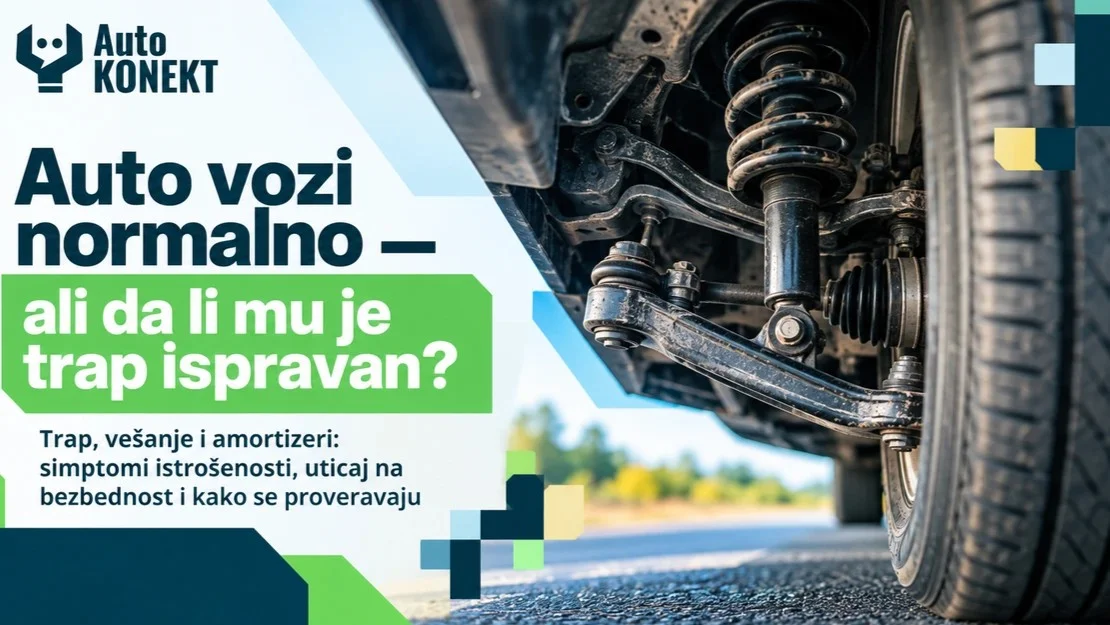
A shock absorber may start leaking, a spring may crack in a place that is difficult to see, or an anti-roll bar link may develop play. A typical sign of suspension damage is a new knocking sound when driving over bumps or speed humps. For more on how to check suspension condition and why wear can go unnoticed, see our article “Your car drives normally — but is the suspension really OK?”.
Wheel bearing and sensors
A damaged wheel bearing typically produces a humming noise that becomes louder as speed increases. An impact may also damage a tyre-pressure sensor (on vehicles where the sensor is fitted to the valve) or the wiring of an ABS sensor.
The underside of the vehicle
On low-clearance vehicles, or when a pothole is particularly deep, the oil sump, exhaust system or engine undertray can be struck. An oil stain or other fluid leak beneath a parked car is a sign that an urgent inspection is needed.
Vehicles with driver-assistance systems
If your car has a camera or radar-based assistance system (for example, lane keeping), some manufacturers specify that the system’s calibration should be checked after wheel alignment work. Ask the workshop whether this applies to your vehicle.
Warning signs to watch for over the following days and weeks
After a hard impact, pay closer attention to how your car sounds and feels for the next few weeks. Look out for the following signs:
• the car pulls to one side on a level road
• the steering wheel is off-centre when driving straight
• vibration through the steering wheel or seat at higher speeds
• knocking, squeaking or rattling over bumps
• a humming noise that increases with speed
• one tyre needs topping up more often than the others, or the tyre-pressure warning light comes on
• a bulge appears on either sidewall of a tyre
• uneven tread wear
• traces of fluid underneath the vehicle
A simple tip: check the tyre pressures immediately after the impact and again the following day. If one tyre has lost pressure, this is a clear sign of a possible tyre or rim problem.
HIT A POTHOLE? DON’T WAIT FOR A PROBLEM TO APPEAR.
The tyre and rim may look fine, but the suspension might not be. On AutoKonekt, find a tyre specialist or a workshop that checks suspension, compare the available services and book an inspection online.
Find a workshop and book an inspection
What to do immediately after hitting a pothole
These steps serve two purposes: keeping you safe and preserving evidence if damage is discovered later. Safety always comes first.
1. Stop only where it is safe. If your vehicle has to stop on the carriageway, secure the area in accordance with traffic regulations, switch on the hazard warning lights and place a warning triangle when required.
2. Inspect the tyres and rims as far as possible, including the sidewalls, but approach the vehicle only from a safe side. If you notice a bulge, a cut or a tyre losing air, do not continue driving on that tyre.
3. Photograph the pothole only if it is safe to do so. Do not step into busy traffic or walk back to a dangerous spot just to take a photo. If possible, photograph the pothole with an object for scale, a wider view of the location and any warning signs — or their absence. If approaching is unsafe, record the exact location and describe the site instead.
4. Record the exact time and location. The easiest way is to save the location on your phone.
5. If there is visible damage, call the police (192 in Serbia) and ask for an official accident report to be prepared. The report is one of the most important pieces of evidence showing where and how the damage occurred.
6. Take the contact details of any witnesses.
7. If you cannot see any damage, proceed carefully. Drive at a moderate speed and watch for vibration, pulling to one side or a tyre-pressure warning. If any of these appear, stop in a safe place. After a very hard impact, have the vehicle inspected as soon as possible even if there are no symptoms, because internal tyre damage may be invisible. After a milder impact, an inspection within the next few days is a sensible precaution.
Here is the catch: if you cannot see any damage straight away, you probably will not call the police. If a fault emerges two weeks later, you will not have an official report from the scene, making it harder to prove that the damage came from that particular pothole. That is why photos, the time and the location can matter even when everything seems fine.
Who is responsible for potholes in Serbia, and how can you claim compensation?
Serbia’s Law on Roads provides that the operator responsible for a public road is liable for damage suffered by road users as a result of a failure to maintain the road in a timely manner. In other words, if your car was damaged because of an unrepaired pothole, you have the right to seek compensation.
Who is responsible for the road?
• State roads (motorways and Category I and II state roads): the public company JP “Putevi Srbije” (Roads of Serbia)
• Municipal roads and streets: the city or municipality through its public road companies or road departments (for example, JP “Putevi Beograda” in Belgrade)
If you are unsure who manages the road section, ask the police during the investigation or contact the local authority.
Documents required for a claim: the example of JP “Putevi Beograda”
Each road operator has its own procedure, and the exact requirements also depend on the circumstances. The official compensation instructions published by JP “Putevi Beograda” provide a useful checklist. Claims are submitted in a free-form written application stating the exact time and place of the incident, a brief description, your address, telephone number and email, with your handwritten signature. For a material-damage claim, the following documents are required:
• the Serbian Ministry of the Interior (MUP) report on the official investigation of the traffic incident
• a vehicle damage inspection and assessment report issued by an authorised insurance company
• electronic readouts or copies of the vehicle registration certificate and driving licence
• a copy of the bank account card or bank account details document
• invoices for parts purchased or services performed, consistent with the damage assessment report, if the repairs have already been completed
• for leased vehicles, written authorisation from the leasing company as the legal owner, supplied by the vehicle user
According to the same instructions, a compensation committee reviews the claim, while the insurer makes the decision on payment. Practical advice: wait for a damage assessment before repairing the car, because repair invoices are compared with the assessment report. Keep photos from the scene and the workshop’s findings as well. Check the responsible operator’s website for the current instructions and submission procedure.
What else should you know?
• If the pothole could reasonably have been spotted in time, the driver may be considered partly responsible, and the amount of compensation may be reduced.
• If the road operator rejects the claim or fails to respond, court proceedings may be the remaining option. Road-safety experts warn that such proceedings, particularly those involving state roads, can take a long time.
• Under Serbia’s Law on Obligations, a claim for compensation generally becomes time-barred three years after you learned of the damage and the person responsible, and no later than five years after the damage occurred.
What about insurance?
Mandatory motor third-party liability insurance does not cover damage to your own vehicle; it covers damage you cause to others. If you have comprehensive motor insurance (kasko), damage from hitting a pothole may be covered as a road traffic incident, depending on your policy terms. Conditions vary: tyres are often treated separately, and insurers commonly require a police report for more significant damage. Check your policy or call your insurer before arranging repairs.
Note: this section is for information only and does not constitute legal advice. For guidance on a particular case, consult a lawyer or your insurer.
When to have the car inspected, and what to ask the workshop to check
Immediately — do not delay
• a bulge or cut in the tyre
• a tyre losing air
• strong vibration or the car pulling sharply to one side
• a metallic noise, scraping, or traces of fluid beneath the vehicle
Within the next few days
If the impact was hard, an inspection makes sense even when there are no symptoms. It is generally cheaper to check than to replace tyres or suspension parts later because they have worn prematurely due to incorrect wheel alignment.
What should you ask the workshop to inspect?
1. At a tyre shop: inspect both sides of the tyres, remove the wheel and check the rim on a wheel-balancing machine, which can also reveal a bent inner edge. Specialist workshops can assess whether a bent rim can be straightened, depending on where and how badly it is damaged.
2. Wheel alignment check: measurements show whether the alignment angles are within the manufacturer’s specified limits.
3. Suspension and steering check on a lift: tie rods, ball joints, bushings, shock absorbers, springs, wheel bearings and the underside of the vehicle.
The order matters: if a part is bent, wheel alignment cannot straighten it. First inspect the vehicle, then replace the damaged part, and only then adjust the alignment.
Ask the workshop for a written record of what was inspected and what was found. This will help you understand the likely cost and may also serve as supporting evidence if you submit a compensation claim.
A WORKSHOP NEAR YOU
Explore AutoKonekt partner workshops on the map and choose a nearby tyre specialist or workshop that can inspect the suspension.
Frequently asked questions
Can a tyre be damaged even if it looks normal from the outside?
Yes. Internal impact damage may not be visible from the outside, and the tyre can fail days or weeks later. That is why it is worth having a professional inspect it after a hard impact.
How long after hitting a pothole can problems appear?
Some appear immediately, while others may take days or weeks. Incorrect alignment can become noticeable gradually through pulling to one side or uneven tyre wear, while tyre damage may not become apparent until months later.
Can I drive with a bulge on the tyre sidewall?
No. A bulge means the tyre’s internal structure is damaged and the tyre may fail suddenly. Fit the spare wheel and have the car inspected.
Can a tyre sidewall bulge be repaired?
No. A tyre with a sidewall bulge must be replaced.
Is a wheel alignment all I need?
Not always. If the impact has bent a suspension or steering component, adjusting the alignment will not repair the damage. The suspension must be inspected first.
Does mandatory third-party liability insurance cover pothole damage?
No. Third-party liability insurance covers damage you cause to other people. For damage to your own car, you can contact the road operator and, if you have comprehensive cover, your own insurer in accordance with the policy terms.
Can I claim compensation if I only noticed the damage several days later?
Your right to claim does not disappear immediately, but without a police report from the scene it is harder to prove what happened. The exact evidence required depends on the road operator and the circumstances. Photos, the precise location, witnesses and the workshop’s report can all help. Consult a lawyer for advice on your particular case.
Who should I report a pothole to so it can be repaired?
Report it to the organisation responsible for that road: JP “Putevi Srbije” for state roads, or the relevant local road company or local government for municipal roads and streets. Reporting a pothole helps other drivers and creates a record that the road operator was informed of the problem.
In summary
A tyre and rim that look fine after hitting a pothole do not guarantee that the rest of the car is undamaged. Drive cautiously, photograph the location if it is safe, watch how the vehicle behaves over the following days and have it inspected after a hard impact.
A pothole can cost you much more than it seems at first glance. A timely check of the tyres and suspension can help prevent further damage, unnecessary expense and — most importantly — risks to your safety.