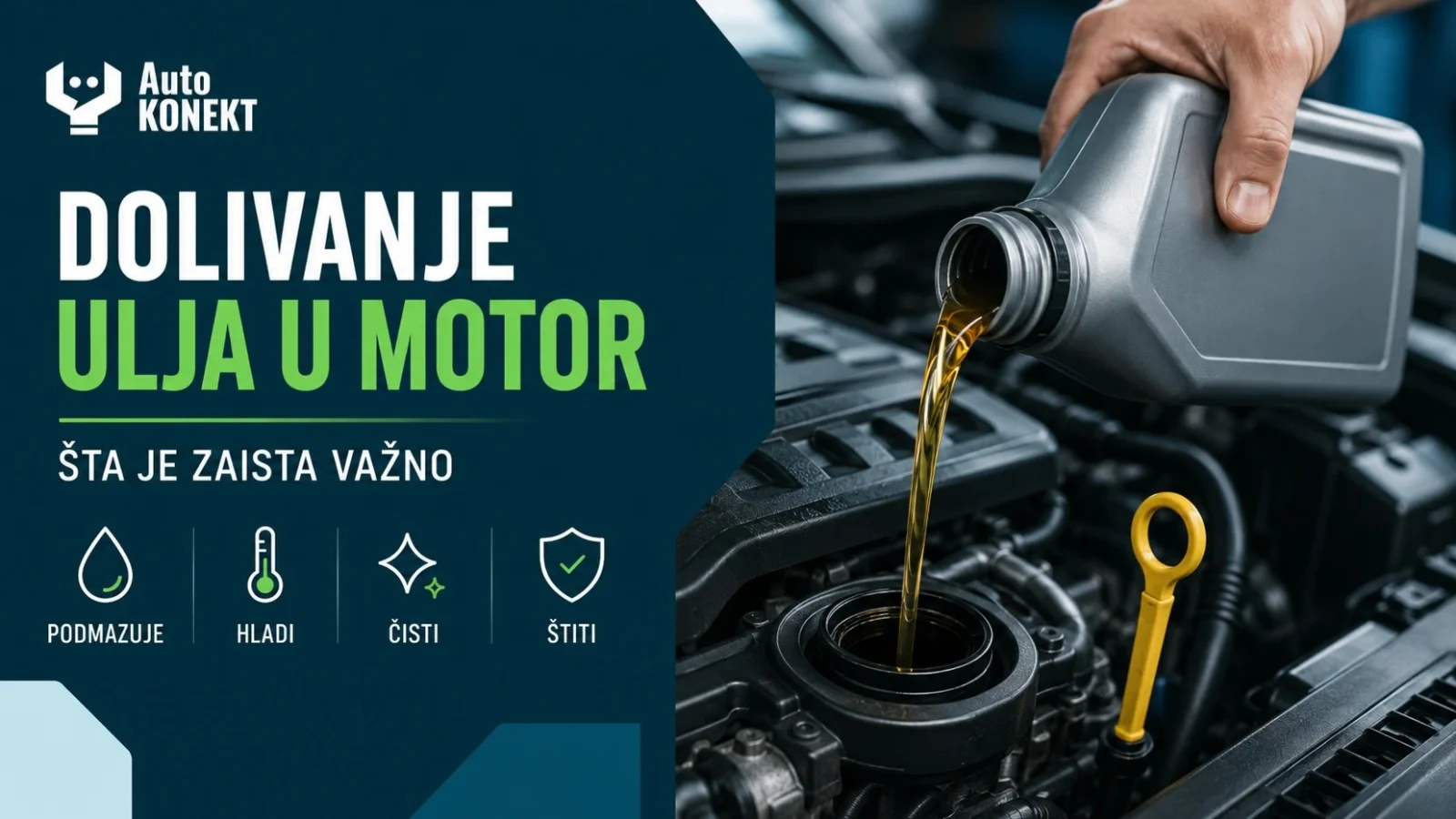
Topping Up Engine Oil: What Really Matters
Topping up engine oil looks like one of the simplest things a driver can do. Open the hood, pour it in, close the hood. And that is exactly why mistakes happen — mistakes that may not show up immediately, but only later on a bill for a catalytic converter, turbocharger, or engine bearings.
Engine oil performs four jobs at the same time: it lubricates, cools, cleans, and seals. When the level drops below the minimum mark, the risk of the oil pump drawing in air increases, and the lubricating film can break down exactly where the engine is under the greatest load. When the level rises above the maximum mark, the problem is different — but no less serious.
And neither situation will necessarily be detected by a warning light in time. The oil-pressure warning light is not a reminder to top up the oil, and not every vehicle is equipped with an oil-level sensor.
How to Check the Oil Level Properly
The sequence matters more than it may seem, because skipping even one step can shift the reading by several millimetres — and several millimetres on the dipstick can represent several hundred millilitres of oil in the sump.
Park on level ground. Even a slight incline can change the reading on the dipstick. Measuring the oil level on a hill or with one side of the car on a kerb is unreliable.
Switch off the engine and wait. The oil needs time to drain back into the sump — generally 5 to 10 minutes after switching off the engine, and longer on some engines. The correct procedure for your vehicle can be found in the owner’s manual.
Take two readings, not one. Pull out the dipstick, wipe it with a clean cloth, insert it fully, and then pull it out again. The first reading is often inaccurate because oil is smeared along the dipstick tube.
Check the level. The oil should be within the specified MIN–MAX range. Always follow the recommendation in your vehicle’s owner’s manual.
Vehicles without a dipstick. An increasing number of newer vehicles no longer have a physical dipstick and display the oil level electronically. In these vehicles, follow the manufacturer’s procedure exactly — this may require the engine to be at operating temperature, the vehicle to be parked on level ground, and the measurement to take several seconds. An aftermarket dipstick should not be treated as the primary reference unless the manufacturer specifies otherwise.
THE RULE THAT MATTERS MOST
Always check the oil under the same conditions. Comparing two measurements only makes sense if both were taken in the same way — otherwise, you may simply be seeing the effect of different oil temperatures rather than actual oil consumption.
MIN and MAX: How Much Oil Is That Actually?
In many passenger-car engines, the difference between the lower and upper marks on the dipstick is approximately half a litre to one litre. Some manufacturers state the exact quantity in their manuals. Volkswagen, for example, has specified approximately one litre for certain dipstick designs and around 0.75 litres for others.
The amount varies from engine to engine, so the only reliable reference is the documentation for your specific vehicle.
The practical takeaway is simple: if the oil level is somewhere around the middle, you probably do not need to add a full litre.
Top up in small amounts — around 200 to 300 millilitres at a time — then wait a few minutes and measure again. Removing excess oil is considerably more complicated than adding a little more.
Which Oil Can You Top Up With?
This is where drivers most often make mistakes, and the consequences are usually silent. The engine will not necessarily stop running, but the emissions-control system may age faster than it should.
Viscosity is not the same as specification.
A marking such as 5W-30 or 0W-20 only describes how the oil behaves at low temperatures and at operating temperature. It does not tell you everything about the oil’s quality, additive package, or suitability for a particular engine.
The specification is what the engine actually requires.
This may include an ACEA category, an API service classification, and a specific vehicle-manufacturer approval.
ACEA categories are designed for different engine and emissions-system requirements. A/B categories are generally used for petrol and diesel engines, while C categories are formulated for compatibility with modern exhaust after-treatment systems. E categories are intended primarily for heavy-duty diesel applications.
Vehicle-manufacturer approvals such as VW 504 00 / 507 00, MB 229.51, or BMW Longlife requirements may impose additional criteria and can be more specific than the general ACEA classification.
Two containers may both say 5W-30 on the front and still be designed for very different engines. The important difference is often written on the back.
Low-SAPS oils and particulate filters.
Vehicles equipped with DPFs and many modern petrol engines with advanced catalytic and particulate-filter systems require oils with controlled levels of sulphated ash, phosphorus, and sulphur — commonly found within certain ACEA C categories.
Using oil that does not meet the required specification can gradually affect the exhaust after-treatment system and increase the risk of particulate-filter problems.
Saving a small amount of money on the wrong oil can therefore turn into a much more expensive repair later.
Can I Mix Oils from Different Manufacturers?
Short answer: in an emergency, yes. As a regular habit, no.
If topping up is unavoidable, the safest approach is to use an oil with the same viscosity grade and, more importantly, the same required specification and manufacturer approval.
Different oil formulations use different additive packages, and those packages are designed to work as a complete system.
A practical risk scale:
• Same viscosity and same specification, different brand — generally acceptable.
• Different viscosity, same required specification — best treated as a temporary solution. Once mixed, the oil no longer behaves exactly like either of the original viscosity grades.
• Oil that does not meet the required specification — use only when necessary to avoid driving with an dangerously low oil level, and inform the workshop what was added.
• Regularly topping up with whatever oil is available — this is the habit to avoid, because after several top-ups the oil in the engine may be significantly different from what the engine was designed to use.
Write down what you added — brand, viscosity, and specification — and tell the technician at the next service.
And remember the order of priorities: if the level is dangerously low, adding a less-than-ideal oil can be safer than continuing to drive without enough oil. The correct oil should then be restored as soon as practical.
Overfilling: A Mistake That Can Cost More Than Low Oil
The idea that “a little extra cannot hurt” is wrong — and often for reasons drivers do not expect.
When the oil level is significantly above the maximum, rotating engine components can come into contact with the oil and aerate or foam it.
Foamed oil cannot maintain a stable lubricating film as effectively as normal oil.
At the same time, excessive oil can contribute to increased crankcase pressure and place additional stress on seals. Oil may also be drawn through the crankcase ventilation system into the intake, potentially affecting the spark plugs, oxygen sensors, catalytic converter, or particulate filter.
Symptoms worth paying attention to include: an oil level above MAX after a correctly performed measurement, foamy oil on the dipstick, bluish exhaust smoke, a smell of burning oil, rough idling, or an illuminated engine warning light.
If the oil level is above the MAX mark after a proper measurement, the excess should be removed in accordance with the vehicle manufacturer’s instructions.
This can often be done by extracting oil through the dipstick tube or draining a controlled amount through the sump plug. For a workshop, it is usually a straightforward procedure.
AN IMPORTANT DISTINCTION
If the oil level has increased on its own, the engine has not been overfilled.
The oil may instead be contaminated or diluted by fuel or coolant.
Milky or foamy oil, or an oil level that rises even though you have not added any oil, is not something to correct at home — it is a reason to have the vehicle inspected.
How Much Oil Is an Engine Allowed to Consume?
Every internal-combustion engine consumes some amount of oil. A small part of the oil film on the cylinder walls can enter the combustion process.
The real question is how much.
Volkswagen has stated in technical documentation that oil consumption of up to 0.5 litres per 1,000 kilometres may fall within the manufacturer’s permitted limit for certain engines.
TotalEnergies technical materials have also noted that oil consumption can vary significantly depending on the engine, its condition, operating conditions, mileage, and driving style.
It is important to distinguish between a manufacturer’s maximum permitted oil-consumption figure and what is typical for a healthy engine in everyday use.
A practical guide for everyday monitoring:
• Up to around 0.2 l per 1,000 km — may be normal depending on the engine and operating conditions.
• 0.2 to 0.5 l per 1,000 km — may still fall within manufacturer tolerances, but it is worth monitoring the consumption carefully.
• More than 0.5 l per 1,000 km — can still be within the official tolerance of some engines, particularly certain turbocharged units, but it is a good reason to investigate the cause.
• More than 1 l per 1,000 km — topping up is no longer a real solution; the underlying cause should be diagnosed.
New engines during the running-in period and some turbocharged engines may consume more oil than average, as can high-mileage engines.
Oil consumption can also increase during prolonged driving at high engine speeds or under heavy load.
When Topping Up Is Not the Solution
Adding oil corrects the level — it does not repair the cause of oil loss.
The following signs mean that the vehicle should be inspected by a workshop:
• the oil level has dropped suddenly between two checks without significant mileage being covered
• oil stains appear underneath the vehicle where it has been parked
• bluish smoke comes from the exhaust, particularly during acceleration
• the oil on the dipstick appears milky or foamy
• the oil smells strongly of fuel
• the oil level rises even though you have not added any oil
What Should You Keep in the Car?
Everything you need fits into a small bag in the boot:
a one-litre bottle of oil with the correct specification for your vehicle, a funnel, a pair of gloves, and a cloth.
It is also useful to keep a photo on your phone of the page in the owner’s manual showing the required oil specification.
When you are standing in a shop somewhere on the road, that information is worth far more than trying to remember whether your engine needs “something like 5W-30”.
Frequently Asked Questions
Can I top up the oil while the engine is hot?
Yes, but allow the oil enough time to drain back into the sump before measuring the level — generally at least five to ten minutes after switching the engine off, unless your vehicle manufacturer specifies a different procedure.
The main risk is not pouring oil into a warm engine, but taking a reading immediately after switching it off. That can produce an artificially low reading and increase the risk of overfilling.
How much oil should I add if the level is at MIN?
In many passenger-car engines, the difference between MIN and MAX is approximately half a litre to one litre, but the exact amount depends on the engine.
Add around 200 to 300 ml, wait a few minutes, and check the level again. Repeat if necessary, always keeping the level within the range specified by the manufacturer.
Can I mix synthetic and semi-synthetic oil?
In an emergency, oils can generally be mixed, but the resulting mixture will not necessarily provide exactly the same performance as the oil originally specified for the engine.
The priority should be to match the required specification and manufacturer approval. Treat mixing different formulations as a temporary solution and return to the recommended oil at the next appropriate service interval.
What should I do if I have overfilled the engine with oil?
If a correctly performed measurement shows the oil level above MAX, the excess should be removed.
Depending on the engine, this can be done by extracting oil through the dipstick tube or by carefully draining a small amount through the sump plug.
If you are unsure how much has been added, the safest option is to have a workshop correct the level.
How often should I check the engine oil level?
Once a month is a reasonable minimum for a vehicle in good condition, and the level should also be checked before every longer journey.
If the engine is known to consume oil, check it more frequently — for example every 500 to 1,000 kilometres, depending on the rate of consumption.
CHECK — DON’T GUESS
If your oil level keeps dropping, or you are not sure which specification your engine requires, have it checked instead of guessing.
On the AutoKonekt platform, you can find and book an appointment with auto repair shops in Belgrade and Novi Sad — without phone calls or waiting.
SOURCES
• Volkswagen Technical Bulletin 17-18-06 — manufacturer oil-consumption limit of up to 0.5 l / 1,000 km for applicable vehicles
• TotalEnergies — technical material on engine-oil consumption
• ACEA Oil Sequences / ATIEL Letter of Conformance — classification of A/B and C engine-oil categories
• Vehicle manufacturers’ owner’s manuals — MIN–MAX dipstick ranges and oil-checking procedures