
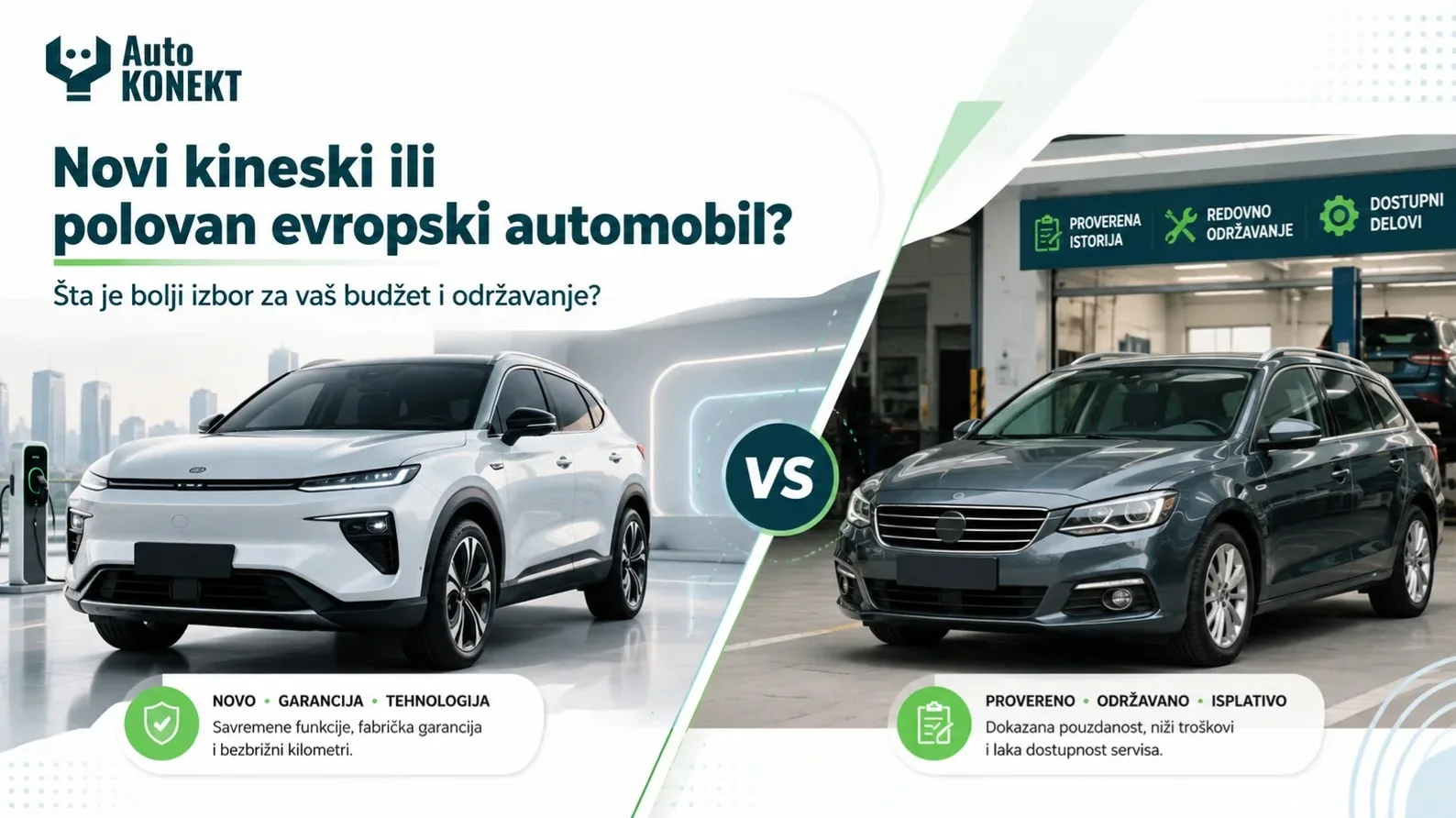
Is it worth buying a Chinese car or a used European one?
Comparison of costs, warranties and service availability in the Serbian market — July 2026
For the same amount of money, you can now buy either a brand-new Chinese car with a factory warranty and extensive equipment or a higher-class used European car supported by a well-established service network. On paper, the choice may seem simple. In practice, the buyer is not choosing between two brands, but between two different types of risk.
With a new Chinese car, the main uncertainties are the size of the service network, the availability of specific spare parts and its future resale value.
With a used European car, the risks involve the vehicle’s actual mileage, the quality of its previous maintenance and the possibility of an expensive failure immediately after purchase.
There is no single answer that applies to everyone. The following article contains specific figures—including prices, warranty periods for individual components and the number of service locations for each brand—to help you decide which option is better for your situation.
Why is this dilemma particularly important in Serbia?
The Serbian market remains strongly oriented towards used vehicles. According to the Statistical Office of the Republic of Serbia, 41,391 passenger cars were registered for the first time in the first quarter of 2026, and 82.9% of them were more than two years old. The most represented brands were Volkswagen, Audi, Škoda, Peugeot and Opel, confirming that a large number of used cars are still being imported into the country.
Source: Statistical Office of the Republic of Serbia, press release dated 5 June 2026 — stat.gov.rs
At the same time, the supply of new vehicles is growing. During the first six months of 2026, 19,515 new passenger cars were registered for the first time. Hybrids took the leading position for the first time, with a 43.62% market share, ahead of petrol-powered vehicles at 41.85%. Chinese brands are making a significant contribution to this growth, particularly through hybrid and electrified models.
The dilemma is therefore no longer between “a proven car and a cheap unknown”. Buyers are now comparing two genuinely competitive products with different risk profiles.
What do you actually get for the same amount of money?
The first step is to establish a realistic price range. The following figures were the official starting prices offered by Serbian importers for new vehicles as of July 2026:
ModelStarting priceNotesChery Tiggo 4 ProFrom EUR 17,9901.5-litre petrol engine, 95 hp, manual transmissionChery Tiggo 4 Pro HybridFrom EUR 22,990Hybrid, Luxury equipment packageBYD ATTO 2From EUR 26,490Electric compact SUV, 4.3 metres longBYD SEAL U DM-iEUR 36,990–39,990Plug-in hybrid, depending on equipment packageBYD SEALION 7EUR 43,590–49,590Electric, depending on equipment package
Sources: cheryauto.rs, byd-auto.rs and importer announcements. Prices are promotional and subject to change—check the current price list before purchasing.
Within the same price range on Serbia’s used-car market, a budget of EUR 18,000 realistically gives you a European compact or lower-medium-class model that is four to six years old. For EUR 25,000, you can choose a medium-class vehicle or an SUV of a similar age.
You may get a higher-class vehicle and a more powerful engine, but without a warranty and without a fully known history.
The key difference that the purchase price does not reveal
With a new vehicle, you are paying for a known history and a warranty, but accepting a more limited choice of service centres.
With a used vehicle, you are paying less for more car, but taking on the maintenance risk from the first day.
This difference cannot be seen in the purchase price. It becomes visible only after several years of ownership.
Warranty: what does “seven years” actually mean?
The greatest advantage of a new car is not its display or equipment. It is the fact that its history is completely known.
You know that it has not been involved in an accident, that its mileage has not been altered and that a previous owner has not postponed maintenance. The warranty provides additional protection, but only within a precisely defined framework.
This is where we need to explain an important distinction that many Serbian buyers do not understand.
Statutory conformity rights are not the same as a commercial warranty
Statutory conformity is your legal right under Serbia’s Consumer Protection Act, specifically Articles 50–53. It lasts for 24 months, has no mileage limit and cannot be shortened or withdrawn by the seller.
A commercial warranty is a voluntary obligation provided by the importer. This is the warranty that may last for 84 months or 150,000 kilometres. Its conditions are defined by the warranty agreement, including the circumstances under which the warranty can be invalidated.
In other words, the “seven-year warranty” mentioned in advertising is a commercial warranty. It does not reduce your statutory conformity rights, but it is subject to considerably more conditions.
Source: Warranty terms at cheryauto.rs/o-kompaniji/garancija, checked on 26 July 2026.
The condition that has the greatest impact on your choice of service centre
The same document states that the distributor reserves the right to exclude a vehicle from warranty coverage if repairs or maintenance inspections have been carried out by an unauthorised service centre, regardless of the type or extent of the work performed.
In practical terms, this means that you may remain tied to the authorised network throughout the entire warranty period.
When there is no authorised service centre in your city, this condition is not merely a formality. It becomes a regular expense in terms of both time and fuel.
Service networks: where Chinese brands genuinely differ
The term “Chinese car” includes manufacturers with completely different levels of local support.
The differences are significant and can change quickly, so you should check the current situation for the specific brand before purchasing. This was the situation in July 2026:
BrandSales and service coverage in SerbiaWarrantyCheryNine locations: Belgrade, Novi Sad, Pančevo, Kraljevo, Niš, Novi Pazar, Subotica, Zrenjanin and Šabac84 months or 150,000 kmBYDOne service centre on Zrenjaninski put in Belgrade and a showroom in New BelgradeSix years or 150,000 km; eight years for the batteryMGAuthorised importer service networkSeven years or 150,000 km, with roadside assistance
Sources: cheryauto.rs, byd-auto.rs and importer announcements. Checked on 26 July 2026.
The contrast is considerable. One brand covers nine cities, while another opened its first authorised service centre in Serbia only in May 2026 and currently operates from a single location in Belgrade.
For a buyer in Belgrade, this difference may be manageable. For a buyer from Užice, Zaječar or Sombor, it changes the entire calculation. Every scheduled service, warranty claim or other intervention may require a journey to the capital.
Before purchasing, it is therefore not enough to ask whether a service centre exists. Check:
how far the nearest authorised service centre is from your home;
how long you will have to wait for a scheduled maintenance appointment;
whether the centre has technicians trained for the specific model and the required diagnostic equipment;
what happens when the vehicle cannot be driven and who pays for towing;
where out-of-stock parts are ordered from and how long delivery normally takes.
The answer “the part will be ordered” is not sufficient.
You need to know whether it will be ordered from a domestic warehouse, a European distribution centre or directly from China. That may be the difference between waiting three days and waiting three weeks.
For electrified vehicles, check the following as well
Extended traction-battery warranties are often advertised for the European Economic Area, which does not include Serbia.
When the battery warranty is a key reason for your purchase, request written confirmation that the extended coverage also applies to vehicles purchased in Serbia and not only to vehicles sold in EEA countries.
Also check:
the minimum battery capacity guaranteed at the end of the warranty period;
whether high-voltage system diagnostics are available in Serbia;
the number of technicians trained and certified to work on high-voltage systems;
the availability and delivery times of high-voltage components.
Safety: what do independent tests show?
The reputation Chinese cars had in 2010 no longer reflects the current situation.
Euro NCAP test results demonstrate this clearly. Since 2022, virtually all Chinese models submitted for testing have received five stars. The NIO Firefly achieved a score of 96% for adult-occupant protection, the highest result in the history of the Euro NCAP programme.
In one series of tests conducted in 2025, 18 of the 28 vehicles tested received five stars, and 13 of those vehicles were manufactured in China.
Sources: Euro NCAP announcements and independent reviews of the results, 2025–2026.
However, there are two limitations that buyers need to understand:
Euro NCAP tests the European specification of a vehicle, which may differ from the version offered in the domestic Chinese market. The result applies only to the tested specification.
Not every model has been tested. Some newer brands and models do not yet have published results, so the same safety level cannot automatically be assumed.
Driver-assistance system ratings have also been inconsistent, including among vehicles that received an overall five-star rating.
The conclusion is simple: the country of origin tells you very little. Check the results for the specific model, specification and model year.
What do you get with a used European car?
The greatest advantage of a popular European model is not the badge on its bonnet. It is the service ecosystem that has developed around it over many years.
For these vehicles, buyers can generally access:
authorised and independent service centres;
specialists familiar with a particular engine or brand;
original and aftermarket parts;
used parts;
well-developed diagnostic capabilities;
extensive practical knowledge of common problems.
A mechanic will often already know the weak points of a particular engine, transmission or model year. This can reduce both diagnostic time and the duration of the repair.
More sources for spare parts
For a popular European model, you can usually choose between an original part, a high-quality aftermarket alternative and—when it is safe and appropriate—a used component.
Competition between suppliers helps reduce prices.
With a newer Chinese model, you may often be dependent exclusively on the official supply channel, where there is no competitive pressure to reduce the price.
Servicing outside a major city
The owner of a popular Volkswagen, Škoda, Opel, Peugeot or Renault can almost certainly find a service centre in their city or nearby.
That does not mean every service centre is equally good. It means that a choice exists and that the owner is not dependent on a single location.
More predictable resale value
For models that have been present in the market for many years, it is easier to estimate their value and how quickly they can be sold.
New Chinese models do not yet have a sufficiently long local history to show how the market will value them after seven or ten years.
This does not necessarily mean that they will depreciate more. It means that the range of possible outcomes is wider.
The greatest risk of a used car is hidden beneath the surface
A used car may look well preserved, have a clean interior and operate smoothly during a short test drive while still requiring substantial investment.
Risk does not increase only with mileage. The way the vehicle has been driven, the quality of previous maintenance and whether earlier repairs were carried out correctly are equally important.
The TÜV Report 2026, based on 9.5 million technical inspections in Germany, shows how vehicle age changes the picture:
Vehicle ageShare with significant defectsContextFive years, at the second inspectionApproximately 10%One in ten vehicles failsEleven years, at the fifth inspection22.9%Almost one in fourFifteen years, at the seventh inspection32.9%Almost one in threeAverage for all vehicles21.5%Fourth consecutive increase
Source: TÜV Report 2026, TÜV-Verband, published on 20 November 2025. The data relates to the German vehicle fleet.
The difference within the same age group is equally important.
Among vehicles that were two to three years old, the best-performing model in the report had a defect rate of 2.9%, while the worst-performing model recorded 17.3%.
These were vehicles of the same age. The difference came from the model itself and how it had been maintained.
What does this mean for a buyer in Serbia?
Buying a “proven European brand” is not enough.
The difference between a good and a bad example of the same model year can be greater than the general difference between brands. A detailed inspection of the specific vehicle is therefore more valuable than any general recommendation based on the badge.
One major failure can eliminate the initial saving
In a modern used diesel vehicle, major costs are commonly associated with:
the diesel particulate filter;
the EGR system;
the AdBlue system;
the turbocharger;
the injectors;
the dual-mass flywheel;
the automatic transmission.
With petrol engines, risks may include excessive oil consumption, timing-system problems, turbocharger failure, direct-injection problems and complex electronics.
Petrol, diesel and hybrid vehicles are therefore not automatically good or bad choices. The specific design, service history and the way you intend to use the vehicle are what matter.
The hidden cost buyers most often forget: time without the car
When cars are compared, most discussions focus on the price of parts and labour.
For a family with only one vehicle, however, a car that has to wait two weeks for a spare part may create a greater problem than the price of the repair itself. This cost does not appear on any price list.
Before purchasing, check whether the seller or service provider offers:
roadside assistance and information on who pays for it;
towing to an authorised service centre;
a replacement vehicle while repairs are being carried out;
support in the event of a breakdown abroad.
This matters with both options.
With a new vehicle, a breakdown is less likely, but service alternatives may be more limited. With a used vehicle, finding a service centre may be easier, but the probability of a breakdown is higher.
Which option suits which buyer?
A new Chinese car is probably the better option when:
you want the vehicle’s complete history to be known;
you do not have time to visit multiple service centres or deal with unexpected repairs;
you plan to keep the car for at least five years;
you live close to an authorised service centre for the specific brand;
a major unexpected repair would seriously disrupt your budget;
you accept that the future resale value is less predictable.
A used European car is probably the better option when:
you understand cars or have a trusted mechanic;
you can have the vehicle inspected thoroughly before purchasing;
you want a higher-class vehicle or a more powerful engine for the same budget;
you live far from the Chinese brand’s service network;
you plan to sell the car after two or three years;
you have a financial reserve for unexpected repairs.
Recommendations by buyer profile
A family with only one car: A new vehicle with reliable local support has an advantage. Predictability is more important than vehicle class. Make sure to check whether a replacement vehicle is available and how roadside assistance works.
Low annual mileage: A carefully selected used petrol car is often the more rational choice. Avoid buying a complex diesel purely because it appears more economical. Short urban journeys increase the risk of problems with exhaust-emission control systems.
High annual mileage: A reliable powertrain, the cost of routine maintenance and repair times are critical. Pay attention to the warranty mileage limit. At 40,000 kilometres per year, a 150,000-kilometre warranty will last for less than four years, not seven.
A buyer from a smaller town: A used European model has a practical advantage because of the greater density of local service centres. A new Chinese vehicle makes sense only when the distance to the authorised service centre is acceptable and roadside assistance is clearly defined.
Ten questions to ask the seller of a new vehicle
Request specific answers, preferably in writing:
How long does the commercial warranty last, and how long do the statutory conformity rights apply?
Which components have shorter warranty periods, and what are those periods?
According to the current price list, how much will the first three scheduled services cost?
Where are the authorised service centres, and which one is closest to me?
What is the average waiting time for a scheduled maintenance appointment?
Where are out-of-stock parts sourced from, and how long does delivery usually take?
Is a replacement vehicle available during repairs, and under what conditions?
Is the warranty transferred to the next owner?
Which actions may result in the loss of warranty rights?
How is a breakdown abroad handled, and who covers the associated costs?
A seller with a well-developed aftersales system should be able to answer these questions without hesitation.
When the answers are vague, that is useful information in itself.
What should be checked before buying a used vehicle?
Arrange an independent inspection that includes:
verification of the vehicle’s identity and history, including the VIN, import records and previous damage;
electronic diagnostics of all control units;
inspection of the engine and transmission, including checks for fluid leaks;
paint-thickness measurement and bodywork inspection;
inspection of the underbody, brakes and tyres;
inspection of the exhaust-emission control systems;
testing the air-conditioning system;
examination of the service documentation;
a test drive with both a cold and a fully warmed-up engine.
Do not spend your entire budget on the purchase price
Even a good used car will often require initial maintenance, new tyres, brake components or fluid replacement after purchase.
Keep a financial reserve. A realistic amount is between 5% and 10% of the vehicle’s value for the first six months of ownership.
Final recommendation
Buy a new Chinese car when your priorities are a warranty, a known history and predictable costs—but only when the specific brand has an authorised service centre within a reasonable distance and you have read the warranty conditions for individual components, rather than relying solely on the advertising slogan.
Buy a used European car when you want an established service network, several sources for spare parts and a more predictable resale value—but only when you can reliably verify the history and technical condition of the specific vehicle.
The worst decision is not buying a Chinese or a European car.
The worst decision is buying a new car without checking the available service support, or buying a used car without a detailed inspection.
You are not buying a country of origin. You are buying a specific model, a specific seller, a specific level of service support and a level of risk that will follow you throughout the next several years.
Frequently asked questions
Are Chinese cars safe?
According to Euro NCAP results, virtually all Chinese models submitted for testing since 2022 have received five stars, while one model achieved the highest adult-occupant protection result in the programme’s history.
However, not all models have been tested, and the tests apply to the European vehicle specification. Check the result for the specific model and model year you are considering.
Is a seven-year warranty really valid for seven years?
For the complete vehicle, it usually is, subject to a mileage limit of 150,000 kilometres.
However, certain components have significantly shorter warranty periods, ranging from 12 months for air-conditioning refrigerant to 36 months for components such as the alternator, starter motor or shock absorbers. Vehicles used as taxis or rental cars may be subject to substantially shorter periods.
Can I service a new car at an independent service centre?
During the commercial warranty period, this is generally not recommended.
The conditions of some importers expressly allow the distributor to exclude a vehicle from commercial warranty coverage if it has been serviced outside the authorised network.
Your statutory conformity rights are not automatically lost, but your commercial warranty may be affected.
Is maintaining a Chinese car more expensive?
Routine maintenance does not necessarily have to be more expensive.
The difference is that, while the warranty is active, you may be tied to the authorised network, where there is less competition to reduce prices. Ask for the prices of the first three scheduled services before buying the vehicle.
Which used European car is the best purchase?
There is no brand that is automatically a good choice.
Technical-inspection data shows that the difference between the best and worst models of the same age can be greater than the general difference between brands.
Give priority to a model with a reliable powertrain and a documented service history, and always arrange an independent inspection.
Which car will be easier to sell in five years?
Popular European models currently have a more predictable used-car market.
The future value of Chinese models will depend on how their service networks develop and on the reputation each brand establishes. These factors are still taking shape.
Are you buying a used car?
An independent pre-purchase inspection costs considerably less than a single overlooked defect.
Through AutoKonekt, you can find a trusted service centre in your city and schedule an inspection before signing the purchase agreement—including diagnostics, an underbody inspection, paint-thickness measurement and verification of the service history.
Schedule a pre-purchase inspection → autokonekt.rs
Are you buying a new vehicle? Check how far the nearest authorised service centre for that brand is from your home—before making your final decision.