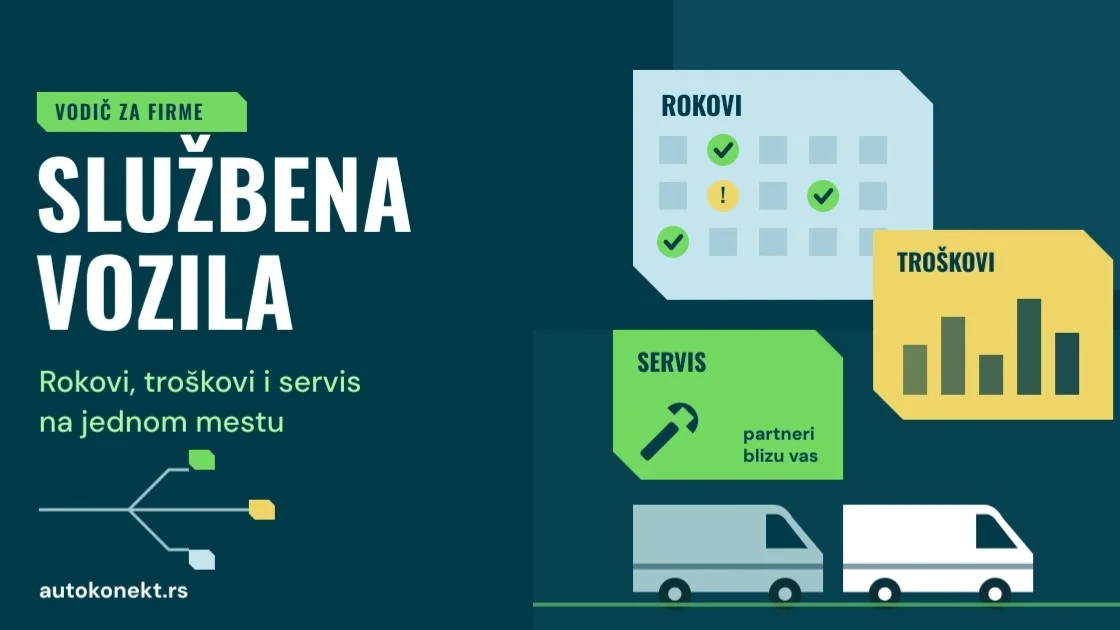
How to Manage Company Vehicles and Reduce Unnecessary Costs
Registrations, maintenance, insurance, tyres and expenses: a practical guide for businesses operating multiple company vehicles.
A company with fifteen vehicles faces dozens of deadlines every year: registration renewals, roadworthiness inspections, insurance policies, tyre changes, scheduled maintenance and vehicle equipment checks. When all this information is scattered across Excel spreadsheets, folders full of invoices and employees' phones, the problem is not negligence. The problem is that the information is not centralised.
This guide explains what you need to monitor, how much a company vehicle really costs and how to organise maintenance across different service providers.
The Cost Companies Often Underestimate: A Day When a Vehicle Is Off the Road
The most expensive cost may be the one you are not tracking at all.
When discussing company vehicle expenses, fuel is usually the first thing that comes to mind. It appears on every receipt and every fuel card statement.
What is much harder to measure is the cost of a day when a vehicle cannot be used: its registration has expired, it has failed a roadworthiness inspection, or a breakdown has occurred that could have been prevented through regular maintenance.
That day may mean a missed meeting, lost business, an employee unable to work and, quite often, a fine.
This is why effective fleet management starts with deadlines rather than prices. When deadlines are under control, expenses become more predictable, and maintenance can be scheduled when it suits your business — not when a vehicle breaks down.
1. Deadlines You Should Track for Every Vehicle
Every obligation follows its own schedule, and when you manage several vehicles, those schedules rarely align.
Here is what should be included in the calendar for every company car and light commercial vehicle.
Registration and Roadworthiness Inspections
Vehicle registration must be renewed annually. This requires a successful roadworthiness inspection, payment of the applicable fees and taxes, and valid compulsory motor third-party liability insurance.
For a business, this means one fixed annual deadline per vehicle.
With fifteen company cars, that means fifteen different deadlines spread throughout the year.
New Vehicles: The First Roadworthiness Inspection After Two Years
Newly manufactured vehicles registered for the first time in Serbia, which were produced in the year of their first registration or the preceding year, must undergo their first regular roadworthiness inspection no later than two years after their initial registration (Road Traffic Safety Act, Article 264).
This is a convenience, but it can also become a trap.
Registration must still be renewed every year, while the date of the first roadworthiness inspection can easily be forgotten because it follows a different schedule.
Companies that regularly renew their fleets may therefore have vehicles operating under both inspection schedules at the same time.
Winter Tyres and Seasonal Changes
From November 1 to April 1, vehicles must have the prescribed winter equipment when roads are covered with snow, ice or black ice.
For passenger cars and light commercial vehicles, this means winter tyres with a minimum tread depth of 4 mm and, on road sections where required by traffic signs, snow chains fitted to the drive wheels.
Plan seasonal tyre changes in advance: before winter and again in spring, when weather conditions allow a safe switch to summer tyres.
The simplest approach is to arrange appointments for the entire fleet in advance, before tyre shops become fully booked.
If your company has no suitable tyre storage facilities, ask your tyre service provider about seasonal storage for the entire fleet.
Insurance, Vehicle Equipment and Driving Licences
Compulsory motor insurance is generally issued for one year and is linked to vehicle registration, while comprehensive insurance has its own expiry date.
Both dates should be included in the same calendar so that you can request and compare insurance quotes in advance, rather than automatically renewing an existing policy.
It is also worth tracking the expiry date of first-aid kits, which are checked during roadworthiness inspections, as well as the validity of driving licences held by employees who operate company vehicles.
2. Company Vehicle Costs: How Much Does One Car Really Cost?
Most companies know how much they spend on vehicles in total, but not necessarily how much each individual vehicle costs.
Without this information, it becomes difficult to answer a question that every business eventually faces:
Is it time to replace a particular vehicle?
What Makes Up the Total Cost of a Vehicle?
The full cost of operating a company vehicle includes:
Fuel
Routine maintenance and repairs
Tyres and seasonal tyre changes
Registration, taxes, fees and roadworthiness inspections
Compulsory and comprehensive insurance
Tolls and parking
Fines and damage-related costs
Vehicle acquisition and usage costs, including depreciation and financing or leasing expenses, depending on how the vehicle was acquired
Depreciation can be one of the largest components of a vehicle's overall cost, while repairs tend to account for an increasing share of expenses as vehicles age.
This is why comparing vehicles based solely on fuel consumption provides an incomplete picture.
One important point when calculating costs: a financial lease payment is not the same as the actual cost of using a vehicle, because it also includes repayment of the vehicle's principal value.
If you include both the full lease payment and depreciation in the same calculation, you will count part of the cost twice.
Depreciation, financing costs (interest) and other expenses should therefore be tracked separately.
Example: How Much Does One Company Car Cost Per Year?
HYPOTHETICAL EXAMPLE — 30,000 KM PER YEAR
ExpenseAnnual costFuelRSD 300,000Maintenance, tyres and repairsRSD 120,000Registration and insuranceRSD 80,000DepreciationRSD 220,000Total annual costRSD 720,000Cost per kilometreRSD 24/kmAnnual cost for 10 vehiclesRSD 7.2 million
This example assumes that the vehicle was purchased without financing and includes only the listed expense categories. For vehicles acquired through leasing or a loan, financing costs (interest) should be added, rather than the entire instalment. The example does not represent a complete Total Cost of Ownership (TCO) model or actual market data.
Even in this simplified example, fuel accounts for less than half of the total cost.
When you multiply these figures by the number of vehicles, it becomes clear why fleet management is not merely an administrative matter, but an issue that deserves the attention of a business owner or financial director.
For a fleet costing RSD 7.2 million per year, every 1% reduction in costs represents a saving of RSD 72,000.
We are preparing a new area of development for AutoKonekt, aimed at companies operating vehicle fleets.
If you would like to help shape this solution, register your interest: [REGISTRATION LINK]
Cost per Kilometre
One of the most useful indicators is the cost per kilometre driven.
It is calculated by dividing a vehicle's total annual costs by the number of kilometres it has travelled during that year.
If two similar vehicles perform comparable tasks, but one has a noticeably higher cost per kilometre, this may indicate a need to examine its maintenance history, operating conditions or whether it is time for replacement.
To calculate this figure, you need two things that companies rarely keep in one place: expenses allocated to individual vehicles and accurate mileage records.
Fuel and VAT: Vehicle Classification Makes a Difference
For companies registered for VAT, there is an important distinction worth understanding before purchasing a vehicle.
Under Article 29 of Serbia's Value Added Tax Act, input VAT generally cannot be deducted for passenger cars, either when purchasing the vehicle or for related fuel, spare parts and services, except when the vehicles are used for specific activities expressly permitted by law.
For fuel used in goods vehicles, input VAT deduction is possible when the prescribed conditions are met.
In other words, the same amount shown on a fuel or maintenance invoice may represent a different actual cost to a company, depending on whether the vehicle is registered as a passenger car or a goods vehicle.
Before purchasing a new vehicle, consult your accountant about how these rules apply to your business.
Vehicle Trip Logs
A vehicle trip log is an important document for recording vehicle use. It connects the vehicle, driver, route and mileage.
For certain vehicles and types of transport, its content is prescribed by a specific regulation (Official Gazette of the Republic of Serbia, Nos. 90/2016 and 4/2017).
The documentation required for an expense and its tax treatment depend on the type of transport and the circumstances, so agree on the appropriate record-keeping method with your accountant.
In practice, a trip log is often a paper form completed by the driver at the end of the month and then manually entered into a computer by someone else.
The closer the information is recorded to the actual journey, the more accurate the data and the faster the accounting process.
3. Fleet Maintenance: Choosing the Right Service Provider for Each Job
A vehicle fleet rarely relies on a single service provider for everything.
Mechanical repairs, tyres, roadworthiness inspections and bodywork are separate activities, while vehicles from different manufacturers may require different workshops.
Good organisation saves both time and money.
Authorised or Independent Service Centre?
For vehicles still covered by a manufacturer's warranty, first check the warranty conditions.
Maintenance in accordance with the manufacturer's specifications and properly maintained service records are essential.
For older vehicles and routine maintenance, a reliable independent workshop can often provide a better balance between price and service availability.
Organise Maintenance by Service Type
A practical approach is to have one or two regular partners for each type of service:
Routine maintenance and mechanical repairs: selected according to vehicle make
Tyre services: seasonal tyre changes and storage for the entire fleet
Roadworthiness inspections: an inspection centre close to where the vehicles are based
Bodywork and paint repairs: a workshop for accident and damage repairs
Roadside assistance: support when vehicles break down away from the company's premises
Location matters more than it may initially seem.
An additional twenty minutes of driving to a workshop means forty extra minutes for the round trip.
Across fifteen vehicles, these differences can add up to a significant organisational cost.
How to Compare Service Offers
When selecting maintenance providers for a fleet, the hourly labour rate should not be the only criterion.
Check the following:
How quickly can the workshop accept the vehicle and complete the work?
Does it provide a warranty on labour and installed parts?
Can it arrange a replacement vehicle?
Can it issue invoices to the company with expenses specified by vehicle?
Does it maintain a service history that you can access?
Companies with multiple vehicles can also negotiate framework arrangements, such as discounts on parts and labour, priority appointments or seasonal tyre service packages for the entire fleet.
COMPARE SERVICE PROVIDERS AND BOOK AN APPOINTMENT ONLINE
With AutoKonekt, you can compare workshops, tyre service providers and roadworthiness inspection centres, and book appointments without making phone calls.
Find service partners by city on our locations page.
4. Fleet Organisation in Practice
Regulations and cost calculations provide the foundation, but in practice, fleet management often breaks down because of poor organisation.
Who makes decisions? Who takes the vehicle to the workshop? Who checks the invoice?
Here is how companies that manage their fleets effectively address these questions.
Who Should Be Responsible for the Fleet?
One person, with a clearly designated deputy.
This does not necessarily need to be a full-time position.
In companies operating between 5 and 50 vehicles, the responsibility often falls to someone in administration, procurement or finance.
What matters is that this person maintains the deadline calendar and expense records, schedules maintenance and approves work up to an agreed financial limit.
Decisions on major repairs and vehicle replacement remain with the director, but should be based on the information prepared by the person responsible for the fleet.
How to Schedule Maintenance Without Disrupting Employees
Coordinate maintenance appointments with the employee assigned to the vehicle, taking their work schedule into account rather than simply saying, "Leave the car at the workshop tomorrow morning."
Combine tasks whenever possible: routine servicing, tyre changes and pre-inspection checks can often be completed on the same day.
Ask whether the workshop offers vehicle collection and return or a replacement car, especially for employees who regularly work in the field.
Choose early morning or late afternoon appointments when the vehicle is least likely to be needed.
How to Prevent Several Vehicles from Being Unavailable at the Same Time
Establish a rule limiting the number of vehicles that can be out of service simultaneously — for example, one or two vehicles, depending on fleet size.
Prepare an annual maintenance schedule, organised by month, so that routine servicing does not become concentrated in the same week.
Schedule seasonal tyre changes in batches of several vehicles per day rather than sending the entire fleet at once.
When deadlines overlap, book roadworthiness inspections and maintenance several weeks before registration expires, allowing time for any necessary repairs.
How to Control Maintenance Invoices and Unexpected Repairs
Establish a spending limit below which a workshop may proceed without additional approval. For work exceeding that amount, require a quotation before repairs begin.
Request that every invoice be issued to the company and include the vehicle registration number, mileage and an itemised breakdown of parts and labour.
Compare each invoice with the vehicle's previous maintenance records. Repeated repairs to the same component should prompt further investigation.
Check the warranty terms for labour and installed parts, and keep the documentation with the vehicle's service history.
For unexpected repairs, ask which work is urgent and which can safely wait until the next scheduled service.
How to Keep Everything in One Place
Fleet management does not have to begin with expensive software.
Regardless of the tools you use, an effective system has five essential elements:
A vehicle register containing key information: registration number, Vehicle Identification Number (VIN), first registration date and the employee assigned to the vehicle.
A deadline calendar with reminders 30, 14 and 3 days before expiry.
Expense records organised by vehicle and cost category.
Mileage records that are regularly updated.
A complete maintenance history for every vehicle.
And one person who is responsible for keeping it all up to date.
When "everyone knows" when a vehicle's registration expires, the reality is often that nobody does.
If Your Fleet Also Includes Heavier Vehicles
If your fleet includes heavier vans, trucks or buses in addition to passenger cars and light commercial vehicles, the list of obligations becomes longer.
Here are some key points:
Roadworthiness inspections every six months. Under Article 264 of Serbia's Road Traffic Safety Act, vehicles subject to six-month inspections include, among others, motor vehicles and trailers with a maximum authorised mass exceeding 3,500 kg (subject to statutory exceptions), buses and rental vehicles. The maximum authorised mass is stated in the vehicle registration document.
A shovel as part of winter equipment. A shovel is mandatory for vehicles in categories M2, M3, N2 and N3, including larger passenger vans, buses and goods vehicles above 3.5 tonnes, except vehicles used in urban public transport.
Driver Qualification Cards for professional drivers. Drivers in categories C and D must hold the required qualification card. It is valid for five years, and renewal requires attendance at five periodic training seminars.
Tachographs. Vehicles required to have a tachograph are also subject to periodic inspections carried out by workshops authorised by the Serbian Road Traffic Safety Agency. As regulations may change, check the applicable inspection interval with your authorised tachograph workshop.
FOR COMPANIES OPERATING MULTIPLE VEHICLES
Help Us Develop a Better Way to Manage Company Vehicles
We are preparing a new area of development for AutoKonekt, aimed at companies that want a simpler way to monitor maintenance deadlines, vehicle servicing and fleet operating costs.
We are looking for companies interested in helping shape this future solution and becoming among the first to try its new features.
Register your interest, with no obligation: [REGISTRATION LINK]
Frequently Asked Questions
Does a New Company Car Need a Roadworthiness Inspection in Its First Year?
No. A newly manufactured vehicle registered for the first time in Serbia must undergo its first regular roadworthiness inspection no later than two years after its initial registration.
Registration must still be renewed annually.
Does a Delivery Van Require a Roadworthiness Inspection Every Six Months?
Delivery vehicles with a maximum authorised mass of up to 3,500 kg are generally subject to annual roadworthiness inspections.
However, six-month inspections may also be mandatory for lighter vehicles, depending on their intended use, such as vehicles used for public transport or rental without a driver.
For vehicles with a maximum authorised mass exceeding 3,500 kg, six-month inspections are mandatory, subject to exceptions prescribed by law.
Can a Company Deduct VAT on Fuel for a Company Car?
As a general rule, input VAT on fuel for passenger cars cannot be deducted, except when the vehicle is used for activities expressly permitted under Serbia's VAT legislation.
For goods vehicles, input VAT on fuel may be deducted when the prescribed conditions are met.
Consult your accountant about your specific circumstances.
When Are Winter Tyres Mandatory for Company Vehicles?
From November 1 to April 1, when the road surface is covered with snow, ice or black ice.
The minimum tyre tread depth is 4 mm.
For vehicles in categories M2, M3, N2 and N3, a shovel is also mandatory winter equipment, except for vehicles used in urban public transport.
How Do You Calculate the Cost per Kilometre for a Company Vehicle?
Add up all annual vehicle costs: fuel, maintenance, tyres, registration, insurance, tolls, fines, depreciation and financing or rental expenses, depending on how the vehicle was acquired.
Do not add the entire financial lease payment to depreciation, as this would result in double-counting part of the cost.
Divide the total by the number of kilometres driven during the year.
How Often Should a Company Car Be Serviced?
Follow the manufacturer's maintenance schedule, based on mileage or time, whichever comes first.
Vehicles used primarily for frequent short urban journeys often operate under severe driving conditions, for which the manufacturer may specify shorter maintenance intervals.
Conclusion
Company vehicles do not create problems simply because there are many of them.
Problems arise because every vehicle has its own deadlines, expenses and service providers, while the relevant information is stored in different places.
When deadlines are managed through a single calendar, expenses are allocated to individual vehicles and maintenance is organised among reliable service partners, a fleet stops being a source of unexpected problems and becomes a manageable, predictable business expense.