
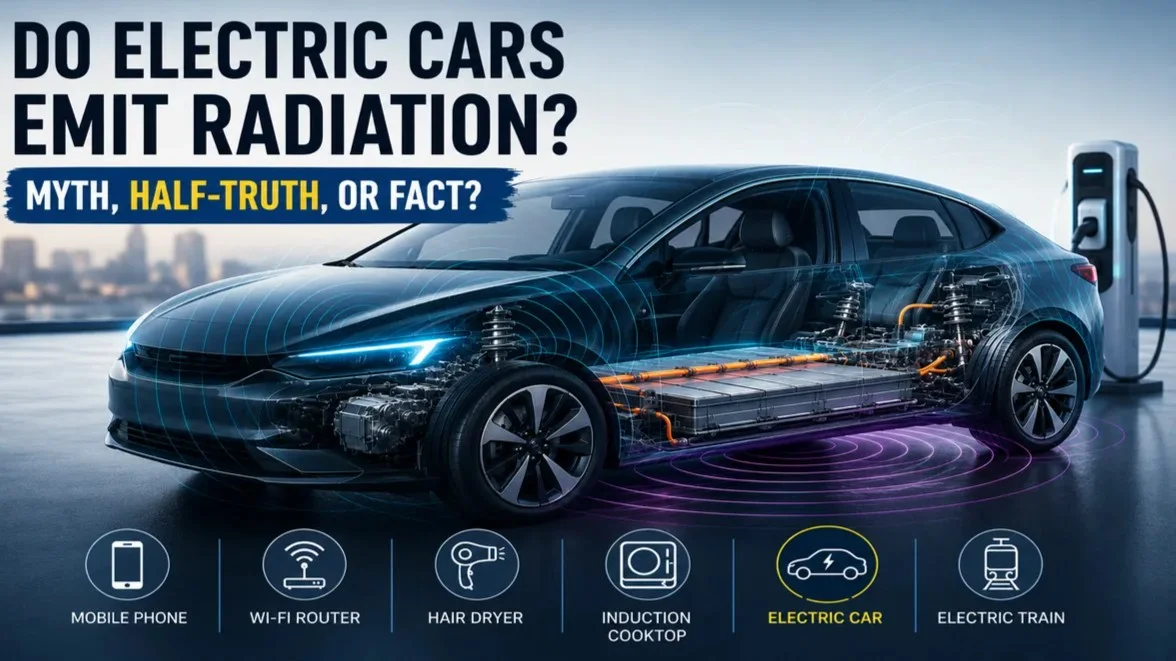
Do Electric Cars Emit Radiation? Myth, Half-Truth, or Fact?
If you have ever discussed electric vehicles, you have probably heard one of the following claims:
"I would never drive an electric car — you're basically sitting on a giant battery."
"Those vehicles emit much more radiation than conventional cars."
"Nobody really knows what the long-term health effects will be."
These statements regularly appear on social media, online forums, and in everyday conversations. But how accurate are they?
The short answer is: electric vehicles do generate electromagnetic fields — but that does not mean they pose a proven health risk. Measurements conducted in multiple independent international studies show that exposure levels remain well below established safety limits. Here's why — and what the numbers actually tell us.
What Does "Radiation" Really Mean?
When people hear the word radiation, they often think of radioactivity, nuclear power plants, or X-ray machines. However, there is a crucial difference between ionizing and non-ionizing radiation.
Ionizing radiation has enough energy to alter the structure of cells and tissues. X-rays and radioactive materials fall into this category.
Electric vehicles do not produce this type of radiation.
Instead, they generate electromagnetic fields similar to those found around:
household electrical wiring,
computers and televisions,
home appliances,
trams and trains,
mobile phones and Wi-Fi equipment.
In other words, an electric car is not a "radioactive car." Its electromagnetic fields belong to the same family as those produced by devices we use every day without a second thought.
Why Do Electric Vehicles Generate Electromagnetic Fields?
Electric vehicles use large amounts of electrical energy to propel the vehicle. The main sources of electromagnetic fields include:
the high-voltage battery,
the electric motor,
high-current power cables,
the inverter and power electronics.
For this reason, electromagnetic fields in electric vehicles are entirely expected.
The real question is not whether they exist, but how strong they are — and how they compare to established safety limits.
What Do the Measurements Show?
Numerous international studies have measured electromagnetic fields in electric, hybrid, and conventional vehicles.
One of the most comprehensive was EM-SAFETY, a European Union-funded project carried out by the independent research institute SINTEF together with nine European partners.
The findings were clear: in all tested electric vehicles, exposure to magnetic fields remained below 20% of the limit recommended by the International Commission on Non-Ionizing Radiation Protection (ICNIRP). Measurements at head level were even lower — below 2% of the recommended limit.
Interestingly, the highest values were recorded near the vehicle floor, close to the battery and during vehicle start-up, rather than around the driver's head or chest.
In practical terms, the part of the body receiving the highest exposure is typically the legs, while overall exposure remains comfortably within recommended safety levels.
To put this into perspective, ICNIRP's guideline limit for low-frequency magnetic fields is approximately 100–200 µT (microtesla) for the general public, while typical levels measured inside electric vehicles are only a few microtesla.
Do Electric Vehicles Emit More Electromagnetic Fields Than Conventional Cars?
The answer is not as straightforward as it is often portrayed.
Vehicles powered by gasoline or diesel engines also contain alternators, electrical wiring, heated seats, infotainment systems, and numerous electronic components that generate electromagnetic fields.
Within the EM-SAFETY project, exposure levels in conventional internal combustion vehicles were measured at roughly 10% of the ICNIRP limit.
In other words, there is a difference between electric and conventional vehicles, but it is significantly smaller than many sensational headlines suggest. In both cases, measured values remain below recognized safety thresholds.
What About Vehicle Charging?
Another common concern relates to charging stations.
Recent research indicates that electromagnetic fields generated during charging generally remain below recommended exposure limits for users sitting inside the vehicle or standing nearby.
To be precise, measurements near the cables of high-power DC fast chargers can temporarily exceed public exposure limits at extremely close distances. However, field strength drops rapidly with distance. At approximately one meter away, exposure levels typically fall to less than half of the limit value.
For drivers sitting in the vehicle or individuals standing nearby, exposure remains within safe ranges.
Is There Evidence That Electric Vehicles Harm Human Health?
To date, there is no scientific consensus indicating that the normal use of electric vehicles causes health problems due to electromagnetic field exposure.
That does not mean research should stop.
The World Health Organization (WHO) classifies low-frequency magnetic fields as "possibly carcinogenic" (Group 2B) — the same category that includes coffee and pickled vegetables. This classification means additional research is warranted, not that a health risk has been proven.
As the number of electric vehicles continues to grow, interest in long-term studies and cumulative exposure assessments is increasing as well.
However, based on the evidence currently available, claims that electric vehicles are dangerous to human health because of "radiation" are not supported by strong scientific evidence.
Conclusion
Do electric vehicles emit electromagnetic fields?
Yes. Like any device through which electricity flows, they generate electromagnetic fields.
Is this the same as radioactive or dangerous radiation?
No.
Is there scientific evidence that electric vehicles pose a health risk because of these electromagnetic fields?
Based on currently available measurements, no.
As with many topics in the automotive industry, the truth lies somewhere between sensationalist headlines and unquestioning enthusiasm for new technology.
The best approach is to rely on verified measurements and scientific evidence rather than myths and assumptions.
Because when it comes to automobiles, accurate information is often just as important as the technology itself.
Frequently Asked Questions (FAQ)
Is it safe to sit above the battery in an electric vehicle?
According to measurements from the EM-SAFETY project, the highest electromagnetic field levels occur near the vehicle floor, close to the battery. Even then, exposure remains below 20% of established safety limits. At seat and body level, exposure is even lower.
Do EV chargers emit radiation?
EV chargers generate electromagnetic fields. Near the cables of high-power DC chargers, field levels can be elevated. However, the strength decreases rapidly with distance, meaning that exposure for drivers and nearby users remains within safe limits.
Do electric vehicles emit more electromagnetic fields than gasoline-powered cars?
There is a difference, but it is smaller than many people assume. Conventional vehicles also generate electromagnetic fields through alternators and onboard electronics. Measurements indicate exposure levels around 10% of recommended limits in conventional vehicles, compared to up to 20% in electric vehicles. Both remain below safety thresholds.
Is there evidence that electric vehicles cause cancer?
No. The WHO classifies low-frequency magnetic fields as "possibly carcinogenic" (Group 2B), the same category as coffee. This classification means further research is needed, not that a causal relationship has been established. At present, there is no scientific consensus linking electric vehicle use to cancer.