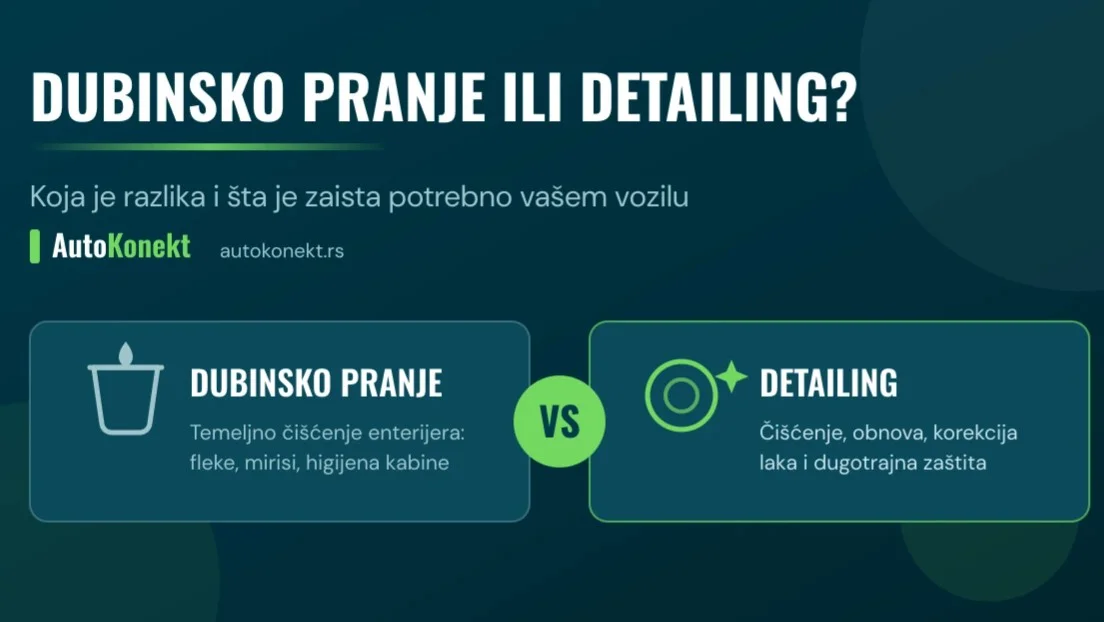

Deep Cleaning or Car Detailing: What’s the Difference and What Does Your Vehicle Need?
Drivers often use the terms deep cleaning and car detailing as though they describe the same service. The reason is simple: in both cases, the car looks cleaner, tidier and better preserved after the treatment. However, there is a significant difference between these two services.
Deep cleaning primarily focuses on thoroughly cleaning the vehicle’s interior, while detailing is a much broader process that may include cleaning, restoration, correction and protection of both interior and exterior surfaces.
In simple terms: deep cleaning cleans the car, while detailing cleans, restores and protects it.
This does not mean that one service is necessarily better than the other. The real question is which service your vehicle currently needs.
What Is Deep Car Cleaning?
Deep cleaning is a thorough process of cleaning the vehicle’s interior, with particular attention paid to textile and upholstered surfaces where dust, stains, grease, food residue, pet hair and unpleasant odours accumulate over time.
Depending on the service provider and the selected package, deep cleaning may include:
vacuuming the entire interior;
washing the seats, backrests and floor mats;
cleaning carpets, floors and the luggage compartment;
cleaning door panels and plastic surfaces;
cleaning the headliner;
cleaning air vents;
treating leather seats;
neutralising unpleasant odours and disinfecting the interior.
The main purpose of deep cleaning is to make the interior cleaner, more hygienic and more pleasant for everyday use.
A professionally performed deep cleaning treatment can significantly improve the appearance of the cabin. However, it generally does not include repairing damaged surfaces, restoring faded plastics, correcting paintwork or applying long-lasting protective coatings.
When Does a Car Need Deep Cleaning?
Deep cleaning is usually a good choice when:
the seats have visible stains;
there is an unpleasant smell inside the car;
the vehicle is frequently used to transport children or pets;
a large amount of dust has accumulated inside the cabin;
the vehicle was purchased second-hand;
the car is being prepared for sale;
smoking previously took place inside the vehicle;
the interior has not been thoroughly cleaned for a long time.
It is important to understand that not every stain or odour can be completely removed.
The result depends on the type of material, the age of the contamination, previously used cleaning products and whether liquids have penetrated into the foam and deeper layers of the seats.
What Is Car Detailing?
Detailing is a much broader concept than standard washing or deep cleaning.
It is a systematic process of thoroughly cleaning, restoring and protecting a vehicle, with the aim of bringing its appearance as close as possible to its best achievable condition and making treated surfaces easier to maintain in the future.
Detailing may include:
interior detailing;
exterior detailing;
or a complete treatment of both the interior and exterior.
Unlike standard car washing, detailing pays close attention to areas that are often overlooked during routine maintenance, including joints, seams, switches, air vents, spaces between seats, inner door edges, badges, wheels, exhaust tips and other difficult-to-reach areas.
What Does Interior Detailing Include?
Interior detailing may include everything covered by deep cleaning, but the process is usually more comprehensive and may include additional restoration and protection of individual materials.
The service may include:
detailed vacuuming of the cabin and deep cleaning of textile surfaces;
cleaning every joint and difficult-to-reach area;
cleaning, conditioning and protecting leather;
cleaning and protecting plastics and treating rubber surfaces;
cleaning seat belts;
removing pet hair;
disinfecting and neutralising odours;
protecting textile surfaces against future liquid penetration;
minor visual restoration of certain surfaces.
With high-quality detailing, the goal is not merely to make the interior look clean immediately after treatment. It is also to ensure that the materials are properly maintained, conditioned and protected.
What Does Exterior Detailing Include?
Exterior detailing focuses on the paintwork, windows, wheels, tyres, lights and other exterior parts of the vehicle.
Depending on the condition of the car and the selected package, it may include:
detailed hand washing and cleaning of wheels and wheel areas;
chemical paint decontamination and removal of iron particles;
removal of tree sap, insects and tar residue;
mechanical decontamination using a clay bar;
single-stage or multi-stage polishing and correction of minor scratches;
removal of improper washing marks and restoration of paint gloss;
protection using wax, synthetic sealant or ceramic coating;
headlight polishing and protection;
treatment of exterior plastic surfaces and protection of wheels and windows.
It is important to understand that polishing does not simply mean “adding shine”.
During professional paint correction, a very thin surface layer of clear coat is removed to reduce the visibility of minor scratches, holograms, oxidation and marks caused by improper washing.
For this reason, polishing should be carried out by a trained professional using appropriate equipment, lighting and a proper assessment of the paint condition.
What Is the Main Difference Between Deep Cleaning and Detailing?
The main difference lies in the purpose and scope of the service.
Deep cleaning
The primary focus is on the interior.
It removes dirt, stains and unpleasant odours.
It usually takes several hours.
It is intended for regular or occasional maintenance.
It generally does not include paint correction.
It is more affordable.
Detailing
It may include both the interior and exterior.
It cleans, restores, corrects and protects.
It may take an entire day or several days.
It is intended for thorough restoration and longer-lasting protection.
It may include polishing and paint correction.
The price depends on the level of correction and protection.
Deep cleaning may be part of a complete detailing treatment, but detailing cannot be reduced to deep cleaning alone.
How Much Does Deep Car Cleaning Cost?
The price of deep cleaning depends on the size of the vehicle, the number of seats, the type of materials, the level of contamination and the services included in the package.
Based on publicly available price lists from service providers in Serbia, the approximate prices for complete deep interior cleaning in specialised centres most commonly fall within the following ranges:
small city car: approximately RSD 5,000–7,000;
mid-size car: approximately RSD 6,000–10,000;
large saloon or estate car: approximately RSD 8,000–12,000;
SUV or vehicle with a larger interior: approximately RSD 10,000–18,000.
Mobile deep-cleaning services that come to the owner’s address are also available, with basic packages starting from approximately RSD 2,500–3,500, depending on the scope of the treatment.
Some service providers quote prices in euros. Publicly available price lists indicate ranges of approximately:
€40–50 for small cars;
€50–90 for mid-size and larger cars;
up to approximately €150 for certain SUV models and more demanding treatments.
Additional charges may apply for:
removing large amounts of pet hair;
cleaning heavily soiled seats;
treating difficult or old stains;
neutralising strong odours;
cleaning child seats;
disinfecting the air-conditioning system;
cleaning vehicles with seven or more seats.
For this reason, the lowest advertised price may not represent the final cost of the service.
Before booking, check whether the package includes the headliner, luggage compartment, doors, plastic surfaces, floor mats and complete drying of the interior.
AutoKonekt tip: You can find verified car washes and deep-cleaning services in your city at autokonekt.rs/lokacije, compare available services and book an appointment in one place.
How Much Does Car Detailing Cost?
The price range for detailing is much broader because the term can refer to very different levels of service.
Approximate market prices may look like this:
interior detailing: approximately RSD 12,000–25,000;
detailed exterior washing and decontamination: approximately RSD 6,000–15,000;
single-stage polishing: approximately €100–200;
multi-stage polishing and more extensive paint correction: approximately €200–500;
complete interior and exterior detailing: approximately €300–700;
premium package with paint correction and ceramic coating: approximately €500 and above.
There may be significant differences between service providers.
For example, publicly available price lists from specialised detailing centres show that complete polishing and protection packages may start at around RSD 68,000, while more advanced packages may exceed RSD 100,000, depending on the vehicle category.
Other providers offer packages that include multi-stage polishing, interior detailing and a multi-year ceramic coating, usually priced between approximately €500 and €650.
These prices are indicative only.
The final quotation depends on the specific vehicle, the condition of the paintwork, the size of the car, the desired result and the type of protective coating selected.
Why Is Detailing More Expensive Than Deep Cleaning?
The higher price of detailing is not caused solely by more expensive products.
Detailing requires more time, specialised equipment, proper lighting, polishing machines, different abrasive compounds, protective coatings and extensive knowledge of the characteristics of different materials.
Before beginning the treatment, it is often necessary to:
inspect the condition of the vehicle;
identify the type and depth of the damage;
thoroughly wash and decontaminate the surfaces;
prepare the paintwork for polishing;
test the correct combination of polishing compound and pad;
perform paint correction;
degrease the surface;
apply the selected protective coating;
allow sufficient curing time for the coating.
For more demanding vehicles, the complete process may take several working days.
The higher the requested level of scratch removal and the longer-lasting the protection, the more labour, materials and expertise are required.
Can Detailing Remove Every Scratch?
No.
Surface scratches located within the clear coat can often be significantly reduced or completely removed by polishing.
However, deep scratches that have penetrated through the clear coat and paint cannot be safely removed through polishing alone.
Such damage may require:
a local repair;
corrective repainting;
or intervention by a professional vehicle painter.
A reputable detailing service should explain before starting the work:
which imperfections can be removed;
which can only be reduced;
which areas are not safe to polish;
what result can realistically be expected.
Promises that every scratch will completely disappear should be treated with caution.
What Is Ceramic Coating?
Ceramic coating is a liquid product applied to a properly prepared surface. After curing, it forms a protective layer over the paintwork.
Its purpose may include:
making the vehicle easier to wash;
reducing the accumulation of dirt;
increasing surface water repellency;
preserving gloss;
providing a certain level of protection against chemicals and ultraviolet radiation.
However, a ceramic coating does not make the vehicle resistant to stone chips, impacts, deep scratches or improper washing.
Its performance and durability depend on:
surface preparation;
product quality;
application method;
curing conditions;
subsequent vehicle maintenance.
There is little value in applying an expensive ceramic coating over improperly prepared, contaminated or heavily scratched paintwork.
Deep Cleaning or Detailing: Which Should You Choose?
The answer depends on the problem you want to solve.
Deep cleaning is usually sufficient when the main issue is:
a dirty interior;
several visible stains;
dust inside the cabin;
an unpleasant odour;
or preparing the interior for sale.
In this case, there is no need to pay for complete detailing simply because it sounds like a more advanced service.
A professionally performed deep cleaning treatment can make a very noticeable difference to the appearance and overall feeling of cleanliness inside the vehicle.
Detailing is more appropriate when:
you want to restore the appearance of an older vehicle;
the paintwork has many minor scratches;
the paint has marks caused by improper washing;
you want longer-lasting paint protection;
you own a more valuable vehicle;
you have purchased a used car whose maintenance history is unknown;
you plan to keep the vehicle for a longer period.
When preparing a used vehicle for sale, high-quality detailing may improve the first impression and make the car more attractive to potential buyers.
However, it is not guaranteed that every dinar invested will be recovered through a higher selling price. The scope of the treatment should therefore be adjusted to the value and condition of the vehicle.
How Often Should Deep Cleaning and Detailing Be Carried Out?
For a car used under normal conditions, deep cleaning is usually performed once a year or once every two years.
More frequent treatments may be justified when:
small children or pets are regularly transported in the vehicle;
the vehicle is used as a taxi or company car;
the driver spends a considerable amount of time inside the vehicle;
passengers have severe allergies.
There is no need to perform aggressive deep cleaning too frequently, particularly if the interior is regularly vacuumed and maintained.
There is no single rule for detailing.
Detailed interior cleaning may be carried out once a year, while the frequency of polishing depends on the condition of the paintwork and the way the vehicle is used.
Polishing should not be regarded as a routine treatment performed without a specific reason.
Every corrective polishing process removes part of the clear coat, which is why it is important that the work is carried out professionally and only when necessary.
Protective coatings should be renewed in accordance with their type, durability and the manufacturer’s recommendations.
How Should You Choose a High-Quality Service Provider?
Before booking deep cleaning or detailing, ask the service provider:
exactly what is included in the price and whether additional charges may apply;
how long the treatment will take and whether interior drying is included;
how leather and sensitive materials will be treated;
whether the paint condition will be assessed before polishing;
which protective products will be used;
what result can realistically be expected;
how the vehicle should be maintained after the treatment.
When choosing a detailing service, it is useful to review photographs of previous work.
However, pay attention to whether the “before” and “after” photographs were taken under similar lighting conditions and from a similar angle.
A major difference between a “before” photograph taken in the shade and an “after” photograph taken under strong lighting does not necessarily mean that the paint correction was equally substantial.
The most important consideration is whether the service provider clearly explains the process, its limitations and the expected result.
Should You Choose the Cheapest Offer?
The cheapest offer is not automatically poor, just as the most expensive offer does not guarantee the best result.
Problems arise when two offers are compared solely based on the name of the service.
One service provider may use the term “deep cleaning” for a package that covers only the seats, floors and floor mats, while another may include the headliner, doors, luggage compartment, plastics, disinfection and drying.
The same applies to detailing.
The term “complete detailing” may refer to detailed cleaning and basic polishing at one provider, while another may include:
multi-stage paint correction;
ceramic coating;
treatment of the wheels;
window protection;
leather conditioning;
textile protection.
Offers should therefore be compared according to the exact scope of work rather than the service name alone.
Compare and book through AutoKonekt: Instead of calling service providers one by one, you can compare available deep-cleaning and detailing services at autokonekt.rs and book a suitable appointment.
Conclusion
Deep cleaning and detailing are not two different names for the same service.
Deep cleaning primarily addresses dirt, stains and unpleasant odours inside the vehicle.
Detailing goes a step further and may include restoring the vehicle’s appearance, correcting the paintwork and providing longer-lasting protection for different surfaces.
For many vehicles, professionally performed deep cleaning will be entirely sufficient.
On the other hand, a vehicle with neglected paintwork, numerous minor scratches or a need for additional protection may benefit considerably more from professional detailing.
The service should not be selected solely based on its name or the lowest available price.
It is important to understand what the package includes, what result can realistically be achieved and whether the treatment is appropriate for the condition and value of the specific vehicle.
Frequently Asked Questions
What is the difference between deep cleaning and detailing?
Deep cleaning is a thorough interior-cleaning service that removes stains, dust and unpleasant odours.
Detailing is a broader process that, in addition to cleaning, may include restoration, paint correction and long-lasting protection of both interior and exterior surfaces.
How much does deep car cleaning cost in Serbia?
Approximate prices for complete deep interior cleaning at specialised service centres range from around RSD 5,000 for smaller cars to RSD 18,000 for SUV models.
Basic mobile packages may start from approximately RSD 2,500–3,500.
The final price depends on the size of the vehicle, the level of contamination and the scope of the selected package.
How long does car detailing take?
Interior detailing usually takes one day.
A complete treatment that includes paint correction and ceramic coating may take several working days for more demanding vehicles because sufficient time must be allowed for the coating to cure.
Does detailing remove all scratches?
No.
Polishing can reduce or remove surface scratches located in the clear coat.
Deep scratches that have penetrated through the clear coat and paint require a local repair or work by a professional vehicle painter.
How often should deep cleaning be performed?
For vehicles used under normal conditions, once a year or once every two years is usually sufficient.
More frequent treatments may be appropriate when children or pets are regularly transported, when the vehicle is used professionally or when passengers have allergies.