
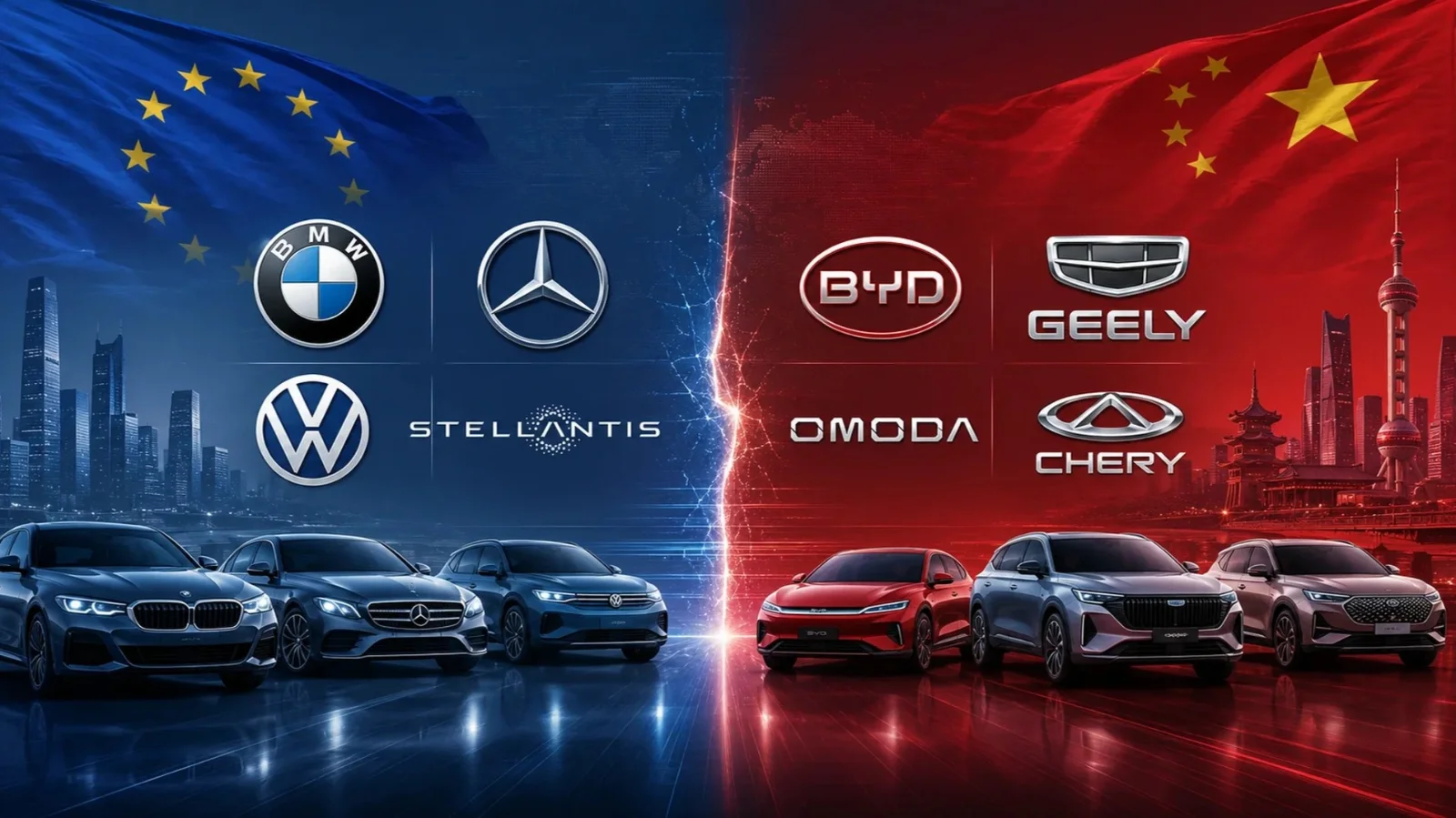
Chinese Cars Are Gaining Ground in Europe: What Does This Mean for Drivers and Service Centres in Serbia?
Until just a few years ago, Chinese cars in Europe were mostly seen as a distant sign of the future. They were present in the news, at motor shows and in automotive industry analyses, but for the average driver in Serbia, they were not a real everyday topic.
Today, the situation is different.
Brands such as BYD, MG, Chery, Omoda, Jaecoo, Geely, XPeng, Leapmotor and others are becoming increasingly visible on European roads. Their growth is no longer only about electric cars, nor only about lower prices. Chinese manufacturers are entering Europe with a broad range of vehicles: from electric vehicles, plug-in hybrids and hybrids to conventional petrol models and SUVs.
That is why the question is being asked more and more often: are Chinese cars changing the European car market — and what does that mean for Serbia?
China is no longer just “cheap production”
The Chinese automotive industry has gone through a major transformation over the past decade. In the past, Chinese cars were most often discussed in terms of price. Today, the conversation increasingly revolves around batteries, software, digital features, the speed of new model development, warranties and the aggressive expansion of sales networks.
According to Inovev data, Chinese brands sold around 795,000 passenger cars in Europe in 2025, excluding Volvo, which represented around 6% of the European market. If Volvo, as a brand owned by China’s Geely Group, is included, the figure rises to around 1.127 million vehicles and 8.2% of the market.
This figure is important for two reasons. First, it shows that Chinese cars are no longer a marginal phenomenon. Second, it shows that the definition of a “Chinese brand” is not always simple.
🟢 AUTOKONEKT ADVICE
Regardless of which Chinese brand you are considering, before buying, check whether there is a service centre in your city that has experience with that exact model. Via autokonekt.rs.
Europe is not one single market
When discussing the presence of Chinese cars in Europe, it is important to avoid oversimplification. It is not true that Chinese brands are conquering all of Europe at the same speed. On the contrary, the differences between countries are significant.
Reuters reported that Chinese manufacturers reached around 11% of the new car market in the United Kingdom in 2025, around 9% in Spain and Italy, while their share in Germany and France was significantly lower.
This is particularly interesting for Serbia. Our market will probably not resemble Germany, where buyers traditionally have a strong attachment to domestic premium and mass-market brands. It is much more realistic that Serbia will be closer to the logic of markets such as Poland, Italy or Spain — where price, equipment, warranty and practicality often carry significant weight in the purchase decision.
Spain: when price and equipment make the difference
Spain is one of the best examples of the rapid acceptance of Chinese brands. JATO Dynamics reported that Chinese manufacturers doubled their market share in Europe in May 2025 to 5.9%, with MG and BYD among the key drivers of growth.
Spain shows one important thing: a buyer does not have to be emotionally attached to a brand if they feel they are getting more for the same or less money.
Italy: Chinese brands are not entering only through electric vehicles
Italy is particularly interesting because it shows that Chinese growth in Europe is not linked only to electric vehicles. According to the company’s official data, BYD increased its sales in Italy tenfold in 2025, to more than 25,000 vehicles, while expanding its sales network to around 100 locations.
This figure is important because it shows that sales alone are not enough. When a sales network expands quickly, the service network must follow. Buyers may accept a new brand, but only if they feel confident that there is support behind it: service, spare parts, diagnostics, warranty and problem resolution.
Poland: perhaps the most useful example for Serbia
Reuters reports that Chinese manufacturers reached an 8.2% market share in Poland in 2025, although just two years earlier their presence had been almost negligible. It is particularly important that almost two-thirds of Chinese vehicles sold in Poland had an internal combustion engine.
This is a very important lesson for Serbia. A more realistic scenario for our market may be the growth of Chinese SUV models, hybrids, plug-in hybrids and more affordable family cars — not only electric vehicles.
Germany and France: growth exists, but not without resistance
Both countries have strong domestic automotive industries, developed sales and service networks, high customer loyalty and strong political sensitivity when it comes to protecting domestic production. That is why the German or French scenario is not necessarily the best picture of what could happen in Serbia.
Tariffs are not stopping the trend — they are only changing the strategy
The European Union has introduced additional countervailing duties on electric vehicles produced in China. According to the European Commission, the additional rates are 17% for BYD, 18.8% for Geely and 35.3% for SAIC, with specific rates for Tesla vehicles from Shanghai and other manufacturers.
Instead of relying only on fully electric vehicles, Chinese manufacturers are increasingly offering hybrids, plug-in hybrids and models with conventional internal combustion engines. They are also more frequently considering local production, partnerships and manufacturing capacity within Europe.
Reuters reported in June 2026 that Chinese manufacturers are further expanding in Europe, and that Geely, through its brands including Volvo, Polestar, Lotus, LEVC, Lynk & Co and Zeekr, became the largest Chinese manufacturer by European registrations in the January–April period.
What does this mean for drivers in Serbia?
If you are buying a Chinese car, or considering one as a used vehicle in a few years, it is important not to look only at the initial purchase price. Several practical questions should be asked:
● Who services that brand in Serbia?
● How developed is the service network?
● Are there independent service centres that have experience with these vehicles?
● How long is the waiting time for parts, and is diagnostics available?
● What are the warranty terms, and what happens when the vehicle is no longer under warranty?
● What will the vehicle be worth in three, five or seven years?
For electric and plug-in hybrid vehicles, there are additional questions: who is trained to work on high-voltage systems, what is the procedure for the battery, and does the service centre have the equipment and knowledge required for that type of work?
What does this mean for service centres?
For service centres, the growth of Chinese brands represents both a challenge and an opportunity. The challenge is clear: new brands are arriving, along with new platforms, different systems, more electronics, more software and an increasing number of electrified powertrains.
In the coming years, it will no longer be enough for a service centre to say: “We work on all brands.” Drivers will increasingly look for concrete confirmation: do you work on this specific brand, this powertrain, this system, this diagnostics?
The AutoKonekt perspective: a new market requires a new service logic
As the car market changes, the way drivers find service centres is changing as well. Cars are becoming more complex, the differences between models are greater, and service requirements are increasingly specific. Drivers no longer need only the nearest service centre — they need a service centre that can truly respond to a specific problem and a specific type of vehicle.
This is where digital platforms such as AutoKonekt are becoming increasingly important. AutoKonekt connects drivers with service partners and helps ensure that vehicle maintenance decisions are not made blindly.
🟢 AUTOKONEKT ADVICE
Not sure which service centre near you works with Chinese brands? Visit autokonekt.rs/lokacije.
Conclusion: the next battle will not be only about car sales
Chinese cars are no longer a question of the future. They are already part of the European market. In some countries, such as Spain, Italy, Poland and the United Kingdom, they are growing rapidly. In others, such as Germany and France, they are encountering stronger resistance.
For Serbia, the most important question is not only how many Chinese cars will be sold. The much more important question is what happens after the purchase: who will maintain them, how long will parts take to arrive, who will perform diagnostics, and what will they be worth as used cars?
The smartest choice will not simply be the car that looks the most affordable today. The smartest choice will be the car that has clear, reliable and accessible support throughout the entire period of ownership.
Frequently asked questions
Are Chinese cars reliable?
Quality and reliability vary from brand to brand, just as they do with any other manufacturer. The key is to check warranty terms, parts availability and service experience with the specific model before buying.
Are there service centres in Serbia that work on Chinese cars?
The number of service centres working with Chinese brands is growing as the number of these vehicles on the road increases. Through AutoKonekt, you can find partners that have experience with specific brands and powertrains.
Are Chinese cars cheaper to maintain?
It depends on the brand, parts availability and the local service network. For newer brands with a smaller presence, parts may take longer to arrive, which can affect both repair costs and repair time.
Which Chinese brands are the most present in Europe?
The most present brands at the moment include MG, BYD, Chery through Omoda and Jaecoo, the Geely Group including Volvo, Polestar, Lynk & Co and Zeekr, as well as Leapmotor and XPeng.
Are Chinese cars coming only as electric vehicles?
No. Examples from Poland and Italy show that Chinese manufacturers are increasingly offering hybrids, plug-in hybrids and models with conventional internal combustion engines.