
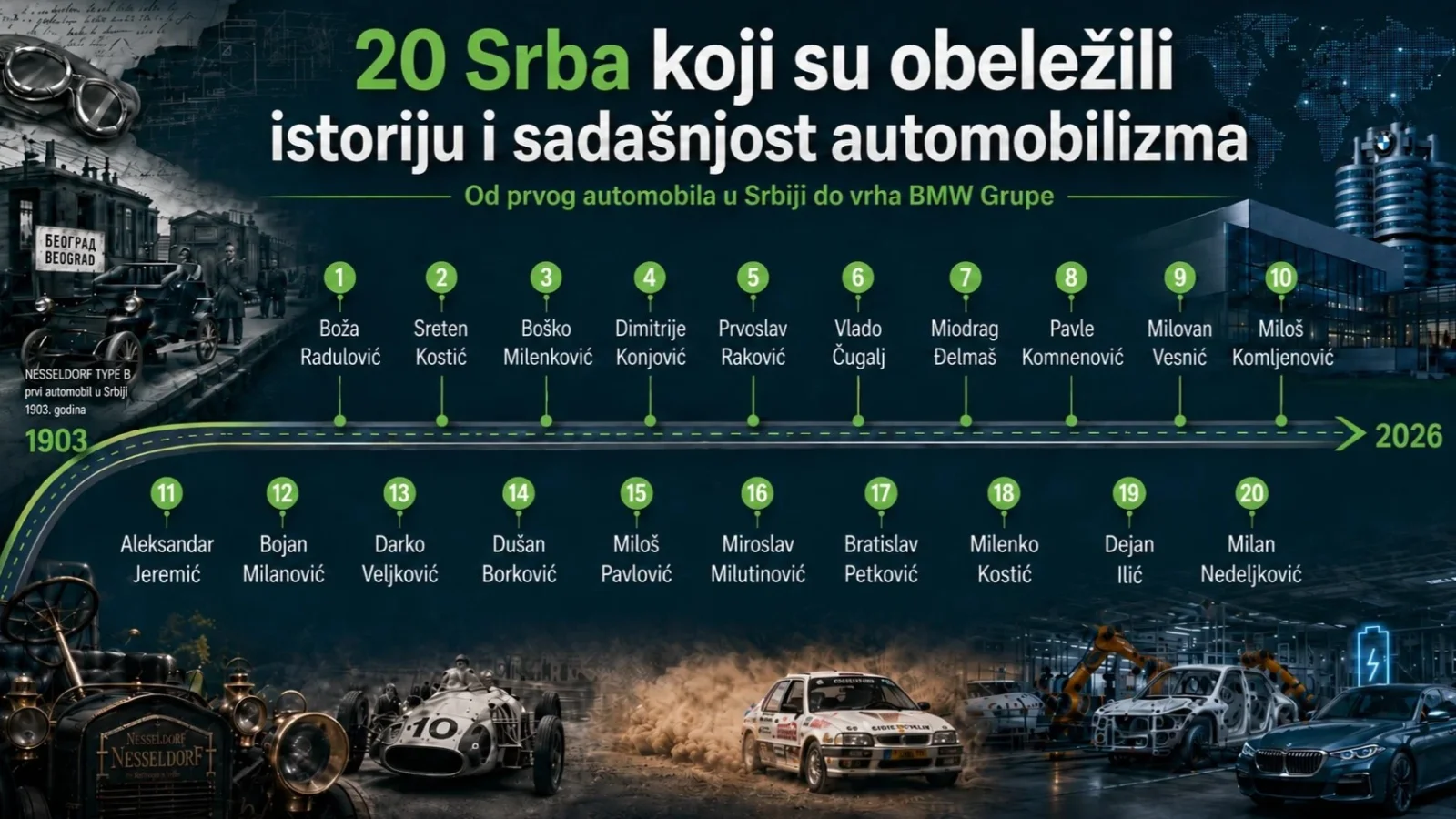
20 Serbs Who Shaped the History and Present of Motoring
The automobile arrived in Serbia by train, accompanied by a factory chauffeur who did not know how to explain what that machine actually was. One hundred and twenty years later, a Serb is leading one of the world’s largest automotive companies. Between those two points stand twenty people — pioneers, engineers, drivers, collectors, and entrepreneurs — whose contributions, whether greater or smaller, became part of automotive history. Some are known around the world; others are almost forgotten even in their own country. All of them deserve to have their stories told — in chronological order, without ranking them by importance.
1. Boža Radulović — the man who brought the first automobile to Serbia
Belgrade merchant and rentier Boža Radulović introduced the first automobile to the Kingdom of Serbia on April 3, 1903 — a Nesselsdorf Type B model, purchased in Vienna for 17,000 crowns. The vehicle arrived by train, together with a factory instructor whose task was to train the owner and his driver within 45 days. Radulović never learned to drive; he left that job to his friend Sreten Kostić. Three years later, he went bankrupt — the automobile turned out to be a more expensive hobby than he had expected.
2. Sreten Kostić — Serbia’s first chauffeur
A photoengraver by profession, Sreten Kostić became the first trained driver in Serbia, instructed by a German factory trainer in 1903. Later, from 1912 to 1915, he served as the personal driver of King Peter I — which also makes him the first royal chauffeur in Serbian history. His original driver’s license, the first one issued in Serbia, is today kept at the Automobile Museum in Belgrade.
3. Boško Milenković — a Serb against Nuvolari
The only Yugoslav representative at the 1939 Belgrade Grand Prix — the last major pre-war automobile race in Europe, held two days after the German invasion of Poland. Milenković drove a Bugatti T51 independently, without a factory team, competing against aces such as Tazio Nuvolari and drivers from Mercedes and Auto Union. He finished fourth, 19 laps behind due to a vehicle failure — a solid result for an independent driver competing against factory teams.
4. Dimitrije Konjović — founder of Ikarus
A retired naval officer and seaplane pilot, Dimitrije Konjović founded “Ikarus” on November 20, 1923, together with four associates — the first Serbian and Balkan factory for aircraft, automobiles, and machinery. He served as the company’s director for almost twenty years, until the German occupation authorities imprisoned him in the Banjica camp. The factory he founded operates today as Ikarbus, one of the leading bus manufacturers in Southeast Europe.
5. Prvoslav Raković — the man who built the Yugoslav automotive industry
Mechanical engineer Prvoslav Raković arrived at the “Crvena Zastava” Works in 1955 and became general director, tasked with turning the Kragujevac arms factory into a serious automobile manufacturer. Under his leadership, Zastava launched licensed production with Fiat, and Raković also initiated the founding of the Faculty of Mechanical Engineering in Kragujevac — an institution that still educates engineers for the domestic automotive industry.
6. Vlado Čugalj — a Serbian truck driver on the world stage
During the 1980s, Vlado Čugalj drove a FAP 1626 VBDT for the PIK “Belje” team in the FIA European Truck Racing Championship — competing in Hungary and Spain. Despite a modest budget, his team remained notable as the only one that returned its racing vehicle to regular use after the races — a pragmatism that marked Yugoslav motorsport of that era.
7. Miodrag “Mika” Đelmaš — an institution of Serbian motorsport
He made his debut at the 5th YU Rally in 1971 and never stopped — winning three championship titles (1990, 2000, 2001), and, more importantly, spending decades building the system. He served as president of the Sports Auto and Karting Association of Serbia, represented domestic motorsport within the FIA, and is today the honorary president of SAKS. Few people in the region have done as much institutionally for the development of this discipline.
8. Pavle “Paja” Komnenović — from the Fiat 1300 to the Porsche Supercup
He began his career in 1971 in a Fiat 1300 at the Tara Rally and ended it driving a Porsche 911 on Europe’s greatest circuits — Silverstone, Nürburgring, and Spa. He won titles in both rallying and circuit racing with the Zastava 101, and in the mid-1990s became one of the few drivers from this region to enter the Porsche Supercup, where in 1995 he finished 11th out of 30 drivers.
9. Milovan “Mikica” Vesnić — the speed family from Užice
Born in 1976 in Užice, he is the son of two-time Yugoslav champion Milun Vesnić and Danica Vesnić, the first female rally co-driver in the history of Yugoslav motorsport. In 2019, Milovan became the first TCR Eastern Europe champion in the history of that series, with five Central European Championship titles and three “Golden Helmets.” His team, ASK Vesnić, is the only professional Serbian team with a complete crew from Serbia — from engineers to mechanics.
10–11. Miloš Komljenović and Aleksandar Jeremić — Serbia’s first points in the WRC
The crew of the Interspeed Racing Team became the first Serbian team to score FIA points in the World Rally Championship, competing in the Junior World Rally Championship (JWRC) in 2007 and 2008 at rallies in Mexico, Jordan, Italy, Finland, Spain, and Corsica. Komljenović and Jeremić were the first to put Serbia on the map of world rallying, at a time when few believed that was possible without factory support.
12–13. Bojan Milanović and Darko Veljković — the first Serbian crew at Dakar
When it comes to the toughest rally on the planet, Milanović and Veljković entered history as the first Serbian automobile crew ever to take part in the Dakar Rally. Although their participation ended during the second stage — the car burned out in the sand after rolling over — the very fact that they competed was a precedent for Serbian motorsport.
14. Dušan Borković — the tallest racing driver in the world, and one of the most successful
At 207 centimeters tall, Borković is probably the tallest professional racing driver in the world — but by results, he is also one of the most serious competitors from this region. He is a three-time European champion (2012, 2015, 2020), the only Serb ever to compete in the World Touring Car Championship (WTCC), and a three-time winner of the Serbia Rally. His career, which continues to this day, is documented in detail on Wikipedia in several languages.
15. Miloš Pavlović — the Serb with a Formula 1 super license
At less than ten years old, he won the Yugoslav karting championship; at 14, he became the youngest karting world champion in history, defeating, among others, future F1 champion Fernando Alonso. In 2010, he became the first driver from the former Yugoslavia to obtain an FIA super license for Formula 1. Although a lack of sponsorship never allowed him to enter F1, since 2014 he has been a Lamborghini factory driver, where he still races and teaches younger generations.
16. Miroslav Milutinović — the man who preserves memory on wheels
While others drove, Miroslav Milutinović researched archives. A member of the Association of Automotive Historians, he is the author of two significant monographs — “Automobiles and the Karađorđević Dynasty 1908–1941” and “Automobiles and Josip Broz Tito 1912–1980” — based on years of research in domestic and foreign archives, as well as conversations with witnesses, drivers, and mechanics. His work, as historian Predrag Marković noted at the presentation of one of the books, was the first to tell the history of motoring in the region through the vehicles of one man.
17. Bratislav “Braca” Petković — founder of the Automobile Museum
Theater director, playwright, and former minister of culture, Petković founded the Automobile Museum in Belgrade in 1994 together with the City Assembly of Belgrade — housed in the “Modern Garage,” the first public garage in the Balkans, built in 1929. The collection of around one hundred automobiles, which he personally gathered over decades, also includes a display case with the personal belongings of Sreten Kostić, Serbia’s first chauffeur. Petković died in 2021 at the age of 73, leaving Belgrade a legacy rare in this part of Europe.
From historic vehicles to regular servicing
The automobiles from this story are now museum exhibits — but every modern car, regardless of brand or year, requires regular inspection and servicing. If you are looking for a reliable service center, tire shop, or technical inspection station in your city, AutoKonekt connects you with authorized partners across Serbia. Find the nearest service provider at autokonekt.rs/lokacije.
18. Milenko Kostić — brought Škoda to Serbia and dominates car sales in the country
Together with his brother Milija, Milenko Kostić founded “Auto Čačak” in 1991. Five years later, the company became the general importer of Škoda for the then Yugoslavia — a brand that has since dominated the Serbian new-car market. By 2022, the company had sold more than 100,000 vehicles, while Škoda has remained one of the best-selling brands in the country for almost three decades.
19. Dejan Ilić — the Serb who made the battery for the first iPhone
Born in Selevac near Smederevska Palanka, Dejan Ilić built his career at the German company Varta from 1987 — first as head of the research team, then as general director. His development team created a revolutionary microbattery system that is now used in most portable devices, including, at Steve Jobs’s personal request, earlier iPhone models. He later led the German state project “Electromobility,” dedicated to the development of batteries for electric vehicles — the technology that today powers every new model on the market.
20. Milan Nedeljković — the Serb at the helm of BMW
Born in 1969 in Kruševac, Milan Nedeljković moved to Germany at a very young age, graduated in mechanical engineering from RWTH Aachen, and spent part of his studies at MIT. He joined BMW as a trainee in 1993 and built the next 33 years of his career exclusively in production — from plants in Munich and Regensburg, through the MINI plant in Oxford, to directorial positions in Leipzig and Munich. Since May 14, 2026, Nedeljković has been Chairman of the Board of Management, CEO of the BMW Group — the highest position ever reached by a person of Serbian origin in a major global automotive company.
From global companies to your neighborhood
Milan Nedeljković today manages production in 15 countries — but regardless of which car you drive, a pre-trip check or regular servicing remains equally important. Compare authorized service centers, tire shops, and technical inspection stations near you at autokonekt.rs and book an appointment in just a few clicks.
Frequently Asked Questions
1. Did the 1939 Belgrade Grand Prix really take place?
Yes. It was held on September 3, 1939, at Kalemegdan, just two days after the German invasion of Poland, and was the last major pre-war automobile race in Europe. The winner was Tazio Nuvolari, while the only Yugoslav participant was Boško Milenković.
2. Who was the first Serb with a Formula 1 super license?
Miloš Pavlović, born in 1982 in Belgrade, became in 2010 the first driver from the former Yugoslavia to obtain the FIA super license required to compete in Formula 1. He never managed to secure the budget to enter the championship, but since 2014 he has been a Lamborghini factory driver.
3. Is a Serb really leading BMW?
Yes. Milan Nedeljković, born in Kruševac, took over as Chairman of the Board of Management of the BMW Group on May 14, 2026, after a 33-year career in the company’s production plants.
4. Who was the first person to bring an automobile to Serbia?
Belgrade merchant Boža Radulović imported the first automobile to the Kingdom of Serbia on April 3, 1903 — a Nesselsdorf Type B model. He never drove the car himself; he left that to Sreten Kostić, who thereby became Serbia’s first chauffeur.
5. Was Zastava the only automobile manufacturer in the former Yugoslavia?
No, but it was by far the largest. In addition to Zastava in Kragujevac, automobiles and vehicles were also produced by Ikarbus in Zemun, which made buses, FAP in Priboj, which made trucks, and other smaller plants, but none reached the production or export volume of the Kragujevac factory.